


 Pro Benefits
 Über
Über
 Bedingungen
 Datenschutz
 Child Safety & Protection
 Benachrichtigungen
 Ayrush Global It Services Pvt Ltd
Taxi Dispatch Software vs Manual Dispatching: Which Model Is Better for Growing Taxi Fleets?
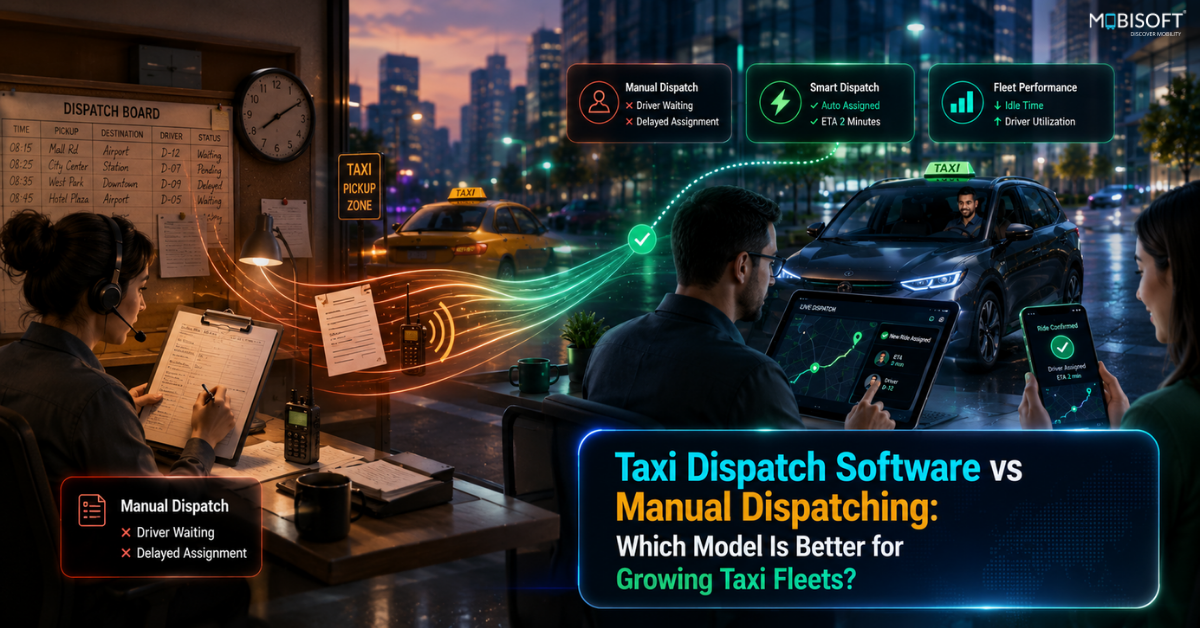
At some point, every growing taxi fleet outgrows manual dispatch. Bookings start coming in faster than any dispatcher can answer. Drivers end up waiting on hold, instead of picking up fares. That's often when fleet owners hit a real decision point. Stick with what's familiar, or adopt taxi dispatch software built for scale. This piece compares both models honestly. It looks at where manual dispatch still works, and where it breaks down. And it shows what automation actually changes for a growing fleet.
What Manual Dispatching Actually Involves
Even today, manual dispatch still runs a good share of smaller fleets. A dispatcher picks up the call, then checks who's nearby. Then the trip gets assigned over radio or phone. It's simple, and for a handful of cars, it works reasonably well.
There's real value in this model too. A human dispatcher can read tone and handle special requests. They can also make judgment calls a system might miss. For fleets running five or ten vehicles, that flexibility matters. It often outweighs the cost of building anything more complex.
But manual dispatch depends heavily on one person's memory and speed. A dispatcher juggling twenty calls an hour makes mistakes. Sometimes a driver gets a trip that was actually closer to someone else. Riders end up waiting longer than they should. Nobody catches it until the complaints start rolling in.
None of this means manual dispatch is outdated everywhere. It simply has a ceiling, and most growing fleets eventually hit it.
Where Manual Dispatch Breaks Down at Scale
Growth changes everything about dispatch. Ten cars might run fine on phone calls and memory. Fifty cars rarely do.
Once booking volume rises, manual dispatch starts showing real cracks. A dispatcher can only track so many vehicles at once before errors creep in. Trips get assigned to drivers who are farther away. That happens simply because they answered the phone first. That wastes fuel, time, and driver patience all at once.
Peak hours make this worse. Morning rushes and evening surges flood the phone lines, and dispatchers can't keep pace. Riders end up waiting far longer than necessary. Some give up and book elsewhere instead.
There's also a visibility problem. Fleet owners running manual dispatch often can't answer basic questions quickly. Which vehicles are idle right now? Which drivers are close to their duty limit? Without a taxi dispatch system tracking this automatically, those answers come from guesswork. Not from real data.
Scaling a fleet on manual dispatch usually means scaling the mistakes along with it.
How Automated Dispatch Changes the Model
Taxi dispatch software approaches the same problem differently. Instead of relying on one person's attention, the system takes over. It handles matching, tracking, and reporting all at once.
Real-Time Trip Assignment Logic
The software matches each booking to the nearest available driver automatically. This happens in seconds, not minutes. There's no waiting for someone to answer the phone. And no dependence on which dispatcher happens to be on duty.
This kind of taxi dispatch solution also learns from patterns over time. It can predict busy zones before they get busy, and reposition idle drivers accordingly. Manual dispatch simply can't do this at any meaningful scale.
Live Fleet-Wide Data Visibility
Every trip, every driver, and every idle vehicle shows up on one screen. Fleet owners can see exactly what's happening in real time. They no longer wait on a dispatcher's summary.
An online taxi management system also keeps a running record of every trip. That data becomes useful later. It helps with spotting slow zones, tracking performance, and planning new routes. Manual dispatch leaves none of that behind.
Manual vs Automated: A Quick Comparison
Put side by side, the difference between the two models becomes obvious fast.
Manual dispatch relies on a person's judgment, memory, and available time. It works fine at low volume. But every added vehicle adds pressure on the same dispatcher. Response time depends entirely on how busy that person already is.
Taxi dispatch software relies on continuous data instead. So response time stays consistent whether a fleet runs ten vehicles or two hundred.
Here's how the two typically compare:
-
Trip assignment speed: manual dispatch takes minutes; automated matching takes seconds.
-
Scalability: manual dispatch struggles past a certain size; software scales at minimal cost.
-
Visibility: manual dispatch offers limited insight; taxi cab dispatch software shows everything at once.
-
Consistency: manual dispatch varies by dispatcher and time of day; automation stays the same.
None of this makes manual dispatch worthless. It simply means the model was never built for fleets this size.
When Growing Fleets Should Make the Switch
Not every fleet needs to switch immediately. A five-car operation with a steady, predictable radius might run fine on manual dispatch. That can hold for years.
The signals for switching tend to show up gradually. Response times start slipping during busy hours. Drivers complain about uneven trip distribution. Owners start hearing the same complaints from riders, week after week.
Growth itself is often the clearest signal because additional vehicles multiply the coordination work. What worked comfortably at ten cars usually buckles at thirty.
A well-built taxi booking and dispatch software platform removes that ceiling entirely. It handles ten vehicles and two hundred with the same consistency. For fleets planning real growth, that consistency matters more than any single feature.
Pick the Right Dispatch Model as You Scale
Manual dispatch worked well for a smaller, simpler fleet. But every model has a natural limit. Growing fleets eventually outgrow what one dispatcher and one phone line can manage. Taxi dispatch software doesn't replace good judgment. It extends that judgment across every vehicle and every booking at once. The fleets that grow smoothly are the ones that switched early. That single decision often defines how much the fleet can handle next.
 Deutsch
 English
 Arabic
 French
 Spanish
 Portuguese
 Turkish
 Dutch
Dutch
 Italiano
 Russian
 Romaian
 Portuguese (Brazil)
 Greek
Greek
