


 Pro Benefits
 Sobre
Sobre
 Termos
 Privacidade
 Child Safety & Protection
 Notificações
 Ayrush Global It Services Pvt Ltd
When Support Volume Doubles Without Warning: Moving Beyond Legacy Systems to a Cloud Contact Center
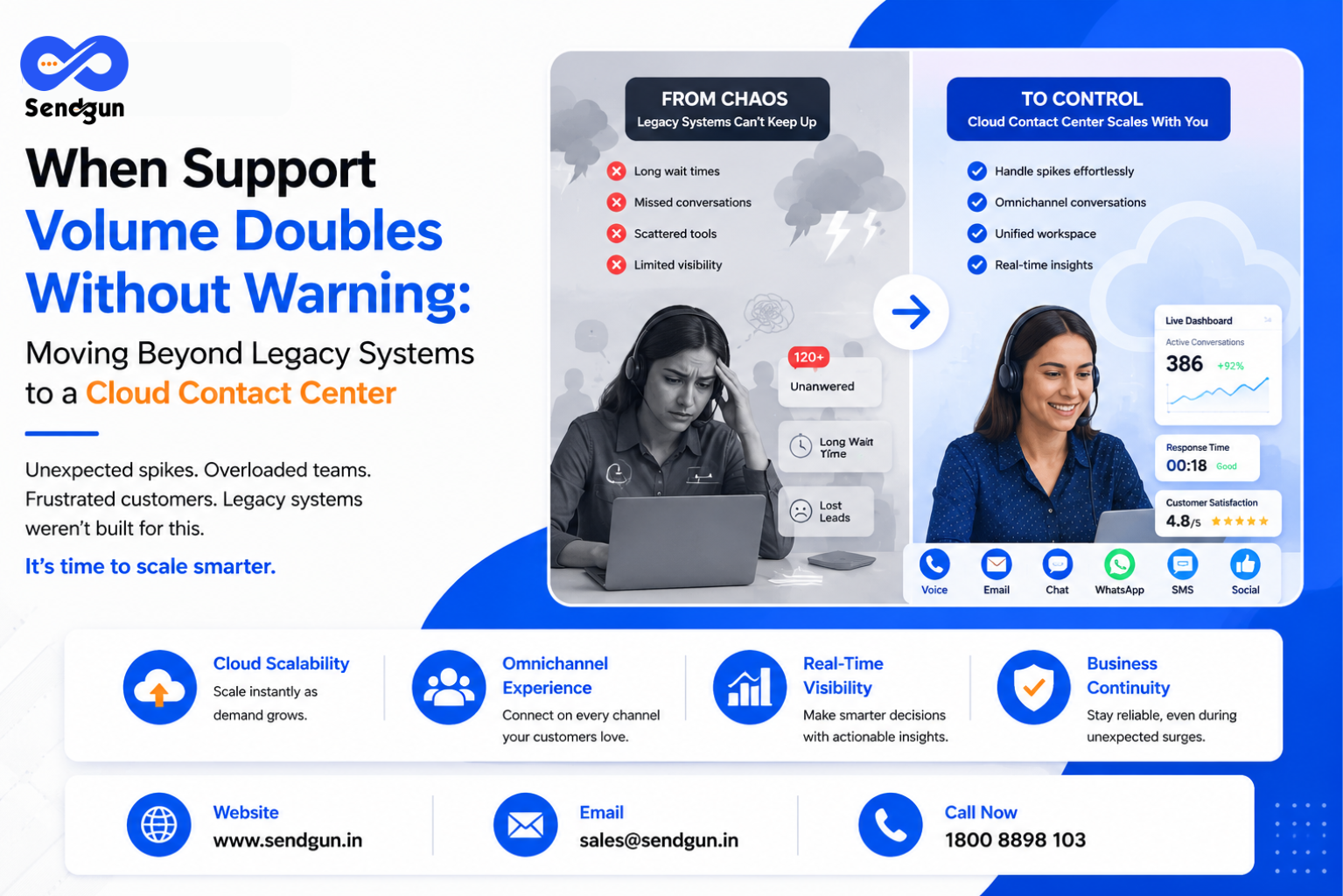
There's a specific kind of panic that hits when call volume spikes faster than anyone expected. Maybe it's a festive sale, maybe a product finally went viral, maybe a competitor just had an outage, and their customers are calling you instead. Whatever the reason, the phones don't stop, and somewhere in your office, someone's quietly realising the current setup just isn't going to hold.
This article isn't really about technology for its own sake. It's about what actually happens to a business when its customer support infrastructure can't keep pace with growth, and what changes once it can.
The moment most businesses don't plan for
Nobody builds their support setup expecting it to handle three times the normal volume on a random Tuesday. Most businesses build for average days, and average days are fine right up until they aren't.
When that spike hits, you start seeing it in small, ugly ways. Hold times creep past what's acceptable. Agents who were calm an hour ago start sounding frazzled. Customers who'd normally wait patiently start hanging up and trying again later, or worse, trying a competitor instead. None of this shows up as one dramatic failure. It shows up as a hundred small ones, and by the time someone notices the pattern, you've already lost some of the goodwill that took months to build.
A genuine cloud contact center service provider exists precisely for this scenario. Not a calm Tuesday. The chaotic one.
What good actually looks like in practice
A few things separate a contact center that genuinely performs under pressure from one that just survives it.
Routing that's actually intelligent matters more than people expect. When a call comes in, the system should know which agent has the right skill, which language the customer probably prefers, and whether that customer has called before about the same issue. Basic round-robin distribution, where the next call just goes to whoever's free, works fine at low volume and falls apart the moment things get busy and complicated.
Omnichannel visibility matters just as much. A customer who messaged on WhatsApp yesterday and is calling today shouldn't have to explain their issue from scratch. The agent picking up that call should already see the WhatsApp thread, the order history, whatever context exists, sitting right there before they say hello.
Real-time monitoring is what lets a manager actually do something useful in the moment, rather than finding out a problem existed after it has already cost you customers. Seeing queue depth rise in real time means you can redistribute load or pull in backup agents before wait times spike past what people will tolerate.
Why traditional setups buckle under pressure
Old-school call centre infrastructure was built around fixed capacity. You bought hardware, leased lines, set up a physical space, and that capacity was basically locked in until you went through the whole process again to expand it.
That works fine when your volume is predictable. It falls apart the second it isn't. Adding ten more agents during a surge means new desks, new lines, sometimes new physical space, and none of that happens in an afternoon. By the time the expansion is ready, the surge that triggered it might already be over, and you've spent money solving yesterday's problem.
Cloud-based systems don't have this constraint baked in. Agents log in from wherever they are, on whatever device they have, and capacity expands through configuration rather than construction. This is honestly the single biggest reason businesses across India have been moving toward cloud contact center in india setups at the pace they have. It isn't really about chasing a trend. It's about not wanting to be stuck the next time volume does something unpredictable.
The compliance layer nobody talks about until it matters
This part gets skipped in most conversations about cloud contact centers, but it shouldn't be. TRAI's guidelines around consent-based calling, KYC verification, and secure call recording aren't optional extras. They're requirements, and a provider who treats compliance as a checkbox rather than a built-in part of how the system runs is setting you up for problems down the line.
Secure call recording specifically matters for more than just compliance. It's how disputes get resolved, how agents get trained properly, and how a business actually proves what was said when a customer claims something different happened.
What this looks like across different business sizes
Startups usually feel this gap earliest, ironically, because growth at that stage is so unpredictable. A founder-led team handling fifty calls a day can suddenly be handling five hundred after one good piece of press, and there's no time to build infrastructure from scratch in that window. Starting with something scalable from day one, even at modest volume, avoids a painful scramble later.
SMEs tend to hit this wall around the point where multiple agents working from different locations start losing track of who handled what. Without a shared system, customer history gets scattered, follow-ups get missed, and managers lose visibility into what's actually happening across the team.
Enterprises generally know they need serious infrastructure from the start, but the specific challenge there is usually multi-location consistency. Keeping routing logic, compliance standards, and quality monitoring identical across five cities or five countries is a genuinely different problem than running one well-organised office, and it needs a platform built to handle that complexity natively.
What to actually check before committing to a platform
A few specific things are worth confirming before signing anything.
Ask how the platform handles a sudden three-times spike in volume, not how it handles average days, because average days were never the concern. Ask how deeply it integrates with whatever CRM or order system you're already running, since a contact center that can't see your existing customer data is only solving half the problem. And ask what compliance support actually looks like day to day, not just as a line item in a sales pitch.
A genuine Cloud Contact Center Solution Built for Modern Enterprises handles all of this as a baseline, not as a premium add-on you discover you need only after something goes wrong.
Conclusion
The businesses that come out ahead during a volume spike aren't the ones with the most agents. They're the ones whose systems can flex without anyone needing to scramble, where routing adjusts intelligently, where every channel feeds into one place, and where compliance was never an afterthought to begin with.
If your current setup makes you nervous every time traffic spikes unexpectedly, that nervousness is usually a pretty reliable signal that it's time for something built to actually handle it.
 Portuguese (Brazil)
 English
 Arabic
 French
 Spanish
 Portuguese
 Deutsch
 Turkish
 Dutch
Dutch
 Italiano
 Russian
 Romaian
 Greek
Greek
