


 Pro Benefits
 About
About
 Koşullar
 Gizlilik
 Child Safety & Protection
 Bildirimler
 Ayrush Global It Services Pvt Ltd
What Tools Are Needed to Build a House?
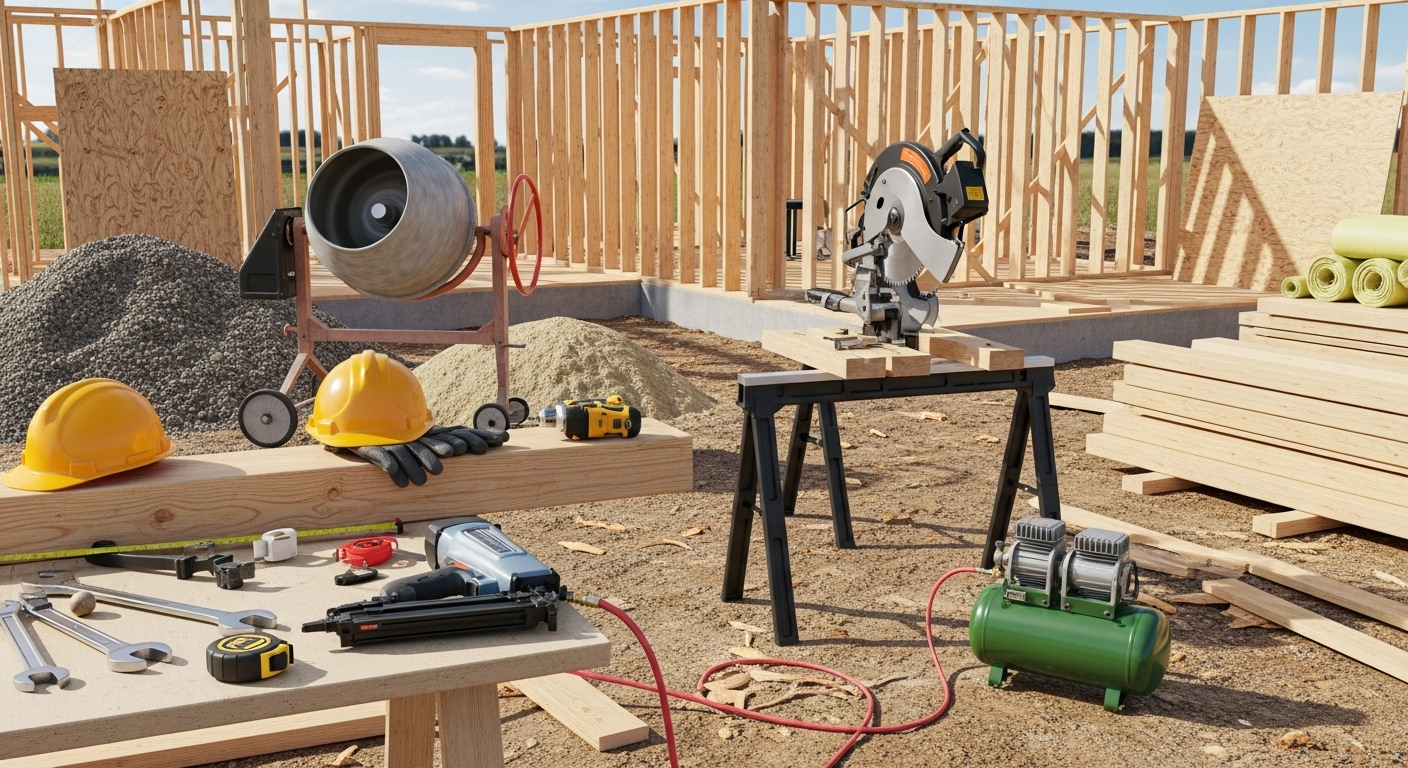
Constructing a home requires an enormous amount of equipment; for example, besides excavation machinery, you also need concrete mixers, framing saws, nail guns, electrical testers, plumbing wrenches, roofing tools, insulation blowers, drywall tools, and finishing tools like paint rollers. Throughout the whole building process, power tools and safety equipment are indispensable.
Constructing a home from the beginning is a complicated undertaking that necessitates elaborate outlines and numerous instruments for every phase. The foundation laying, as well as the interior finishing, are all steps that consist of both hand tools and machinery. Besides helping you build efficiently, knowing these tools also ensures the supply of safety and accuracy.
During the pre-construction phase, it’s highly recommended to utilize construction cost estimating services to plan your project expenses accurately. These services help you outline potential costs, including tool rentals and purchases, ensuring you stay within budget and avoid unexpected financial overruns caused by inadequate planning.
Tools for Site Preparation
Site preparation is the very first phase of any construction journey. The aim here is to get the land ready to work on by clearing, leveling, and marking layout points.
The most important equipment that is utilized in this process is excavators, and they are used for such purposes as digging trenches and/or removing debris. Skid steer loaders are frequently used for shifting earth and for leveling the surface. Manual tools such as shovels, spades, and picks accomplish the task of excavation in hard-to-reach areas very efficiently. Surveying devices like transit levels, measuring wheels, and laser levels assist in the precise staking out of the place.
Tools for Foundation Work
Structural strength relies on the foundation. In this case, concrete mixers are the best for making the concrete on the spot. To reinforce foundations, rebar cutters and benders are utilized. Levels and screeds guarantee that the surface is flat and even.
The use of concrete vibrators facilitates the removal of air bubbles to increase strength, while wheelbarrows help in carrying the concrete to different areas of the formwork. After pouring, trowels and floats make adjustments to the surface.
Framing Tools
Framing is the main support structure of the house. Circular saws and miter saws are essential for cutting lumber accurately. Nail guns are quicker and more reliable than hammers, whereas chalk lines and framing squares are suitable for precise measurements.
Speed squares, measuring tapes, and spirit levels have functions of aligning and measuring each frame piece correctly. Scaffolding and ladders provide safe access to higher levels when framing is being done.
Tools for Wall Construction
No matter if concrete blocks, bricks, or timber framing, wall building necessitates the use of both heavy-duty and precision tools. Bricklayers employ trowels, jointers, and spirit levels to ensure that bricks are laid evenly. Masonry saws and mortar mixers serve as tools for cutting and mixing. Rebar tying tools are used to strengthen block walls, while buckets, mortar boards, and hoes facilitate the process of applying the mortar.
Roofing Tools
Roofing is a very important weatherproofing process. The use of specialized tools like roofing nailers makes the process of fastening shingles faster and safer. Utility knives and roofing hammers are the tools that help trim and nail the shingles. Roof brackets and harnesses provide safety when working at heights. Shingle removers are not only for re-roofing projects, but also improve productivity.
Tools for Door and Window Installation
Both accuracy and muscle power are necessary to install doors and windows. Old frames can be removed easily with the help of pry bars and crowbars. On the other hand, shims, levels, and caulking guns are used to make the installations airtight and square. It is very common for cordless drills and screwdrivers to be used in securing hardware and hinges.
Tools for Electrical Work
Electrical installation is a job that demands the utmost precision and strict adherence to safety rules. The entire set of tools needed for the job consists of wire cutters, strippers, and crimpers, which are used for the preparation of electrical wiring. Fish tape is a tool to pull the wires through the conduit. When changing the shape of the metal piping, conduit benders are used.
Electricians have multimeters and voltage testers, which they employ to check the current flow and thus avoid any hazards. Using power drills with hole saws, the workers cut holes in the studs and panels for cable entry points.
Tools for Plumbing Installation
Plumbing installations require power, precision, and airtight connections. Pipe wrenches, basin wrenches, and channel locks are used to tighten and adjust fittings. To cut and make threads on pipes, tradesmen utilize pipe cutters and threaders.
Soldering torches and flux are the basic necessities for soldered connections during plumbing. A plumber’s snake is a long, flexible tool used to clear drain clogs, while plungers help during fixture testing.
Tools for HVAC Installation
Heating, ventilation, and air conditioning (HVAC) systems necessitate special tools for their installation. Sheet metal shears and snips are the instruments utilized to fabricate ducts. Duct lifters permit the installation of heavy units at height.
Hvac vacuum pumps are necessary for extracting refrigerants in lines, while gauge manifolds assist in pressure measurement. Pipe insulation tools not only improve efficiency but also help avoid the formation of condensation or freezing.
Insulation Tools
If energy efficiency is your aim, then insulation has to be done correctly. Blower machines are employed for loose-fill insulation such as cellulose or fiberglass. Utility knives and straightedges cut batts and foam boards precisely. Staple guns affix insulation to framing. When handling insulating materials, safety gear such as respirators and gloves is a must-have.
Drywall Tools
Drywalling or Sheetrock installation necessitates smooth finishing. Drywall saws cut panels, while screw guns attach them to studs. Taping knives and mud pans are the tools for finishing joints with the joint compound. Drywall lifts allow the carrying of heavy panels during ceiling installation. Sanding tools provide walls with a clean finishing touch.
Flooring Tools
Installing floors varies depending on the type of material used—be it tile, hardwood, vinyl, or carpet. Floor scrapers remove old glue from the floor. Tile cutters change the shape of ceramic pieces. For vinyl or laminate, tapping blocks and mallets help to create tight seams. Trowels apply glue, and floor rollers hold the tiles in place. Knee pads protect from injuries if the work is done for a long time at the floor level.
Painting and Finishing Tools
Paint is essential to give the house a final touch. Rollers and brushes are traditional tools, and spray guns quickly cover the area. Drop cloths are there to ensure that the surfaces are protected, whereas painter’s tape defines the lines, making them look neat. Sanding blocks prepare the wall, and spackling tools fill in the gap created by nail holes or other imperfections.
Exterior Tools: Siding, Decking, Landscaping
Nailers and circular saws ease the job of cutting materials and also of fixing them in the case of cladding. Deck building or fence construction necessitates the utilization of post-hole diggers as well as augers. The garden tools are the ones that will spruce up the lawn; they are essential and thus indispensable, such as hoes, rakes, and wheelbarrows.
Deck screw guns, speed squares, and levels are being used to make sure the desk surface is unshaken and even.
Power Tools Every Builder Needs
Power tools have a wide utility range across various construction stages. Among these are the reciprocating saws, which are most suitable for demolition, table saws for precision lumber cutting, jigsaws for curves, and angle grinders for trimming.
Generators offer power in places that are off the grid, and oscillating multi-tools give options to a user while they can use them for cutting, sanding, and scraping.
Safety Equipment
Safety is paramount. Hard hats and goggles give protection from falling objects and dust. Gloves and masks help prevent coming into contact with chemicals. Steel-toe boots are the best for the protection of feet. Safety harnesses are compulsory for work at heights and for scaffolds. Fire extinguishers and first aid kits are needed on every job site.
Tool Storage and Transport Solutions
Storing tools in an orderly manner is one of the ways to save money and also to increase the efficiency of the work. Tool belts allow you to have your tools within reach at all times. Rolling toolboxes enable one to carry their work gear around with ease. Jobsite chests are perfect for storing large tools safely. Tool trailers make it easier to move heavy-duty equipment across locations. Portable workbenches allow you to tend to your work from any place.
Optional but Helpful Tech Tools
The use of technology allows for higher accuracy and better management of a project. Laser distance measurers are quick and precise. Drones provide an aerial view of the site while capturing its progress. Tablets with project management capabilities facilitate real-time recording and coordination. 3D scanners facilitate layout.
Summary Tool Table
|
Construction Stage |
Essential Tools |
|
Site Preparation |
Excavators, shovels, laser levels |
|
Foundation |
Concrete mixers, rebar benders, trowels |
|
Framing |
Circular saws, nail guns, chalk lines |
|
Wall Construction |
Masonry saws, mortar mixers, rebar tools |
|
Roofing |
Roofing nailers, harnesses, and utility knives |
|
Electrical |
Wire strippers, conduit benders, multimeters |
|
Plumbing |
Pipe wrenches, cutters, and soldering torches |
|
HVAC |
Shears, duct lifters, vacuum pumps |
|
Drywall |
Drywall lifts, mud pans, sanding tools |
|
Flooring |
Tile cutters, mallets, adhesive trowels |
|
Painting/Finishing |
Paint rollers, tape, and spackle tools |
|
Exterior & Landscaping |
Nailers, augers, rakes, deck screw guns |
|
General Power Tools |
Saws, grinders, compressors, multi-tools |
|
Safety Equipment |
Hard hats, gloves, masks, safety harnesses |
Frequently Asked Questions
1. Can I build a house without professional tools?
No, building a house requires a variety of specialized tools. Even DIY builders will need to rent or buy professional-grade equipment.
2. What is the most expensive tool in home construction?
Heavy equipment like excavators, concrete mixers, and drywall lifts is among the most expensive tools.
3. Are there services that can help estimate tool costs?
Yes, estimating services can outline all expected tool purchases or rentals along with labor and materials.
4. Can tools be rented instead of purchased?
Yes, most major hardware stores and rental companies offer daily or weekly rental of tools like compressors, saws, and concrete mixers.
5. What safety tools are mandatory for every stage?
Basic safety gear includes hard hats, gloves, safety goggles, and steel-toe boots. For elevated work, harnesses are essential.
 Turkish
 English
 Arabic
 French
 Spanish
 Portuguese
 Deutsch
 Dutch
Dutch
 Italiano
 Russian
 Romaian
 Portuguese (Brazil)
 Greek
Greek
