


 Pro Benefits
 About
About
 Koşullar
 Gizlilik
 Child Safety & Protection
 Bildirimler
 Ayrush Global It Services Pvt Ltd
Cable Slicer: A Complete Guide for Precision Cable Sample Preparation | Sipcon
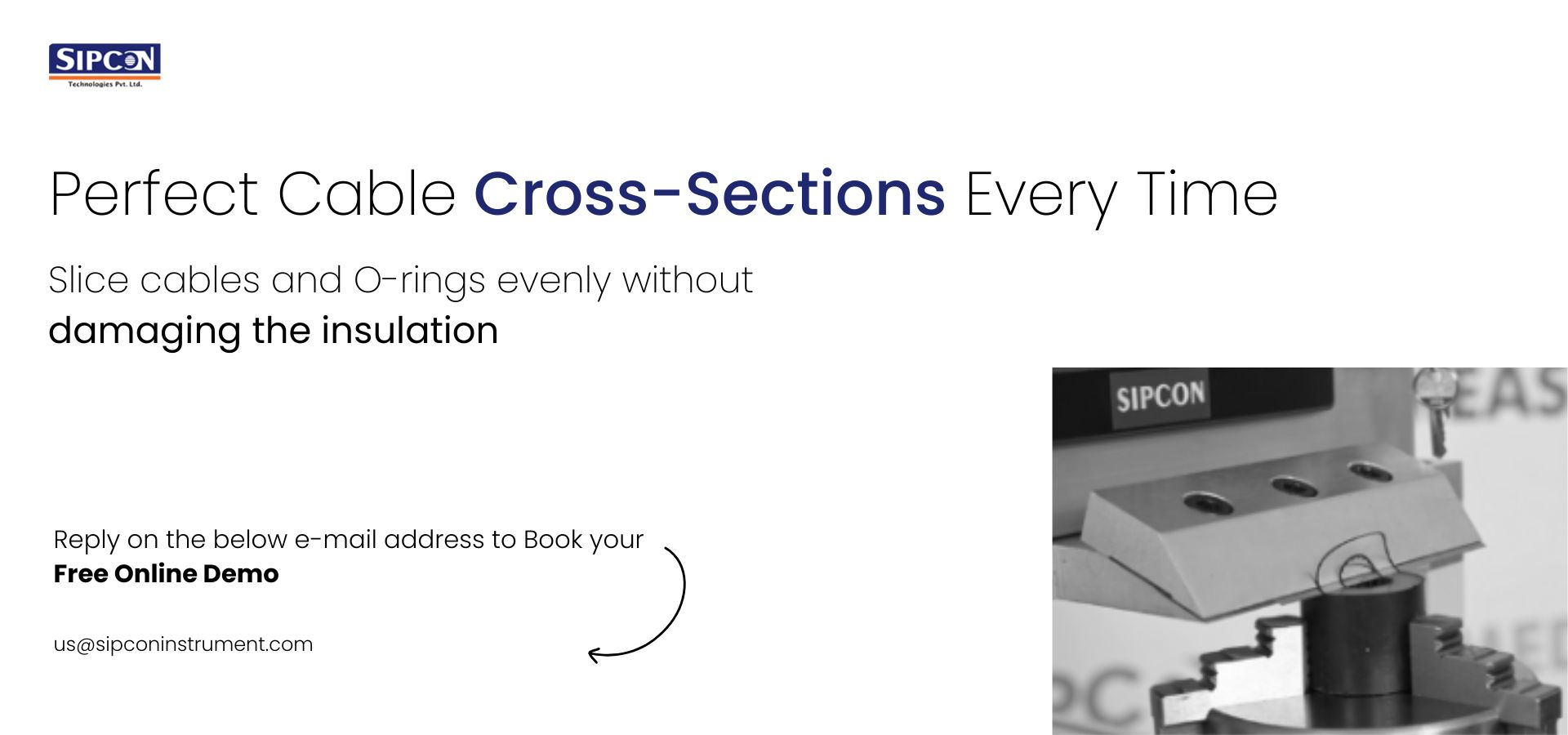
When people think about cable testing, they usually focus on insulation resistance, tensile strength, aging tests, or conductor quality. But there's one small step that quietly affects the reliability of every result—sample preparation.
If the cable specimen isn't prepared correctly, the test itself can never be fully accurate. A rough cut, uneven surface, or damaged insulation may introduce errors before the sample even reaches the testing equipment. That's exactly why a cable slicer, also known as a Cable O-ring Cutter or O ring cable cutter, has become an essential tool in cable testing laboratories and manufacturing facilities.
Many technicians underestimate this stage. They assume any sharp blade will do the job. It rarely works that way. Precision matters more than people realize.
Let's understand why.
What is a Cable Slicer?
A cable slicer is a precision instrument designed to prepare cable samples by making clean, controlled circular cuts through insulation without damaging the conductor underneath.
Unlike manual knives or ordinary cutters, the tool maintains consistent cutting depth, making it easier to produce repeatable samples for laboratory testing.
The equipment is commonly used before tests involving:
- Insulation thickness measurement
- Physical property testing
- Tensile testing
- Aging studies
- Material analysis
- Quality control inspections
A properly prepared specimen saves time later. A poorly prepared one usually means repeating the entire process.
Why Sample Preparation Matters More Than Most People Think
Testing standards demand consistency.
If one sample has a rough cut while another has a perfectly smooth edge, comparing their results becomes difficult.
Even a tiny nick in the insulation can affect mechanical properties during tensile testing.
This is where many labs make mistakes.
They invest in advanced testing machines but overlook the preparation stage.
Small deviations can ruin the results.
How Does a Cable O-Ring Cutter Work?
The working principle is fairly straightforward.
The cable is securely positioned inside the cutter.
A precision blade is adjusted according to the insulation thickness.
The operator rotates the cable or cutting mechanism, allowing the blade to create a perfectly circular cut around the insulation.
Instead of crushing or tearing the material, the cutter slices it smoothly.
Once the ring cut is complete, the insulation section can be removed without damaging the conductor.
Simple in theory.
Precision in practice.
Step-by-Step Process for Using an O Ring Cable Cutter
Although different models have slightly different mechanisms, the general procedure remains similar.
Step 1: Select the Right Cable Size
Choose the correct holder or guide based on the cable diameter.
Using the wrong size affects cutting accuracy.
Don't rush this part.
Step 2: Adjust Blade Depth
The blade should cut only through the insulation layer.
Too shallow and the insulation won't separate properly.
Too deep and the conductor may get scratched.
Step 3: Secure the Cable
Place the cable firmly inside the cutter.
Movement during cutting often creates uneven slices.
Step 4: Rotate Smoothly
Rotate the cutting assembly with steady pressure.
Avoid forcing the blade.
The cutter is designed to slice—not tear.
Step 5: Remove the Insulation Ring
After the circular cut is complete, gently remove the insulation section.
Inspect the conductor carefully.
There should be no visible scratches or deformation.
Applications of Cable Slicers
A Cable O-ring Cutter finds applications across multiple industries where cable quality directly impacts safety and performance.
Some common sectors include:
- Electrical cable manufacturing
- Automotive wiring production
- Aerospace cable inspection
- Railway cable testing
- Defense cable quality control
- Wire and cable testing laboratories
- Research institutions
- Certification laboratories
Any facility performing physical testing on insulated cables benefits from consistent sample preparation.
Features to Look for in a Good Cable Slicer
Not every cutter offers the same level of precision.
Before selecting one, check these features.
Precision Blade Adjustment
Accurate blade depth ensures repeatable cutting without damaging conductors.
Wide Cable Diameter Range
A versatile machine accommodates different cable sizes without requiring multiple tools.
Durable Construction
Frequent laboratory use demands a rigid, stable body that maintains alignment over time.
Smooth Operation
The cutting mechanism should rotate freely without excessive force.
Operators appreciate this during long testing sessions.
Replaceable Blades
Sharp blades maintain clean cuts.
Easy replacement reduces downtime.
Safe Design
Blade exposure should remain minimal during operation to reduce accidental injuries.
Common Mistakes While Preparing Cable Samples
Many preparation errors are surprisingly common.
Avoid these whenever possible.
Using Excessive Force
More pressure doesn't improve cutting quality.
It usually damages the specimen.
Ignoring Blade Wear
A dull blade tears insulation rather than slicing it.
Regular inspection helps maintain consistent performance.
Incorrect Blade Depth
This is perhaps the most frequent mistake.
Even slight over-adjustment may score the conductor.
Unstable Cable Position
If the cable shifts during cutting, the ring becomes uneven.
That affects measurement accuracy later.
Benefits of Using a Precision Cable O-Ring Cutter
Using a dedicated O ring cable cutter offers several practical advantages.
- Uniform sample preparation
- Reduced operator errors
- Better repeatability
- Faster laboratory workflow
- Improved compliance with testing procedures
- Cleaner insulation removal
- Lower risk of conductor damage
The difference becomes noticeable when processing large batches of samples.
Consistency saves both time and effort.
Understanding Cable O-Ring Cutter Price
One question buyers frequently ask is about the Cable O-ring Cutter Price.
The answer depends on several factors.
Pricing varies based on:
- Cutting capacity
- Supported cable diameter range
- Blade adjustment mechanism
- Material quality
- Precision engineering
- Manufacturing standards
- Additional accessories
Rather than choosing the lowest-priced option, laboratories usually evaluate long-term reliability.
A precision tool that performs consistently for years often proves more economical than replacing inexpensive equipment repeatedly.
Choosing the Right Cable Slicer Manufacturer
Selecting the right cable slicer manufacturer involves more than comparing specifications.
Look for manufacturers that understand cable testing rather than simply producing cutting tools.
Consider factors such as:
- Manufacturing experience
- Build quality
- Calibration consistency
- Spare parts availability
- Technical support
- After-sales service
- Product reliability
These aspects become increasingly valuable once the equipment is in daily laboratory use.
Maintenance Tips for Longer Service Life
Routine maintenance doesn't take much time.
Yet it significantly improves accuracy.
Keep the following practices in mind:
- Clean blades after regular use.
- Remove insulation residue.
- Store the cutter in a dry environment.
- Replace worn blades promptly.
- Check adjustment mechanisms periodically.
- Avoid dropping the equipment.
A few minutes of maintenance can prevent unnecessary downtime later.
Final Thoughts
A reliable cable slicer may not be the largest instrument in a testing laboratory, but it plays an important role in producing dependable test samples. Clean insulation cuts reduce preparation errors, improve repeatability, and help technicians work with greater confidence during mechanical and electrical testing.
For laboratories and cable manufacturers looking for precision sample preparation equipment, Sipcon Technologies Pvt. Ltd. offers testing solutions designed around practical industrial requirements. Choosing the right Cable O-ring Cutter isn't just about the tool itself—it's about ensuring every test begins with a properly prepared sample, because accuracy starts long before the actual measurement does.
 Turkish
 English
 Arabic
 French
 Spanish
 Portuguese
 Deutsch
 Dutch
Dutch
 Italiano
 Russian
 Romaian
 Portuguese (Brazil)
 Greek
Greek
