


 Pro Benefits
 Sobre
Sobre
 Termos
 Privacidade
 Child Safety & Protection
 Notificações
 Ayrush Global It Services Pvt Ltd
7 Key MVP Development Phases Every Startup Should Follow
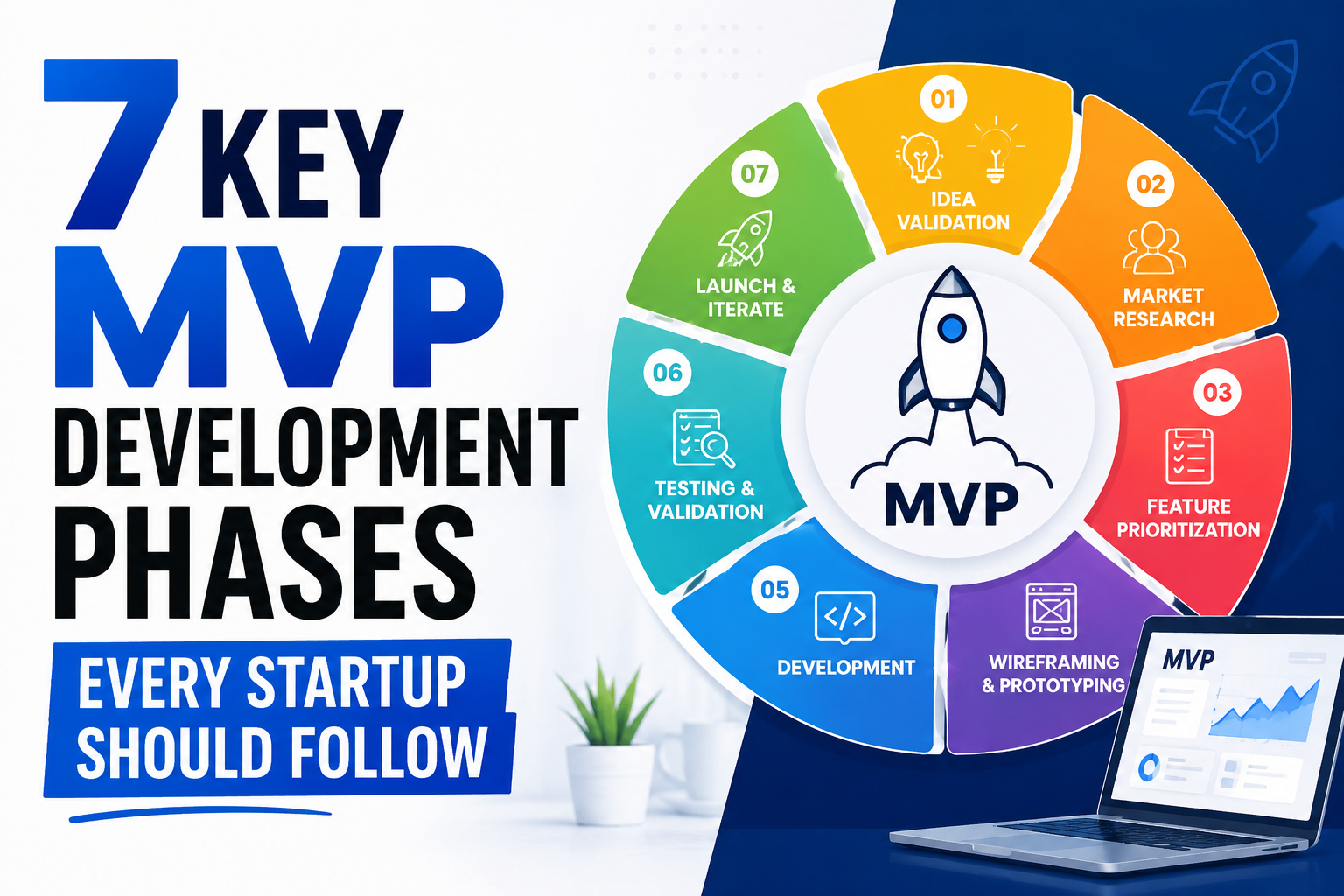
MVP development phases help startups validate product ideas, reduce wasted development costs, and launch faster by focusing only on essential features.
Many startups overbuild products before validating demand, which leads to wasted time, higher costs, and delayed launches. A structured MVP process helps teams validate assumptions early and launch faster with less risk.
-
Market reality: Simple, focused MVPs typically ship in 8-16 weeks when scope is tight, and teams are decisive, with timelines stretching for complex, regulated products.
-
Why this matters: Speed without validation just accelerates mistakes. A lean, phase-driven MVP turns uncertainty into learning loops you can afford.
What Are MVP Development Phases?
MVP development phases are the structured steps startups follow to validate ideas, prioritize essential features, build faster, and reduce product risk before scaling. These phases help teams move from problem validation to launch using real user feedback instead of assumptions.
Why Structured MVP Product Development Stages Matter for Startups
Without a structured MVP process, startups often overbuild, waste budget, and delay launch. Following clear MVP product development stages improves decision-making, speeds up development, and increases the chance of product-market fit.
Phase 1: Discovery & Problem Validation (Weeks 1-2)
Goal: Prove the problem is real, frequent, and valuable enough to solve before you write code.
What to do
-
Talk to 10-20 target users in structured interviews; avoid pitching, dig into workflows, switching costs, and willingness to pay.
-
Map alternatives (spreadsheets, incumbent tools, hacks) and why they fail in edge cases.
-
Write a one-sentence problem statement: “For [who], [pain] occurs [frequency], costing [time/money].”
Founder insight
-
Five real users who commit to a pilot or pre-pay teach you more than 500 survey clicks. Pre-commitments are the strongest early signal.
Example
-
B2B compliance tool: “Seed-stage CFOs spend 6–8 hours/month reconciling SOC 2 evidence, risking failed audits and delayed contracts.”
Sprint planning (Week 1-2)
-
Week 1: 10 interviews, competitor gap analysis, draft problem statement.
-
Week 2: Landing page smoke test (value prop + waitlist), pricing conversation with 3–5 prospects, define riskiest assumption.
Deliverables
-
Problem statement, target persona, qualitative insights, evidence of demand (waitlist signups, pre-commit interest).
Phase 2: Scope & Feature Prioritization (Week 3)
Objective: Define the smallest set of features that delivers core value.
What to do
-
Write user stories for one core workflow (“As a [persona], I want to [action] so I can [outcome]”).
-
Use MoSCoW to bucket features; keep 3-5 Must-haves only.
-
Optionally apply RICE scoring to the Must-haves to sequence work.
Example
-
Uber v0: open app → see nearby cars → request ride → driver en route. Everything else (ETA accuracy polish, promos, ratings) is “later.”
Founder insight
-
Write acceptance criteria as if it’s a contract with your future self. Vague scope today becomes expensive rework tomorrow.
Sprint planning (Week 3)
-
Feature list, MoSCoW board, acceptance criteria, definition of done, analytics plan (events for activation/retention).
Deliverables
-
Prioritized scope (3-5 Must-haves), success metrics for v1.
Phase 3: UX Flows, Wireframes, and Clickable Prototype (Weeks 4-5)
Goal: Validate the user journey and information architecture before code.
What to do
-
Map the end-to-end journey from first touch to core value delivery.
-
Produce low- to mid-fidelity wireframes; evolve into a clickable prototype.
-
Run 5-7 usability tests on the prototype; fix obvious friction.
Example
-
Fintech onboarding: cut KYC from 12 fields to 4 progressive steps; onboarding completion jumps in prototype tests.
Founder insight
-
A day of prototype testing can save two weeks of engineering. Keep the design system minimal but consistent - it pays back in dev speed later.
Sprint planning (Weeks 4-5)
-
Week 4: Wireframes, journey map, content strategy for empty states/errors.
-
Week 5: Clickable prototype, 5-7 user tests, iteration pass, dev handoff docs.
Deliverables
-
Approved prototype, UX notes, design tokens/components, tracked usability findings.
Phase 4: Technical Planning & “Boring” Stack Selection (Weeks 5-6, parallel-friendly)
Objective: Choose proven tools that speed delivery and reduce unknowns.
What to do
-
Select frameworks your team knows well (e.g., Next.js/Rails + Postgres/Supabase; Stripe; Vercel/Railway). Favor speed and iteration over premature scale.
-
Define data model, integration points, auth, and basic security.
-
Plan instrumentation: activation event, retention cohorts, key health checks.
Example
-
Marketplace MVP: Next.js + Supabase; Stripe Connect for payouts; file storage via Supabase; feature flags via LaunchDarkly, later or a simple config to start.
Founder insight
-
Each third-party integration adds 1-2 weeks on average. Integrate only what’s essential for the core flow.
Sprint planning (Week 5-6, often overlaps with Phase 3)
-
Architecture diagram, ERD, environment setup, CI/CD skeleton, linting/testing baseline, security checklist.
Deliverables
-
Architecture doc, backlog ready for build, environments live.
Phase 5: Build in Short, Outcome-Focused Sprints (Weeks 7-12)
Objective: Ship the core workflow quickly, with working software every 1-2 weeks.
What to do
-
Organize 2-week sprints; demo to real users each sprint.
-
Implement Must-haves first; defer automation where humans can bridge the gap early (“manual before automated”).
-
Treat integrations as their own mini-sprints to avoid hidden delays.
Reference timelines
-
Simple MVP: ~8-10 weeks total to launch when discovery/design are tight.
-
Typical SaaS MVP: 8-16 weeks depending on scope and integrations.
Example sprint plan (6 weeks build)
-
Sprint 1 (Weeks 7-8): Auth, basic nav, core data model, “happy path” for main action.
-
Sprint 2 (Weeks 9-10): Complete core flow, essential integration (e.g., Stripe), error states, analytics events.
-
Sprint 3 (Weeks 11–12): Polish critical UX, access control, email notifications, soft-launch build.
Founder insight
-
Decision velocity on the founder side is the biggest multiplier. Slow approvals turn 8 weeks into 16.
Deliverables
-
Working core features, integrated payment (if needed), event tracking, and feature-flagged toggles where risky features exist.
Phase 6: QA, Launch Prep, and Soft Launch (Weeks 12-14)
Goal: Protect first impressions; validate reliability with a limited audience.
What to do
-
Functional QA, UAT with 5-10 early users, security basics (authZ, HTTPS), performance checks on critical paths.
-
Instrument error monitoring and feedback channels.
-
Prepare onboarding, docs, and concise release notes.
Example
-
B2B beta: onboard 8 design partners; run a 2-week pilot; collect activation and retention signals before opening the gates.
Founder insight
-
Resist “just one more feature.” Stability, onboarding clarity, and visible value beat breadth at launch.
Deliverables
-
Signed-off test plan, beta feedback report, go/no-go checklist.
Phase 7: Measure, Learn, and Iterate (Ongoing, Weeks 14+)
Goal: Turn usage into insight and prioritize what moves retention, not opinions.
What to do
-
Track activation (did users hit the value moment?), retention (D1/D7/D30), engagement depth, NPS/qualitative “jobs to be done” feedback.
-
Run the “40% very disappointed” test to judge product-market pull.
-
Iterate in 2-week cycles; prune features that don’t drive activation or retention.
Example
-
After launch, founders see activation at 32% due to a confusing import step; they ship a sample dataset and inline tips, lifting activation to 51% in two sprints.
Founder insight
-
Build, measure, learn only works if you commit roadmap time to post-launch iteration -schedule 30-40% of capacity for it.
Comparison Table: MVP Complexity vs. Timeline
|
MVP type |
Typical timeline |
Team pattern |
Notable risks |
|
Simple single-flow web app |
8-10 weeks |
1 PM, 1-2 FE, 1 BE, 1 designer/QA |
Over-scoping, skipping interviews |
|
Moderate SaaS with 1-2 integrations |
12-16 weeks |
Product lead, 2-3 devs, designer |
Integration delays, decision bottlenecks |
|
Complex/regulatory, multiple personas |
16-24 weeks |
4-6 cross-functional + compliance |
Compliance, data security, orchestration |
Real-World Case Snippets
-
Logistics SaaS MVP (moderate): 14 weeks from discovery to pilot. Stripe + a mapping API each added ~1-2 weeks; tight MoSCoW and weekly founder decisions kept scope intact.
-
Marketplace MVP (simple): 9 weeks using a “boring” stack and manual ops for approvals; launched to 50 beta users, then automated after seeing >40% “very disappointed” score.
Expert viewpoint
-
Lean teams can reach the market faster by shipping only must-haves, running short sprints, and iterating from feedback- a consistent theme across MVP guides and studios.
Best Practices That Consistently Pay Off
-
Ruthless scoping: 3-5 Must-haves only; everything else goes to the backlog
-
Validate before code: Interviews, landing page tests, and pre-commit signals beat assumptions.
-
Choose a boring stack: Optimize for speed and familiarity, not hypothetical scale.
-
Ship every 1-2 weeks: Demos to real users each sprint, keep the build tethered to reality.
-
Instrument from day one: Activation, retention, and error monitoring guide iterations.
-
Manual before automated: Humans in the loop reduce build time and validate process fit.
Common Mistakes to Avoid
-
Feature creep disguised as “quick wins.” It isn’t quick.
-
Skipping discovery because “we are the users.”
-
Over-engineering infra (Kubernetes, microservices) on day one.
-
Ignoring integration lead times and compliance overhead.
-
Launching without analytics and feedback loops.
-
Treating MVP as “v0 forever” instead of a learning step toward PMF.
Actionable Founder Checklist
Discovery (Week 1-2)
-
10-20 interviews completed with notes and quotes
-
One-sentence problem statement
-
Landing page with waitlist and >5% visitor-to-signup
-
3+ pilot commitments or LOIs (if B2B)
Scope (Week 3)
-
1 core workflow defined in user stories
-
MoSCoW list with 3–5 Must-haves
-
Acceptance criteria for each Must-have
Design (Weeks 4-5)
-
Journey map and wireframes
-
Clickable prototype tested with 5-7 users
-
Critical UX issues resolved
Tech planning (Weeks 5-6)
-
“Boring” stack chosen and environments set up
-
ERD/architecture doc and integration plan
-
Analytics events for activation/retention are defined
Build (Weeks 7-12)
-
Working software is demoed each sprint
-
Core flow complete; payment/auth if applicable
-
Error monitoring and basic security are in place
Launch (Weeks 12-14)
-
UAT with 5-10 users
-
Onboarding guide and support channel live
-
Soft launch checklist passed
Iterate (Ongoing)
-
Activation >40-60%, depending on the product
-
D7 retention is tracked and improving
-
Top 3 friction points addressed in each sprint
Founder Insights and Opinions
-
Start with a hair-on-fire problem. If prospects won’t pre-commit time or money, you’re still in discovery.
-
Your job is decision throughput. Fast, clear decisions keep momentum; ambiguity multiplies costs.
-
Use “customer council” calls biweekly with your earliest users; they are your free product team.
Industry Benchmarks and Timelines at a Glance
-
Phases of MVP development: discovery, planning, design, development, testing, and launch.
-
Typical MVP timeframe: 8 -16 weeks for focused web/SaaS; complex products take several months.
-
What speeds you up: tight scope, familiar stack, few integrations, decisive stakeholders.
-
What slows you down: compliance, custom components, decision bottlenecks, and scope creep.
Conclusion
MVP success rarely comes from building more features. It comes from validating faster, reducing waste, and solving one core user problem well. By following structured MVP development phases, startups can launch faster, reduce product risk, and improve product-market fit through continuous iteration. For startups, following structured MVP product development stages helps reduce risk, improve learning speed, and move toward product-market fit faster.
Frequently Asked Questions
1. What are the essential MVP development phases for startups?
Seven phases cover the lifecycle: Discovery & Validation, Scope & Prioritization, UX & Prototyping, Technical Planning, Build (2-week sprints), QA & Launch Prep, and Measure & Iterate. This mirrors standard MVP product development stages used across Lean and Agile teams.
2. How long does an MVP take to build if I have limited resources?
A focused SaaS MVP usually takes 8-16 weeks, depending on scope, integrations, and compliance.
3. Which features should be in my MVP vs. my roadmap?
Keep only Must-haves - the features without which your core workflow breaks - and push Should/Could-haves post-launch. MoSCoW and RICE help enforce discipline.
4. What metrics prove my MVP is working?
Activation rate (users reaching first value), D1/D7/D30 retention, qualitative feedback/NPS, and the “40% very disappointed” signal from early cohorts.
5. Can an MVP be built in 3 months with a small team?
Yes -with a tight scope, a boring stack, few integrations, and fast decisions, 10-12 weeks is realistic for many products.
6. Should I automate operations in my MVP?
Not initially. Use humans-in-the-loop for complex steps to validate the workflow, then automate the steps users consistently need.
 Portuguese (Brazil)
 English
 Arabic
 French
 Spanish
 Portuguese
 Deutsch
 Turkish
 Dutch
Dutch
 Italiano
 Russian
 Romaian
 Greek
Greek
