


 Pro Benefits
 Sobre
Sobre
 Termos
 Privacidade
 Child Safety & Protection
 Notificações
 Ayrush Global It Services Pvt Ltd
Credit Underwriting Explained: A Practical Guide to Smarter Risk Assessment in Lending
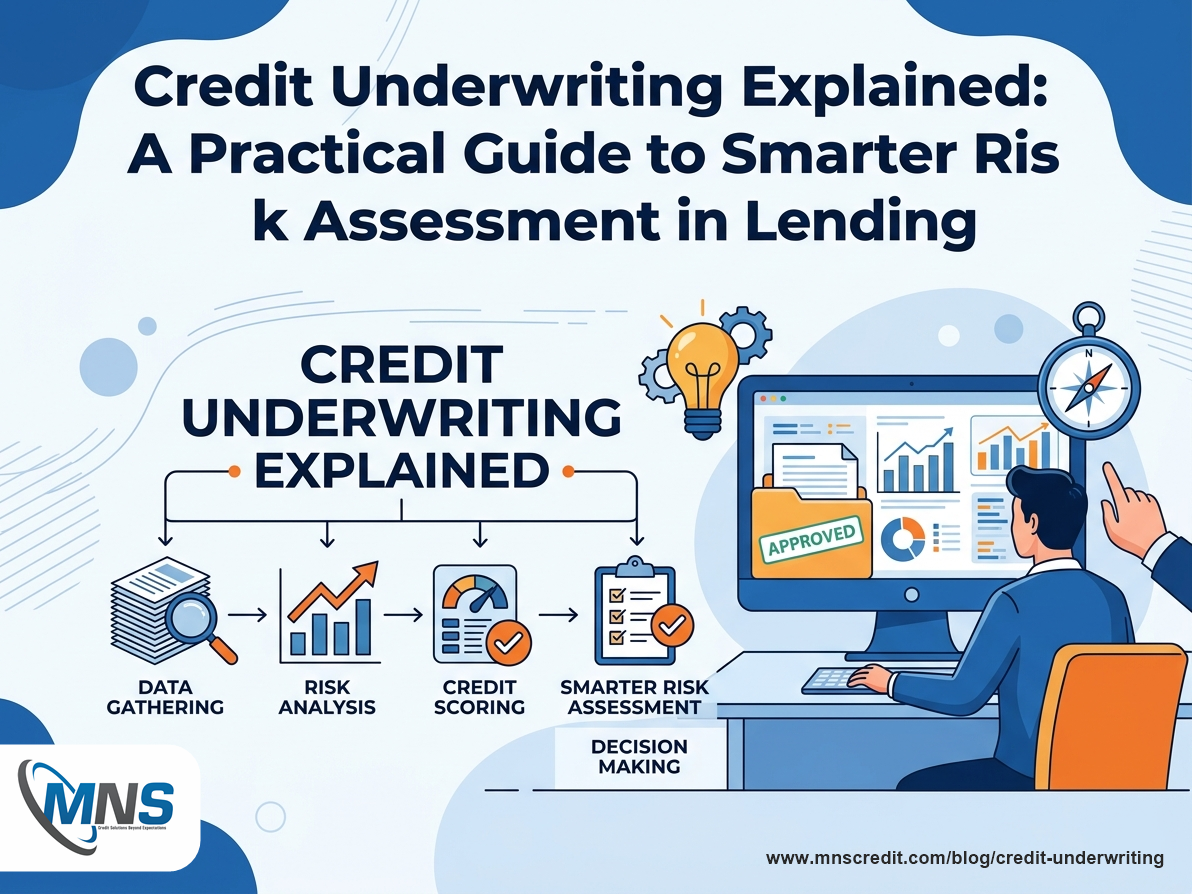
What Is Credit Underwriting?
Credit underwriting is the process through which a lender evaluates whether to extend credit to a borrower — and if so, on what terms. It is the analytical engine behind every lending decision, from a small business loan application to a large corporate credit facility. At its core, underwriting answers one fundamental question: given everything we know about this borrower, is the expected return on this credit adequate compensation for the risk of non-repayment?
The term originates from the historical practice of underwriters signing their names beneath a risk they agreed to accept — literally writing their name under the description of the risk. In modern lending, the practice is far more sophisticated, but the essential commitment remains the same: the underwriter assesses the risk, makes a judgment, and accepts accountability for the credit decision that follows.
The Five Cs of Credit: The Foundation of Underwriting Analysis
The most enduring framework in credit underwriting is the Five Cs model, which organises the dimensions of borrower risk into five analytical categories that collectively determine the quality of a credit proposition.
Character refers to the borrower's willingness to repay — their track record of honouring financial obligations, their reputation in the market, and the integrity of the management team in a business lending context. A borrower with an impeccable repayment history across multiple prior credit relationships is demonstrating character that is directly predictive of future behaviour.
Capacity is the borrower's ability to repay from current income and cash flows. This is assessed through income verification, debt service coverage analysis, and the calculation of key Financial Ratios such as the Debt Service Coverage Ratio (DSCR) and Interest Coverage Ratio. Capacity analysis answers the question: can this borrower service the proposed debt from their existing and projected earnings without undue stress?
Capital refers to the borrower's own financial stake in the transaction — the equity, savings, or assets they are committing alongside the borrowed funds. Borrowers with significant capital at risk have a stronger incentive to protect their investment and are more likely to prioritise debt service even under financial pressure.
Collateral encompasses the assets that the lender can claim in the event of default. Strong collateral reduces the severity of loss if repayment fails, even when it cannot fully substitute for adequate capacity. Collateral assessment considers both the current value of the security and its likely realisable value in a distressed scenario.
Conditions refers to the broader economic and industry environment in which the borrower operates, as well as the specific purpose of the loan. A credit proposal that is fundamentally sound in stable conditions may be significantly riskier during an economic downturn or in an industry facing structural disruption.
The Underwriting Process: Step by Step
A structured underwriting process moves through several defined stages, each of which builds the analytical foundation for the final credit decision.
Application and data gathering is the first stage. The underwriter collects financial statements, tax returns, bank statements, business plans, and other relevant documentation from the borrower. The completeness and consistency of the information provided is itself an early signal — borrowers who provide comprehensive, well-organised documentation are typically more financially disciplined than those whose records are incomplete or inconsistent.
Financial analysis translates the collected data into structured metrics. This includes calculating key Financial Ratios across multiple years, analysing income statement trends, reviewing balance sheet composition, and stress-testing cash flow projections under adverse scenarios. For business borrowers, accessing a Business Information Report that independently verifies financial data and provides payment behaviour intelligence adds a critical layer of objectivity to this analysis.
Risk rating assigns a quantified risk score to the credit application, positioning it within the lender's risk appetite framework and determining the pricing and terms appropriate to the assessed risk level. A well-calibrated risk rating system ensures that the return earned on each credit is proportionate to the risk accepted — the fundamental economics of sustainable lending.
Common Underwriting Errors and How to Avoid Them
Several recurring errors undermine the quality of credit underwriting decisions. Overreliance on collateral — approving loans based primarily on asset security without adequately assessing repayment capacity — is a structural error that consistently produces elevated default rates, because distressed recovery of collateral is almost always more costly and uncertain than anticipated.
Recency bias — the tendency to weight recent positive performance too heavily relative to longer-term risk factors — is another common failure mode. A borrower whose revenues have grown strongly for two years but who operates in a highly cyclical industry and carries significant leverage may look compelling at the peak of the cycle and prove highly problematic at the trough.
Finally, relationship override — allowing commercial relationship considerations to override objective risk analysis — is the most human of underwriting errors. Building a structured, documented underwriting process with defined approval authorities and mandatory analytical requirements is the most effective mitigation for relationship-driven bias.
Smarter Underwriting in Practice
Smarter credit underwriting is not about applying more complex models — it is about applying the right analytical framework consistently, with full access to verified information, and with the discipline to weight risk factors accurately regardless of commercial pressure. The businesses and lenders that achieve the best credit outcomes are those that treat underwriting as a genuine analytical discipline rather than an administrative hurdle to be cleared on the way to closing a deal.
Conclusion
Credit underwriting, done well, is one of the most valuable functions in any lending or credit management organisation. The Five Cs framework, applied through a structured and documented process, with high-quality verified information and consistent risk discipline, produces credit decisions that are accurate, defensible, and commercially sustainable. In lending, the quality of the underwriting is ultimately the quality of the portfolio — and the quality of the portfolio determines the financial health of the institution.
 Portuguese (Brazil)
 English
 Arabic
 French
 Spanish
 Portuguese
 Deutsch
 Turkish
 Dutch
Dutch
 Italiano
 Russian
 Romaian
 Greek
Greek
