


 Pro Benefits
 About
About
 Términos
 Privacidad
 Child Safety & Protection
 Notificaciones
 Ayrush Global It Services Pvt Ltd
Optimizing Types of Regression Testing for Multi-Module Applications
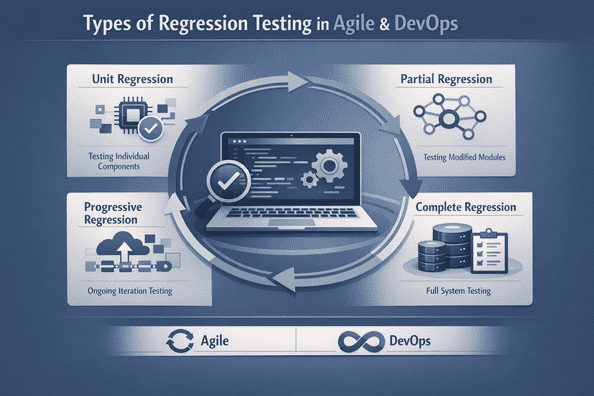
Managing multi-module applications presents unique challenges for QA teams. I’ve observed that as systems grow in complexity, even minor changes in one module can unintentionally affect others. In production environments, this often leads to late-stage defects and last-minute hotfixes - unless teams implement types of regression testing strategically.
Through analyzing several production workflows, it’s clear that effective regression strategies aren’t about testing everything equally - they’re about optimizing testing focus based on risk, history, and inter-module dependencies. Teams that approach regression testing pragmatically catch more critical defects while keeping release cycles efficient.
Why Optimization Matters
In large, multi-module systems, running the full regression suite for every change can take hours or even days. Teams I’ve observed often have strict deadlines, and running unnecessary tests can slow down releases. Optimizing types of regression testing ensures that:
- High-risk areas are validated first
- Critical business logic remains stable
- QA teams maintain efficiency without sacrificing software quality
- Defect detection remains high even in complex applications
Lessons from Real-World Production Workflows
1. Map Inter-Module Dependencies
One recurring pattern is that QA teams start by mapping module dependencies. Changes in one module often ripple across others. By understanding these relationships, teams can decide where selective regression testing is sufficient and where complete regression is necessary. This targeted approach significantly reduces wasted test runs while ensuring critical paths remain validated.
2. Prioritize Regression Based on Risk and History
Observing production teams, prioritization often relies on historical defect trends. Modules with frequent past defects are tested first, while stable modules with minimal recent changes may only undergo selective or automated regression. This approach aligns testing effort with actual risk, improving defect detection rates in production.
3. Combine Types of Regression Testing Strategically
In practice, teams employ multiple types of regression testing based on release context:
- Selective Regression: Focuses on modules affected by recent code changes
- Complete Regression: Applied before major releases or when dependencies are complex
- Automated Regression: Covers stable, high-impact workflows to free QA bandwidth for exploratory testing
This hybrid approach ensures that every release maintains software quality without overwhelming the QA team.
4. Integrate Regression Testing Into CI/CD Pipelines
Automation frameworks integrated into CI/CD pipelines allow teams to run the right type of regression at the right time. I’ve observed that production teams using this approach detect defects almost immediately after code commits, reducing late-stage surprises and improving release confidence.
5. Monitor Test Effectiveness and Update Regularly
Even optimized regression suites can become outdated. Production teams that regularly review test coverage, remove redundant tests, and update scripts based on new module changes maintain high defect detection rates over time. Metrics like test failure trends and coverage reports are essential for guiding optimization efforts.
Real-World Example
A multi-module SaaS application I analyzed had overlapping releases for several teams. The QA team implemented an optimized regression strategy:
- Selective regression for modules affected by minor changes
- Complete regression before major feature releases
- Automated regression for high-impact, stable workflows
- CI/CD integration to run prioritized tests automatically
The outcome: critical production defects dropped by 60%, release cycles stayed on schedule, and QA efficiency increased significantly. The optimization allowed the team to focus testing effort where it mattered most, rather than testing everything uniformly.
Key Takeaways
- Map inter-module dependencies to guide regression strategy
- Prioritize modules based on risk and historical defects
- Use selective, complete, and automated regression strategically
- Integrate regression tests into CI/CD for immediate feedback
- Review and update test suites regularly to maintain effectiveness
Observing production teams consistently reinforces this insight: optimizing types of regression testing in multi-module applications isn’t just about saving time - it’s about focusing resources where they prevent the most critical defects and maintain high software quality.
 Spanish
 English
 Arabic
 French
 Portuguese
 Deutsch
 Turkish
 Dutch
Dutch
 Italiano
 Russian
 Romaian
 Portuguese (Brazil)
 Greek
Greek
