


 Pro Benefits
 About
About
 Términos
 Privacidad
 Child Safety & Protection
 Notificaciones
 Ayrush Global It Services Pvt Ltd
Event Shuttle Software: Reduce Costs, Delays & Risks
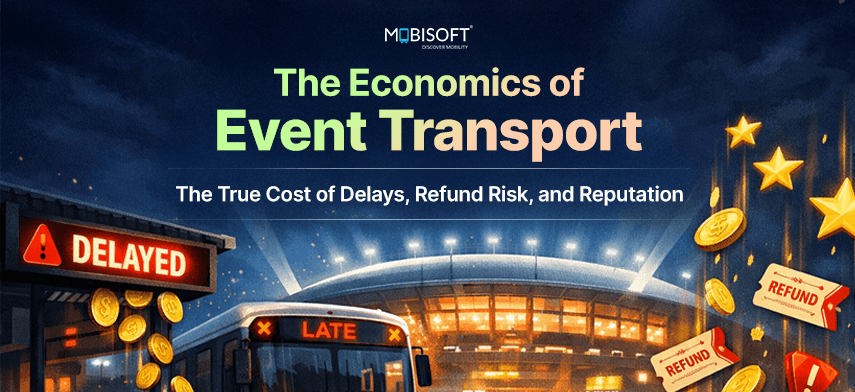
Every event has a detailed, line-itemed, and carefully negotiated budget. Each category, including the venue, catering, AV, content, and marketing, gets its allocation, its vendor, and its approval chain. And then there's transport. Usually added late, usually priced on the lowest workable quote, and almost always treated as part of the event that simply needs to get people there through effective event transportation management.
That framing is costing event organizations far more than they realize, especially when the event logistics cost is underestimated.
When transport goes wrong, it doesn't stay contained to a dispatch schedule or a fleet report. It bleeds into session attendance figures, sponsor activation windows, exhibitor lead volumes, and post-event satisfaction scores. It surfaces in refund requests filed 48 hours after the event closes, impacting refund management in events. It appears in a sponsor who doesn't renew, and does not explain, "We're reviewing our events strategy."
The financial damage from a transport failure rarely appears where the failure actually occurred. That's precisely what makes it so persistently expensive and so consistently ignored, often contributing to hidden costs in logistics and gaps in operational risk management.
What follows is a financial argument, not a logistics checklist. One that ops leaders, planners, and founders need to work through before the planning cycle begins, because the organizations getting event economics right have recognized something the rest of the industry hasn't formally priced: transport is revenue infrastructure, and most events are leaving it entirely unprotected within their event logistics management approach.
Preventing these cascading disruptions depends on implementing a data-driven event transportation management software.
Why the Event Industry Misprices Transport Risk?
There's a structural problem in how most event organizations think about transport, especially in event transport planning. It has to do with how teams are built, how performance is measured, and how accountability is distributed across an event organization. In most setups, the people making transport decisions are not the same people who feel the consequences of those decisions. And that gap, seemingly administrative, is where the mispricing begins.
Transport budgets are typically owned by operations or logistics teams, often under broader transportation logistics management, with a straightforward mandate:
- Get the fleet sourced,
- Get the routes planned,
- Keep costs within the allocated line.
Success, for such teams, looks like vehicles dispatched on time and spending kept under budget. What it does not look like, because nobody has formally connected these outcomes, is attendee satisfaction scores, sponsor renewal rates, or forward ticket velocity. Those metrics live in marketing, in partnerships, in commercial. Transport never appears in their reporting either. So the financial consequences of a transport failure scatter across departments that had no hand in the transport decision, and the ops team that made the call never sees the full bill, increasing the cost of logistics operations.
This is, in organizational theory terms, a classic accountability gap. The cost is real and measurable. It simply falls outside the boundary of the team generating it.
The procurement dimension compounds this further. Most event transport is sourced the same way venue catering is sourced: on a unit price. Cost per vehicle, cost per route, cost per hour. It is a costly way to buy a service whose failure can compromise the financial outcomes of every other investment made in the event. Risk-adjusted procurement, the kind that factors in supply chain transportation cost and broader transportation cost optimization, is almost absent from how transport vendors are evaluated and contracted.
The most revealing is what the data says, or rather, what it doesn't. Consider what most post-event reporting actually captures within event management logistics:
- Session attendance rates
- Sponsor activation metrics and lead scan volumes
- F&B revenue per attendee
- Overall NPS and satisfaction scores
- Ticket rebooking and renewal intent
Transport performance appears in none of these categories as a discrete variable. There is no standard line in any major event ROI framework that attributes NPS movement, sponsor underdelivery, or session attendance shortfall to transport quality. Which means that even when transport failure is the primary driver of a poor outcome, the post-event report will log the symptom, a drop in satisfaction scores, and an exhibitor flagging low foot traffic, without ever naming the cause.
The result is:
- A planning cycle that corrects for the wrong things.
- Next year's content gets upgraded because this year's NPS dipped.
- Next year's catering budget increases because F&B feedback was poor.
- And transport stays roughly the same, since reports never flagged it, limiting operational efficiency in logistics.
For founders and strategists building event programs with serious revenue ambitions, this is crucial. You cannot manage the financial risk of a function you are not measuring. And right now, most organizations are not measuring transport at all within their event transportation management systems. Closing this visibility gap requires a connected transportation management system that links transport decisions directly to business outcomes
READ MORE: How Transport Delays Generate Compounding Operational Losses
 Spanish
 English
 Arabic
 French
 Portuguese
 Deutsch
 Turkish
 Dutch
Dutch
 Italiano
 Russian
 Romaian
 Portuguese (Brazil)
 Greek
Greek
