


 Pro Benefits
 Σχετικά
 Όρους
Όρους
 Ιδιωτικότητα
 Child Safety & Protection
 Ειδοποιήσεις
 Ayrush Global It Services Pvt Ltd
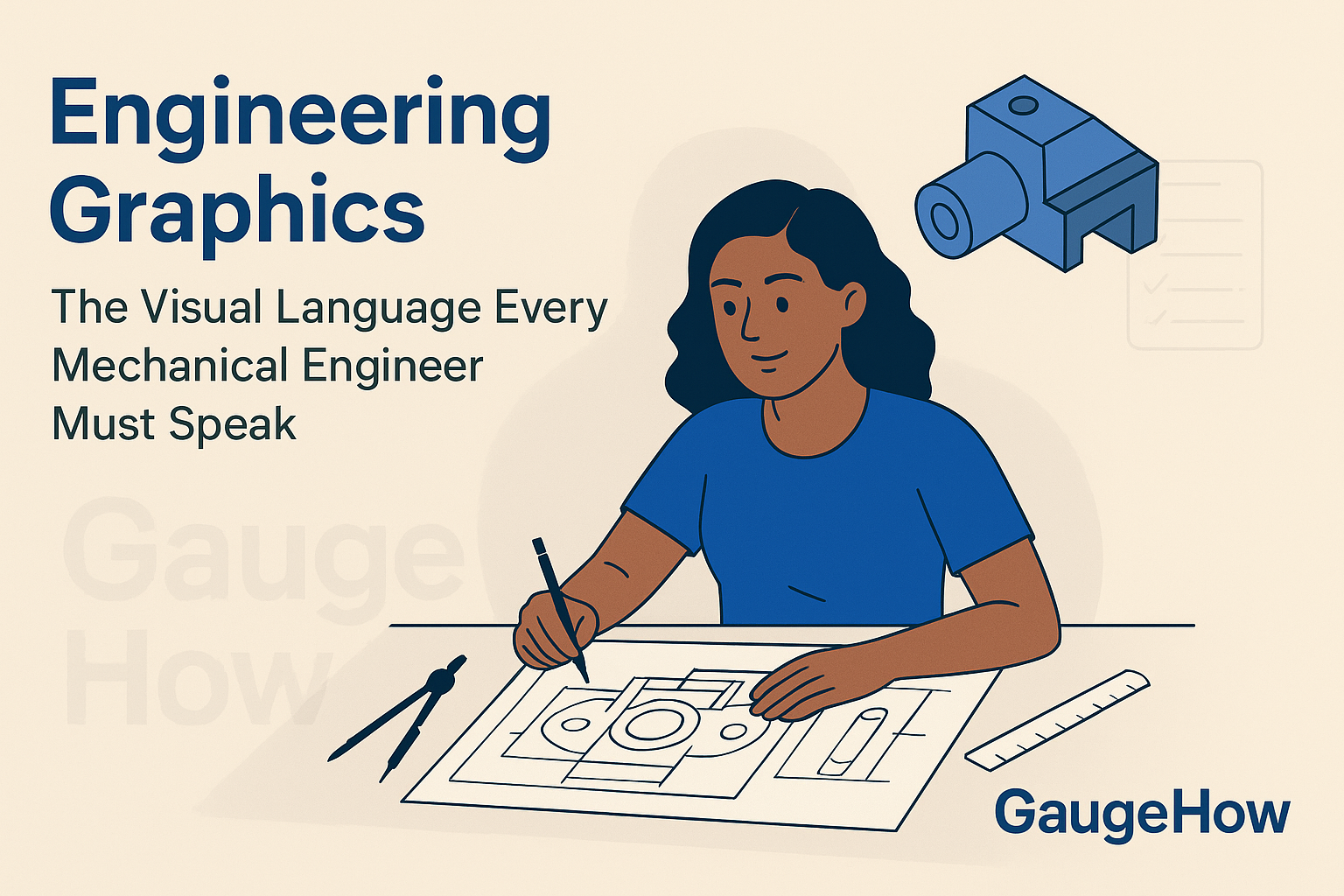
Engineering Graphics is not just dra wing lines on paper — it’s the language that turns ideas into real, buildable things. Whether you’re sketching a bracket on a napkin or modelling a gearbox in a CAD suite, strong visualization skills separate the people who imagine from the people who make. In this post we’ll explore why Engineering Graphics matters, which practical skills to focus on, and which courses and resources (including some from gaugehow) will get you job-ready fast.
Why engineering graphics matters — more than you think
Too often students treat drawing as a school task — something to be finished and forgotten. But think about it: the first step in any design process is communicating intent. A poor drawing = misinterpretation = manufacturing delays = higher costs. Good engineering graphics reduces ambiguity and helps teams collaborate better across design, manufacturing and quality.
Good drawings also make your designs testable. A precise 2D detail or a clear 3D section view tells the machinist what tolerances are critical — and that’s where Geometric Dimensioning & Tolerancing (GD&T) enters the picture. Mastery of graphics + GD&T = better parts, fewer reworks.
Core skills to focus on (practical, hands-on)
- Orthographic projection & sections — read and create views so anyone can build your part.
- Dimensioning & tolerancing — not just numbers; know what matters.
- Sketching & concept visuals — fast, rough sketches help iterate early ideas.
- CAD modelling — turn sketches into parametrized models that can be simulated. For example, courses like AutoCAD for Mechanical Engineers teach the nuts-and-bolts of drafting for production.
- Reverse engineering basics — learn to capture geometry from real-world parts; check out Computer-Aided Reverse Engineering for techniques.
- Metrology & measurement — if you can measure it, you can control it — see Engineering Metrology for metrology foundations.
Practical course pathway (what to learn, and in which order)
Start with drawing fundamentals, move to CAD, then layer in measurement, GD&T and domain-specific topics:
- Begin: Engineering Drawing — learn projection, symbols, dimensioning.
- Next: AutoCAD for Mechanical Engineers — practical drafting for shop drawings.
- Parallel: Engineering Metrology — measurement tools, uncertainties, CMM basics.
- Advanced: Computer-Aided Reverse Engineering — scanning, mesh to CAD workflows.
- Bonus: Python for Mechanical Engineers — automate drawing checks, batch-rename files, process measurement data.
This path mixes manual skills, software literacy and measurement — the trinity of modern mechanical design.
Real projects that teach faster than theory
Classroom theory is fine, but the fastest learning happens when you build. Try these projects:
- Recreate a small household part (hinge, handle) in CAD from scratch, then produce a 2D drawing for manufacturing.
- Use a caliper and micrometer to measure an existing part; create a dimensional inspection report.
- Scan a simple object (phone case, bracket) and follow a reverse-engineering workflow to produce a parametric CAD model.
- Write a small Python script to parse a drawing file or automate a BOM export (this is where Python for Mechanical Engineers helps).
These projects teach the messy realities — tolerances that “won’t fit”, fillets that break drafts, and how to communicate changes fast.
How gaugehow (and similar platforms) help
Platforms like gaugehow bundle short, focused modules that let you learn by doing. Instead of a big semester course, you get micro-lessons, project assignments, and templates you can reuse. I recommend using a structured playlist: start with drawing, then AutoCAD, then metrology, and finish with a reverse-engineering capstone. If you’re strapped for time, look for lifetime-access plans so you can revisit material as tools evolve.
Tips employers actually look for
Employers rarely say “we want someone who can draw nicely.” They do say they want candidates who can reduce iteration time and cut manufacturing surprises. Show them:
- A clean set of 2D production drawings with proper tolerances.
- A CAD model with organized features and a clear history.
- Inspection reports or CMM screenshots (even small — proof counts).
- A short note about any process improvements you suggested during a project.
A portfolio beats a perfect resume every time.
Common mistakes (and how to avoid them)
- Over-dimensioning — only control what matters.
- Relying on 3D views without exploded 2D details for manufacturing.
- Ignoring datum selection — datums are the backbone of GD&T.
- Not thinking about assembly tolerances early in design.
Fix these with peer reviews: have a machinist or quality engineer glance through a drawing before finalizing it.
Where to go next — curated resource links
To start building the full skillset quickly, explore these linked resources:
- Engineering Drawing course — Engineering Drawing
- AutoCAD course — AutoCAD for Mechanical Engineers
- Reverse engineering primer — Computer-Aided Reverse Engineering
- Metrology fundamentals — Engineering Metrology
- Automating engineering tasks — Python for Mechanical Engineers
Also browse the general catalog at gaugehow for related mechanical courses and specializations.
Final thoughts — make it real, make it measured
Engineering Graphics is the quiet skill that keeps products manufacturable, affordable, and reliable. Invest time in the basics — projection, proper dimensioning and measurement — and the rest becomes easier. Keep practising, keep a small portfolio, and use automation (Python) to remove repetitive busywork.
If you want, I can convert this into a formatted blog post for your site, or produce short social captions and a pinned CTA that links to the Engineering Drawing course — just say the word.
Details
Visit us : Deepak S. Choudhary (Founder ) Working from workspace: Incuspaze, Vijay nagar, Indore, Madhya Pradesh, India, 452001
Contact: +919685671890
Email: info@gaugehow.com
Website: https://gaugehow.com/

 English
 Arabic
 French
 Spanish
 Portuguese
 Deutsch
 Turkish
 Dutch
Dutch
 Italiano
 Russian
 Romaian
 Portuguese (Brazil)
