


 Pro Benefits
 About
About
 Termini e Condizioni
 Privacy
 Child Safety & Protection
 Notifiche
 Ayrush Global It Services Pvt Ltd
Operational Mechanics Behind AI Trading Agents in Live Markets
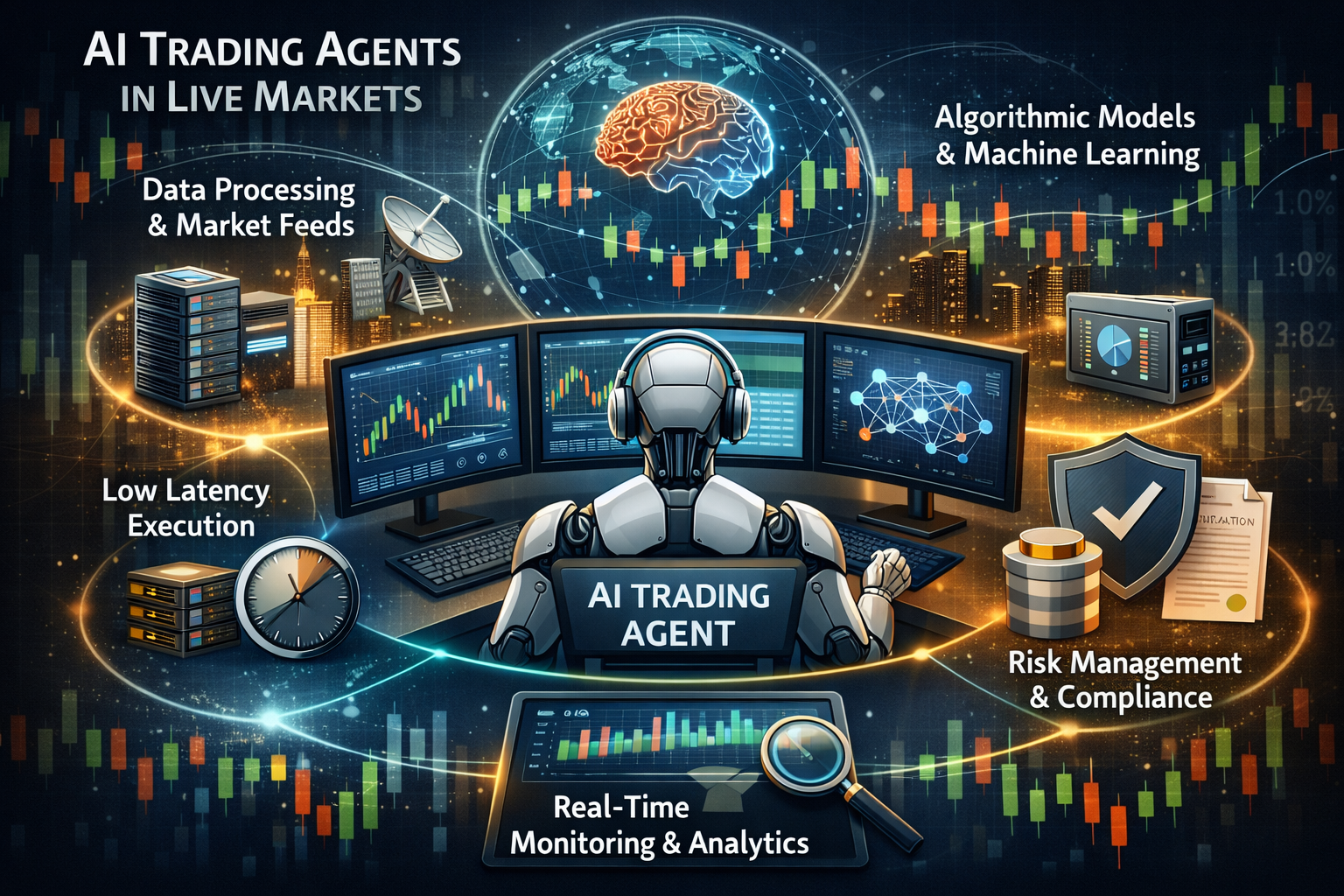
Artificial intelligence has redefined the mechanics of financial markets, transforming traditional trading desks into algorithmically driven ecosystems. At the center of this evolution lies AI Trading Agent Development, a discipline that combines quantitative finance, distributed systems engineering, and advanced machine learning. Modern trading agents no longer execute simple rule-based strategies; they interpret streaming data, adapt to volatility, and manage risk in real time. Understanding the operational mechanics behind these agents is essential for organizations seeking to deploy reliable, compliant, and high-performance systems in live market environments.
Foundations of Intelligent Trading Agent Architectures in Live Markets
The architecture of an intelligent trading agent is typically modular, layered, and event-driven. In AI Trading Agent Development, system designers decompose functionality into discrete components that interact through well-defined interfaces. This separation ensures maintainability, scalability, and fault tolerance under live trading conditions.
At a high level, a trading agent architecture includes:
-
Market data ingestion modules
-
Signal generation and feature extraction layers
-
Decision engines powered by predictive models
-
Order management and execution subsystems
-
Risk control and monitoring services
Each module must operate under strict latency constraints. Market microstructure dynamics, including bid-ask spreads and order book depth, require agents to process information in milliseconds or microseconds, depending on the asset class.
Architecturally, most production systems adopt microservices or service-oriented designs. Components communicate via message queues or streaming frameworks, ensuring asynchronous processing and resilience. Fault isolation is critical. If a predictive model fails, it must not compromise order routing or compliance logging.
Another foundational consideration is determinism. For auditability, trading decisions should be reproducible given identical data inputs. This requirement influences logging strategies, model versioning, and data retention policies.
Data Engineering Pipelines for Real Time Decisions in Market Exchanges
Trading agents depend on robust data engineering pipelines. In live markets, data is heterogeneous, high-frequency, and often noisy. The quality of downstream decisions is directly proportional to the integrity of upstream data handling.
A typical pipeline consists of:
-
Real-time ingestion of market feeds
-
Data normalization across exchanges
-
Feature computation and transformation
-
Storage in low-latency data stores
-
Archival for historical backtesting
Market feeds may include tick-level price updates, order book snapshots, and trade confirmations. These streams must be cleaned to remove anomalies such as out-of-sequence messages or duplicate ticks.
Feature engineering is equally critical. Trading agents compute derived metrics such as:
-
Moving averages and volatility measures
-
Order imbalance ratios
-
Liquidity metrics
-
Momentum indicators
Latency-sensitive features are often computed in memory using stream processing engines. Less time-critical analytics may be processed in batch mode for model retraining.
In many organizations offering AI agent development services, the emphasis is placed on building resilient pipelines that can handle feed interruptions and exchange-level outages. Redundancy mechanisms, such as secondary data providers and failover nodes, are essential for operational continuity.
Finally, data lineage tracking ensures transparency. Every model input must be traceable to its original source, enabling post-trade analysis and regulatory audits.
Model Training, Validation, and Continuous Learning Frameworks
Predictive modeling is the analytical core of intelligent trading systems. However, model development in financial markets differs significantly from other domains due to non-stationarity and adversarial dynamics.
The training lifecycle typically includes:
-
Historical data collection and labeling
-
Feature selection and dimensionality reduction
-
Model selection and hyperparameter tuning
-
Cross-validation with walk-forward analysis
-
Stress testing under simulated market shocks
Common modeling approaches include supervised learning for price prediction, reinforcement learning for policy optimization, and ensemble methods for robustness.
Walk-forward validation is particularly important. Instead of random data splits, models are trained on past windows and tested on forward periods to emulate live conditions. This approach reduces look-ahead bias and data leakage.
Continuous learning frameworks allow periodic retraining as market conditions evolve. However, blind retraining can degrade performance. Therefore, model governance processes include:
-
Performance threshold monitoring
-
Drift detection algorithms
-
Automated rollback mechanisms
In advanced AI Trading Agent Development environments, model versioning systems track parameter changes, training datasets, and evaluation metrics. This ensures reproducibility and simplifies root-cause analysis when anomalies occur.
It is also essential to decouple research environments from production systems. Research clusters may prioritize experimentation, whereas production clusters demand stability and strict change control.
Low Latency Infrastructure and Execution Algorithms Design Principles
Execution efficiency determines whether theoretical alpha translates into realized profit. Infrastructure design therefore focuses on minimizing end-to-end latency, from signal generation to order acknowledgment.
Core infrastructure components include:
-
High-performance computing nodes
-
Co-located servers near exchange data centers
-
Kernel bypass networking technologies
-
Optimized serialization protocols
Low latency is not merely about speed; it is about predictability. Jitter in execution times can result in slippage or adverse selection.
Execution algorithms, such as time-weighted average price and volume-weighted average price strategies, are often embedded within the trading agent. More advanced systems dynamically adjust execution tactics based on liquidity conditions and order book depth.
Design principles typically include:
-
Event-driven processing to reduce blocking calls
-
In-memory data grids for rapid access
-
Parallelized computations using multi-threading
-
Deterministic state management
Monitoring tools continuously measure round-trip times and reject rates. When thresholds are exceeded, alerts trigger automated throttling or circuit breakers.
In the context of AI stock trading software development, infrastructure must also integrate seamlessly with brokerage APIs, clearing systems, and post-trade reconciliation modules. Robust API abstraction layers prevent vendor lock-in and simplify system evolution.
Risk Management Logic Embedded in Autonomous Agent Systems Design
Risk management is not an external overlay but an embedded component of autonomous trading agents. Every decision must be filtered through pre-trade, intra-trade, and post-trade risk controls.
Key risk control mechanisms include:
-
Position limits per instrument and portfolio
-
Maximum drawdown constraints
-
Value at risk thresholds
-
Exposure caps across correlated assets
Pre-trade checks validate order size, margin availability, and compliance rules before submission. Intra-trade controls monitor open positions in real time, ensuring that evolving exposures remain within defined tolerances.
Autonomous agents also incorporate dynamic risk adjustments. For example, volatility spikes may trigger automatic position scaling or temporary suspension of certain strategies.
Risk logic is typically implemented as a separate but tightly integrated service. This separation allows independent updates without modifying core trading algorithms. Nevertheless, communication between the decision engine and risk module must be low latency and highly reliable.
Stress testing frameworks simulate extreme scenarios, such as flash crashes or liquidity freezes. These simulations evaluate how agents respond under abnormal conditions and whether built-in safeguards activate as intended.
Comprehensive logging is indispensable. Every risk check, override, and exception must be recorded for audit trails and forensic analysis.
Regulatory Constraints and Compliance Monitoring Layers in Trading
Financial markets operate under stringent regulatory regimes. Autonomous trading systems must therefore integrate compliance monitoring into their operational fabric.
Regulatory considerations typically include:
-
Market abuse prevention rules
-
Order-to-trade ratio limits
-
Best execution obligations
-
Record-keeping requirements
Compliance layers monitor trading patterns for suspicious behavior, such as spoofing or layering. Real-time surveillance algorithms flag anomalies and may automatically suspend trading activity pending review.
Order throttling mechanisms ensure adherence to exchange-specific limits. These mechanisms prevent excessive message rates that could violate market rules.
Auditability is paramount. Systems must store:
-
Time-stamped order logs
-
Decision rationale metadata
-
Communication records with brokers
Change management processes further ensure that updates to algorithms undergo documented review and approval cycles.
Cross-border trading introduces additional complexity, as different jurisdictions impose distinct reporting standards. Therefore, compliance modules often include configurable rule engines capable of adapting to regional requirements without major architectural changes.
Human Oversight, Control Loops, and Governance Models Frameworks
Despite high levels of automation, human oversight remains essential. Governance frameworks define the boundaries within which trading agents operate and establish escalation protocols.
Operational control loops typically involve:
-
Real-time dashboards for performance monitoring
-
Manual override capabilities
-
Incident response workflows
-
Periodic strategy reviews
Human operators monitor key metrics such as profit and loss, drawdown, latency, and risk exposure. If anomalies arise, they can disable specific strategies or the entire trading system.
Governance models also address ethical considerations and accountability. Clear documentation of model assumptions, data sources, and risk parameters reduces ambiguity regarding responsibility.
Segregation of duties is another common practice. For example:
-
Quantitative researchers develop models
-
Engineers deploy and maintain infrastructure
-
Risk officers approve parameter thresholds
-
Compliance teams monitor regulatory adherence
This structured separation reduces conflicts of interest and enhances operational integrity.
Training programs ensure that personnel understand both technical and financial dimensions of the system. Without domain literacy, effective oversight is impossible.
Scalability Challenges and Distributed Deployment Strategies
As trading volumes grow and strategies diversify, scalability becomes a central concern. Systems must handle increasing data throughput without sacrificing performance.
Distributed deployment strategies typically rely on:
-
Container orchestration platforms
-
Horizontal scaling of microservices
-
Load balancing across compute nodes
-
Geographic redundancy
Elastic scaling allows additional compute resources to be provisioned during periods of high market activity. Conversely, resources can be reduced during off-peak hours to optimize cost efficiency.
State synchronization across distributed nodes presents challenges. Consistency models must ensure that all components operate on coherent data snapshots, particularly when managing portfolio-wide risk metrics.
Latency-sensitive components are often deployed closer to exchanges, while analytics and reporting modules may reside in centralized data centers. This hybrid topology balances speed with manageability.
In mature AI Trading Agent Development ecosystems, observability tools aggregate logs, metrics, and traces across distributed environments. These tools facilitate rapid diagnosis of bottlenecks and failures.
Capacity planning exercises simulate projected growth scenarios. By modeling increased order flow and data rates, architects can identify infrastructure constraints before they impact live trading.
Conclusion
The operational mechanics of intelligent trading agents extend far beyond algorithmic signal generation. They encompass architecture design, data engineering, model governance, infrastructure optimization, embedded risk controls, regulatory compliance, human oversight, and distributed scalability. Each layer must function cohesively under strict latency and reliability constraints. When these components are thoughtfully engineered and continuously monitored, autonomous trading systems can operate with precision and resilience in dynamic market environments. A comprehensive understanding of these mechanics is indispensable for building robust, transparent, and accountable trading technologies.
 Italiano
 English
 Arabic
 French
 Spanish
 Portuguese
 Deutsch
 Turkish
 Dutch
Dutch
 Russian
 Romaian
 Portuguese (Brazil)
 Greek
Greek
