


 Pro Benefits
 About
About
 Termeni
 Confidențialitate
 Child Safety & Protection
 Notificări
 Ayrush Global It Services Pvt Ltd
What Are Salary Ranges? Definition, Meaning, and Examples
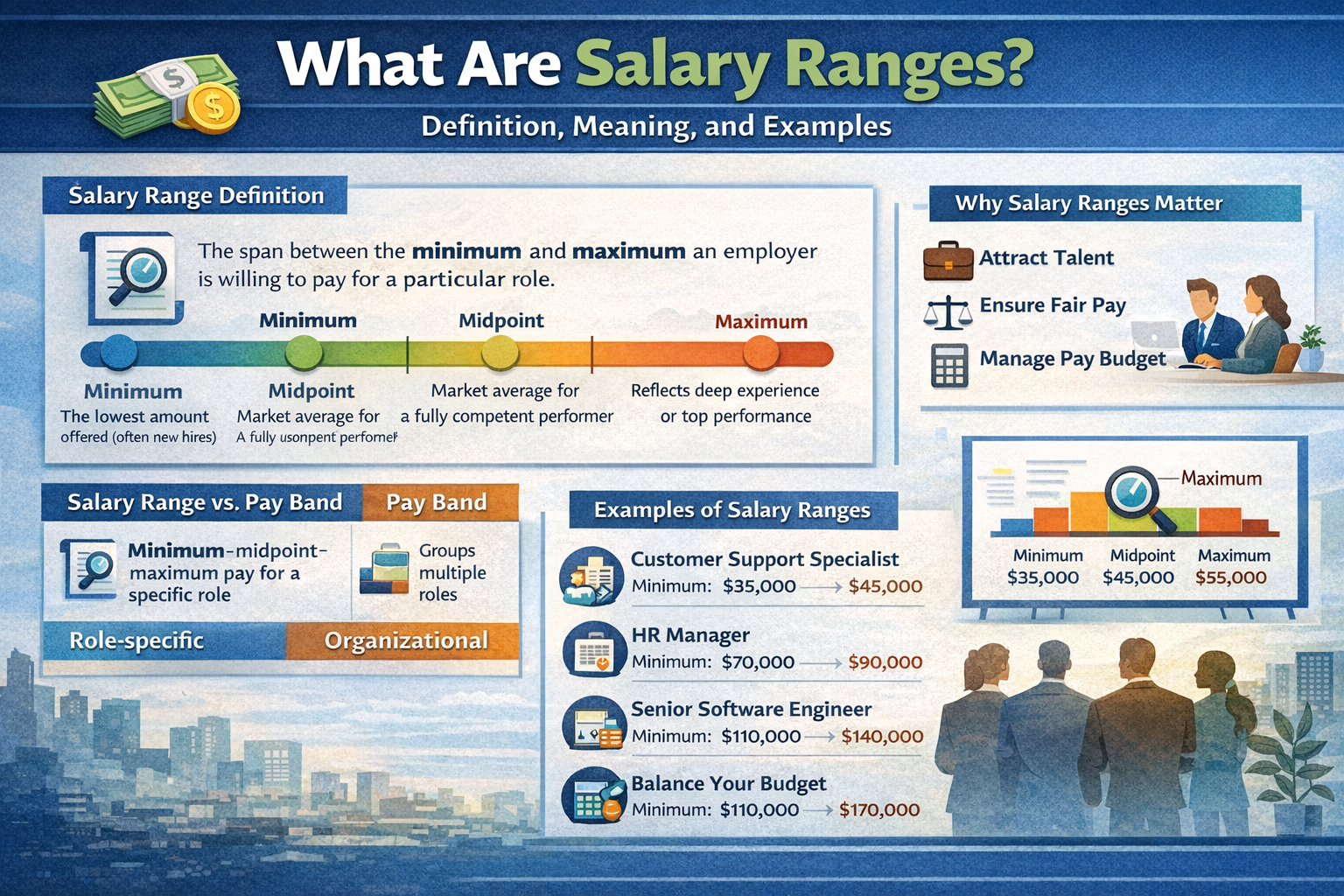
Salary ranges are one of the most important yet often misunderstood aspects of compensation. Whether you are a job seeker evaluating an offer, a first-time manager setting pay for a new hire, or a small business owner trying to stay competitive, understanding how salary ranges work can help you make smarter financial decisions.
In simple terms, a salary range defines the minimum and maximum amount an organization is willing to pay for a specific role. It provides a structured framework that ensures fairness, consistency, and alignment with market expectations. But salary ranges are more than just numbers, they reflect how companies value work, compete for talent, and manage their budgets effectively.
This guide explains salary ranges in clear, jargon-free language, with practical examples to help you fully understand the concept.
What Is a Salary Range?
A salary range is the span between the lowest and highest pay offered for a particular job within an organization. It establishes a structured compensation boundary to guide hiring decisions, promotions, and performance-based pay adjustments.
According to TalentHR (2025), salary ranges function as a reflection of how organizations value work, compete for talent, and manage their financial resources. In other words, they serve both strategic and operational purposes.
Every salary range includes three core anchor points that define the pay structure.
The Three Core Components of a Salary Range
Minimum Salary
The minimum salary represents the lowest amount an employer is willing to offer for a role. It is typically reserved for entry-level employees or individuals who meet basic job requirements but have limited experience.
For example, if a company sets a salary range of $40,000 to $60,000 for a junior marketing role, the minimum salary of $40,000 would likely apply to someone just starting their career.
Midpoint Salary
The midpoint is considered the market-aligned value of the role. It reflects what a fully competent employee with solid experience and consistent performance would typically earn.
Using the previous example, if the midpoint is $50,000, this amount represents the expected salary for an employee who has grown into the role and performs effectively.
Midpoints are often determined using external salary data and benchmarking tools.
Maximum Salary
The maximum salary is the highest pay level for a role. It is usually reserved for employees with deep expertise, exceptional performance, or long tenure.
In the same example, a maximum salary of $60,000 might apply to a highly experienced marketing professional who consistently delivers outstanding results.
Why Do Companies Use Salary Ranges?
Salary ranges help organizations balance fairness, competitiveness, and financial control. Without them, pay decisions can become inconsistent, leading to employee dissatisfaction and potential compliance issues.
Here are the main reasons companies rely on structured salary ranges.
Ensuring Fair Pay
Salary ranges provide a clear framework that helps employers avoid subjective or biased compensation decisions. They promote internal equity by ensuring employees in similar roles receive comparable pay.
Attracting Talent
Competitive salary ranges make job offers more attractive to candidates. In today’s job market, transparency around pay is becoming a key factor in recruitment success.
Supporting Career Growth
Salary ranges provide employees with a clear path for financial progression. As employees gain experience and improve performance, they can move within the range.
Managing Budgets
Compensation is one of the largest business expenses. Salary ranges help organizations control costs while maintaining competitive pay levels.
Salary Range vs. Pay Band: What’s the Difference?
Many people confuse salary ranges with pay bands, but they serve different purposes.
Salary Range
A salary range applies to a specific job role. It defines the minimum, midpoint, and maximum pay for that role.
For example, a software developer position might have a salary range of $80,000 to $120,000.
Pay Band
A pay band is broader and includes multiple roles or job levels within a single compensation management tier. It is used to structure overall organizational pay frameworks.
For instance, a company might have a pay band for “Professional Roles” that includes positions such as marketing specialists, HR analysts, and IT coordinators.
Key Distinction
Salary ranges focus on role-specific compensation decisions, while pay bands provide a high-level structure for organizational pay management.
Types of Salary Structures
Organizations use different approaches to design salary ranges depending on their size, industry, and workforce strategy.
Market-Based Salary Structures
Market-based structures rely heavily on external salary data. Organizations benchmark their pay against industry standards to remain competitive.
This approach is common in fast-moving industries like technology, where talent demand is high and compensation levels change frequently.
Example: A tech startup might set developer salary ranges based on current market surveys to attract skilled candidates.
Traditional Grade-Based Structures
Traditional salary structures organize roles into hierarchical pay grades. Each grade has defined salary ranges and progression steps.
This model is widely used in large corporations and public sector organizations because it provides clear career pathways and predictable compensation growth.
Example: A government agency might have structured pay grades that employees move through based on tenure and performance.
Broadband Salary Structures
Broadband structures combine multiple pay grades into fewer, wider salary bands. This approach offers more flexibility and supports flatter organizational structures.
It is popular among modern companies that prioritize agility and cross-functional collaboration.
Example: A startup might use broad salary bands to allow employees to transition between roles without complex pay adjustments.
Real-World Salary Range Examples
Understanding salary ranges becomes easier when you see practical examples.
Example 1: Entry-Level Role
Customer Support Specialist
-
Minimum: $35,000
-
Midpoint: $45,000
-
Maximum: $55,000
A new hire might start near the minimum, while experienced employees move toward the midpoint over time.
Example 2: Mid-Level Professional Role
HR Manager
-
Minimum: $70,000
-
Midpoint: $90,000
-
Maximum: $110,000
The midpoint reflects the expected salary for a fully capable HR professional managing key responsibilities.
Example 3: Senior-Level Role
Senior Software Engineer
-
Minimum: $110,000
-
Midpoint: $140,000
-
Maximum: $170,000
Top performers with specialized expertise may reach the maximum level.
How Salary Ranges Are Determined
Organizations follow a structured process to establish salary ranges.
Job Evaluation
Employers analyze job responsibilities, required skills, and organizational value to determine compensation levels.
Market Research
Companies gather data from salary surveys, industry reports, and benchmarking tools.
Internal Equity Analysis
Organizations ensure pay consistency across similar roles within the company.
Budget Considerations
Financial planning influences how wide salary ranges can be.
How Salary Ranges Benefit Job Seekers
Salary ranges are not just useful for employers, they also help job seekers make informed career decisions.
They allow candidates to:
-
Understand earning potential before applying
-
Negotiate offers confidently
-
Compare opportunities objectively
-
Plan long-term career growth
Transparent salary ranges reduce uncertainty and improve trust between employers and employees.
Common Misconceptions About Salary Ranges
Some people misunderstand how salary ranges work.
Myth: Everyone earns the midpoint
In reality, employees start at different points depending on experience, skills, and performance.
Myth: Salary ranges are fixed
Ranges are regularly updated to reflect market changes and business needs.
Myth: Maximum salary is easy to reach
Most employees do not reach the maximum unless they demonstrate exceptional performance over time.
Conclusion
Salary ranges are essential tools that help organizations manage compensation fairly and strategically. They define the boundaries of pay for a role, guide hiring decisions, support career progression, and ensure financial control.
For job seekers and employers alike, understanding salary ranges provides clarity and confidence in compensation discussions. As workplaces continue evolving toward greater transparency and fairness, salary ranges will remain a cornerstone of effective workforce management.
By learning how salary ranges work, individuals and organizations can make smarter, more informed decisions about pay, career growth, and long-term success.
 Romaian
 English
 Arabic
 French
 Spanish
 Portuguese
 Deutsch
 Turkish
 Dutch
Dutch
 Italiano
 Russian
 Portuguese (Brazil)
 Greek
Greek
