


 Pro Benefits
 About
About
 Voorwaarden
 Privacy
 Child Safety & Protection
 Meldingen
 Ayrush Global It Services Pvt Ltd
Why Institutions Must Simplify Admissions Workflow to Stay Competitive
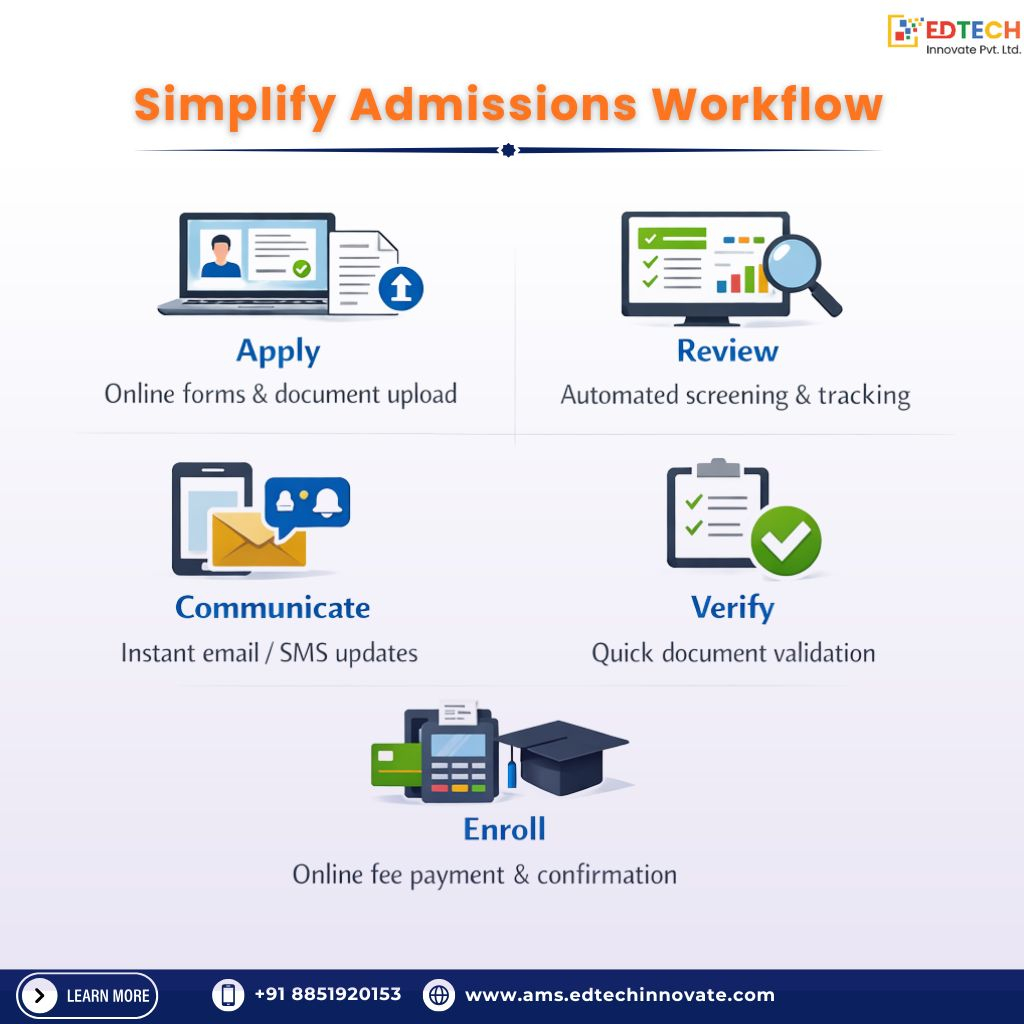
In 2026 and beyond, competitiveness in education will be shaped as much by operational intelligence as by academic distinction. Institutions that continue to treat admissions as a routine administrative cycle rather than a strategic governance function risk eroding responsiveness, compliance readiness, and enrollment stability. To simplify admissions workflow is not merely to digitize forms; it is to reengineer institutional process architecture in alignment with transparency, scalability, and data-driven leadership.
Admissions sits at the intersection of revenue forecasting, regulatory compliance, stakeholder trust, and brand positioning. As competition intensifies and digital expectations rise, simplification becomes a strategic imperative rather than a procedural upgrade.
The Competitive Landscape Has Fundamentally Changed
Educational markets have become saturated and performance-driven. Parents and students compare institutions across service quality, communication clarity, processing timelines, and digital experience. The admissions journey is often the first operational touchpoint—its structure signals institutional maturity.
Institutions relying on fragmented communication channels, manual document verification, and spreadsheet tracking inadvertently project operational fragility. By contrast, a structured Online Admission Process supported by a professionally designed Online Admission Portal reinforces credibility and discipline.
Competitive advantage today begins at the application stage.
Complexity Weakens Institutional Agility
Many institutions accumulate operational layers over time—additional approval checkpoints, separate verification sheets, email-based clarifications, parallel tracking systems. What once provided flexibility now creates inefficiency.
Manual students admission register practices and spreadsheet duplication introduce:
-
Data inconsistencies
-
Limited visibility into application status
-
Slower approval cycles
-
Increased reconciliation effort
-
Audit vulnerabilities
Workflow complexity reduces institutional agility. Leadership lacks real-time visibility. Decision-making becomes reactive. Application turnaround time increases, affecting conversion rates and student enrollment outcomes.
Simplification must therefore be positioned as process engineering—not cosmetic automation.
Governance as the Foundation of Simplification
True simplification embeds governance into workflow architecture. A structured Admission Management System introduces role-based access, approval hierarchies, audit logs, and document traceability. Each stage of evaluation—from application submission to final confirmation—operates within defined controls.
An effective admission management solution aligns with principles found in best business management software: automation, accountability, measurable performance, and dashboard visibility. The goal is not to reduce oversight but to strengthen it through structure.
Whether deployed as admissions software for schools, admissions software for private schools, or as part of a broader university admission management system, governance alignment ensures consistency across departments and campuses.
Digital Expectations Demand Professional Execution
Applicants now expect clarity, speed, and transparency. A structured Online application form with validation rules reduces incomplete submissions and documentation errors. Automated acknowledgments and status updates eliminate uncertainty.
A modern online admission software framework enables:
-
Secure document uploads
-
Automated eligibility checks
-
Centralized communication logs
-
Real-time status tracking via an admission tracker
This approach transforms perception. Parents interpret structured digital admissions management as institutional competence. Admission made easy is not about lowering standards—it is about eliminating friction through disciplined systems.
Data Intelligence as a Strategic Asset
Admissions data, when consolidated within an online enrollment management system, becomes strategic intelligence. Integrated with enterprise-grade data management software, institutions can analyze:
-
Application inflow trends
-
Geographic demand distribution
-
Conversion ratios by program
-
Scholarship allocation effectiveness
-
Enrollment yield forecasting
Without structured education admissions software, forecasting remains speculative. With integrated analytics, leadership can proactively adjust seat allocation, staffing, and marketing strategies.
Student enrollment management thus shifts from reactive counting to predictive planning.
Integration Across the Institutional Ecosystem
Admissions cannot operate as a standalone module. Competitive institutions integrate admissions into a broader technology ecosystem:
-
Student Information System for academic record continuity
-
Learning Management System for onboarding and course access
-
School Accounting Software for automated fee reconciliation
-
attendance software india platforms for lifecycle tracking
An integrated online admission management system ensures data flows seamlessly from inquiry to academic onboarding. Duplicate entries are eliminated. Financial reconciliation accelerates. Compliance reporting improves.
This lifecycle continuity strengthens operational resilience and institutional coherence.
read more: What is Student Admission Software and Why Schools Need It?
Scalability: Preparing for Growth
Scalability differentiates institutions positioned for expansion from those constrained by legacy processes. A structured school admission software environment must support centralized oversight with campus-level configurability. For universities, a robust university admission management system must accommodate multiple faculties, postgraduate streams, and diverse regulatory frameworks within a unified governance model.
Scalable admissions software enables:
-
Multi-campus dashboards
-
Program-level configuration flexibility
-
Policy-based eligibility automation
-
Centralized performance metrics
Institutions that engineer scalability early avoid fragmentation during growth phases.
Regulatory Preparedness as Competitive Strength
Regulatory oversight continues to intensify. Institutions must maintain documentation integrity, quota transparency, scholarship accountability, and secure data practices.
Manual processes expose vulnerabilities. Structured Admission Management Software enforces:
-
Mandatory document checkpoints
-
Timestamped approvals
-
Immutable audit trails
-
Secure data repositories
Compliance readiness reduces risk and strengthens stakeholder confidence. In competitive environments, reputational stability becomes a differentiator.
Enhancing Leadership Oversight
Simplifying admissions workflow enhances governance visibility at the leadership level. Trustees, principals, and registrars require real-time insights into:
-
Inquiry-to-application conversion
-
Offer-to-enrollment ratios
-
Processing turnaround times
-
Program-specific demand patterns
An integrated admission tracker and centralized reporting dashboards transform admissions into a measurable performance function. Leadership can identify bottlenecks, allocate resources strategically, and respond rapidly to emerging trends.
Institutional agility is built upon visibility.
From Administrative Task to Strategic Lever
Admissions historically operated as an administrative necessity. Today, it is a strategic lever shaping financial sustainability and competitive positioning.
A structured online admission management system reduces operational burden while enhancing transparency. Integrated workflows allow institutions to experiment with new admission ideas, measure impact, and refine strategy based on evidence rather than intuition.
The alignment of digital admissions management with broader institutional planning ensures long-term resilience.
Competitive Differentiation Through Process Excellence
Process excellence communicates institutional capability. Schools and universities that deploy integrated admissions software frameworks demonstrate operational maturity. Faster response times, reduced errors, and transparent communication improve parent confidence and increase enrollment conversion rates.
Institutions that simplify admissions workflow are better positioned to:
-
Adapt to policy shifts
-
Scale across regions
-
Launch new academic programs
-
Maintain consistent service quality
Competitiveness is no longer confined to academic offerings—it extends to operational sophistication.
Future-Proofing Institutional Growth
As enrollment markets fluctuate and regulatory frameworks evolve, institutions must anticipate change rather than react to it. Structured digital infrastructure provides the flexibility required for adaptation.
The combination of:
-
Governance-driven Admission Management System architecture
-
Integrated online enrollment management system intelligence
-
Ecosystem connectivity across academic and financial platforms
-
Centralized data management software capabilities
creates institutional resilience.
Simplification ensures that operational complexity does not outpace strategic ambition.
Conclusion
In an increasingly digital and enrollment-driven education environment, institutions that fail to simplify admissions workflow risk diminished agility and competitive disadvantage. Simplification is not a superficial automation exercise—it is a governance transformation that aligns structured processes, accountability mechanisms, and data intelligence within a unified framework.
A disciplined Online Admission Process supported by an integrated Admission Management System and online enrollment management system strengthens transparency, enhances parent trust, and equips leadership with predictive insight into student enrollment dynamics. When admissions integrates seamlessly with Student Information System, Learning Management System, School Accounting Software, and related infrastructure, it evolves into a strategic institutional asset.
Institutions seeking sustained competitiveness must approach admissions reform as a leadership mandate. This is where EdTech Innovate’s Admission Management System (AMS) provides structured digital admissions management—offering scalable workflow governance, compliance-ready documentation control, and integrated data oversight within a unified platform. By aligning operational discipline with digital intelligence, institutions can simplify admissions workflow while strengthening long-term growth readiness, transparency, and market positioning in 2026 and beyond.
Frequently Asked Questions
1. Why is it strategically important to simplify admissions workflow today?
Simplifying admissions workflow strengthens institutional agility, reduces processing delays, and enhances compliance readiness. In competitive and regulated education markets, structured workflows enable faster decision-making, improved transparency, and stronger enrollment conversion outcomes.
2. How does an Admission Management System improve governance?
An Admission Management System embeds role-based permissions, approval hierarchies, audit trails, and documentation controls into the admissions lifecycle. This ensures traceability, accountability, and measurable oversight—critical for regulatory compliance and leadership reporting.
3. What is the advantage of implementing an Online Admission Process with a portal?
A structured Online Admission Process supported by an Online Admission Portal and validation-enabled Online application form reduces errors, incomplete submissions, and communication gaps. It enhances institutional professionalism while improving applicant experience.
4. How does an online enrollment management system support long-term planning?
An online enrollment management system consolidates admissions data into actionable insights. When supported by data management software, it enables student enrollment forecasting, demand analysis, and capacity planning aligned with institutional growth strategy.

 English
 Arabic
 French
 Spanish
 Portuguese
 Deutsch
 Turkish
 Italiano
 Russian
 Romaian
 Portuguese (Brazil)
 Greek
Greek
