


 Pro Benefits
 О нас
О нас
 Условия использования
 Конфиденциальность
 Child Safety & Protection
 Оповещения
 Ayrush Global It Services Pvt Ltd
BIS Certificate, License & Licence Guide in India
Introduction
In India, product quality and safety are regulated by strict national standards. To ensure compliance, businesses must obtain a BIS Certificate before manufacturing, importing, or selling certain regulated products. The process of obtaining approval is known as BIS Certification, and once approved, the manufacturer receives a BIS License (also spelled as BIS Licence). This blog explains everything you need to know about BIS approval, including the certification process, types of licenses, benefits, and documentation requirements.
What is BIS Certificate?
A BIS Certificate is an official approval issued by the Bureau of Indian Standards. It confirms that a product complies with the applicable Indian Standard (IS) and meets safety and quality requirements. The BIS Certificate allows manufacturers to use the ISI mark or CRS mark on their products, depending on the applicable certification scheme.
What is BIS Certification?
BIS Certification is the process through which products are tested and verified for compliance with Indian Standards. It ensures that products sold in India meet predefined quality and safety benchmarks.
BIS certification is mandatory for several products such as:
-
Electrical appliances
-
Electronics
-
Cement and steel
-
Automotive components
-
Household goods
Without proper BIS Certification, regulated products cannot be legally sold in India.
What is BIS License / BIS Licence?
A BIS License or BIS Licence is the authorization granted to a manufacturer after successful certification. It permits the manufacturer to apply the ISI mark or relevant compliance mark on approved products.
The terms BIS License and BIS Licence mean the same thing—the only difference is spelling (License is American English, Licence is British English).
Key Features:
-
Issued for a specific product and manufacturing unit
-
Valid for a fixed period
-
Requires renewal after expiry
-
Subject to surveillance and inspections
Holding a valid BIS License is mandatory for continued production and sale.
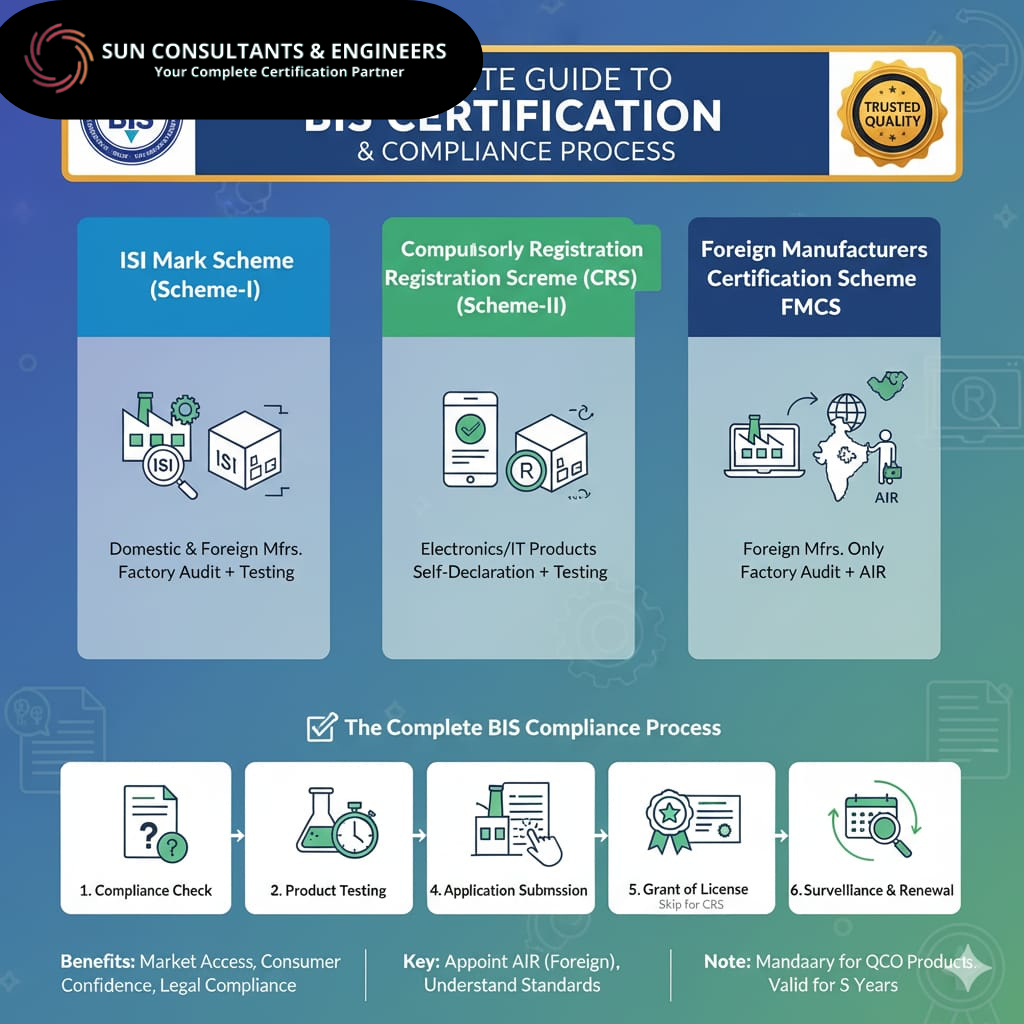
Types of BIS Certification Schemes
The BIS authority operates different certification schemes based on product type and origin.
1. ISI Mark Scheme
Applicable mainly for domestic manufacturers.
2. Compulsory Registration Scheme (CRS)
Mostly for electronics and IT products.
3. Foreign Manufacturers Certification Scheme (FMCS)
For foreign manufacturers exporting to India.
Each scheme requires compliance with relevant Indian Standards.
BIS Certification Process (Step-by-Step)
The BIS Certification process follows a structured procedure:
Step 1: Identify Applicable Standard
Check whether your product falls under mandatory certification and determine the correct Indian Standard (IS).
Step 2: Application Submission
Submit an online application along with required documents and fees.
Step 3: Product Testing
Product samples are tested in BIS-recognized laboratories.
Step 4: Factory Inspection
BIS officials may inspect the manufacturing facility to verify quality control systems.
Step 5: Grant of BIS License / BIS Licence
After successful evaluation, the BIS Certificate and license are issued.
Documents Required for BIS Certification
Proper documentation is essential for smooth approval.
Common Documents Include:
-
Application form
-
Business registration certificate
-
Manufacturing process details
-
Quality control plan
-
Product test reports
-
Factory layout
-
Trademark certificate
Incomplete documentation can delay the issuance of the BIS Certificate.
Benefits of BIS Certificate
Obtaining a BIS Certificate provides several advantages:
-
Legal permission to sell products in India
-
Improved brand credibility
-
Increased consumer trust
-
Compliance with government regulations
-
Competitive advantage in the market
BIS Certification assures customers that the product is safe, reliable, and compliant with Indian standards.
Consequences of Not Having BIS License
Selling regulated products without a valid BIS License or BIS Licence may result in:
-
Heavy penalties
-
Product seizure
-
Legal action
-
Business suspension
Therefore, obtaining proper certification is not optional—it is a legal necessity.
Common Challenges in BIS Certification
Many businesses face difficulties such as:
-
Identifying the correct Indian Standard
-
Delays in laboratory testing
-
Factory inspection issues
-
Documentation errors
Professional assistance can help streamline the certification process and reduce approval time.
Conclusion
A sunconsultants.co.in. is essential for businesses dealing with regulated products in India. Through the BIS Certification process, manufacturers can obtain a valid BIS License or BIS Licence, ensuring their products comply with Indian Standards. While the process involves multiple steps—application, testing, inspection, and approval—proper preparation and documentation make it manageable.
 Russian
 English
 Arabic
 French
 Spanish
 Portuguese
 Deutsch
 Turkish
 Dutch
Dutch
 Italiano
 Romaian
 Portuguese (Brazil)
 Greek
Greek
