


 Pro Benefits
 About
About
 Termini e Condizioni
 Privacy
 Child Safety & Protection
 Notifiche
 Ayrush Global It Services Pvt Ltd
TRQ Scheme Explained: Meaning, Benefits, and How It Works
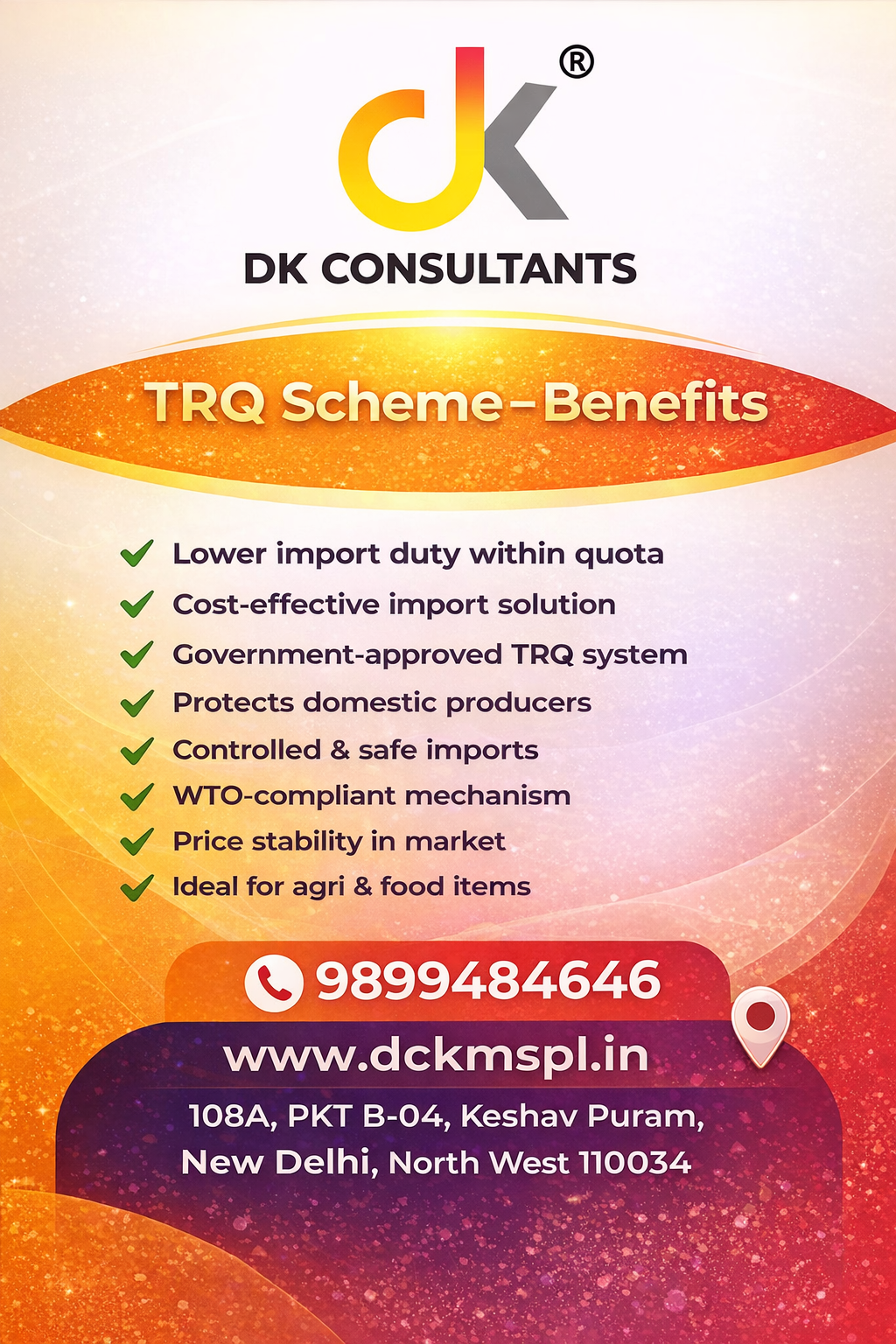
International trade plays a crucial role in the economic development of countries. To balance free trade with the protection of domestic industries, governments use various trade policy tools. One such important mechanism is the TRQ Scheme, also known as the Tariff Rate Quota system.
The TRQ Scheme is widely used across the world to regulate imports, stabilize domestic markets, and ensure fair competition between local producers and foreign suppliers. This blog explains the meaning, benefits, and working mechanism of the TRQ Scheme in a simple and comprehensive way.
What Is the TRQ Scheme?
The TRQ Scheme stands for Tariff Rate Quota Scheme. It is a trade policy instrument that combines two elements:
-
Tariffs (import duties)
-
Quotas (import quantity limits)
Under the TRQ Scheme, a certain quantity of goods can be imported at a lower tariff rate, while imports beyond that limit are charged a higher tariff rate.
In simple words, the TRQ Scheme allows limited imports at affordable duty rates, but discourages excessive imports by imposing higher tariffs once the quota is crossed.
Understanding the TRQ System
The TRQ System is designed to strike a balance between trade liberalization and domestic protection.
Instead of completely banning imports or imposing high tariffs on all imports, the TRQ System:
-
Encourages controlled imports
-
Protects local farmers and industries
-
Ensures supply stability in the domestic market
This system is commonly applied to agricultural products, food items, and sensitive goods such as dairy, sugar, grains, and meat.
What Is a Tariff Rate Quota?
A Tariff Rate Quota (TRQ) is a trade measure where:
-
Imports within the quota limit are subject to low or zero tariffs
-
Imports above the quota limit face significantly higher tariffs
For example:
A country may allow 100,000 tons of wheat imports at 5% duty. Any import above this quantity may be charged 40% duty.
This structure makes the Tariff Rate Quota an effective policy tool to regulate import volumes without completely restricting trade.
Objectives of the TRQ Scheme
The TRQ Scheme is implemented to achieve several economic and policy objectives:
1. Protect Domestic Producers
The scheme safeguards local farmers and manufacturers from sudden surges in cheap imports.
2. Ensure Market Stability
By controlling the quantity of imports, the TRQ System prevents price volatility in domestic markets.
3. Promote Fair Competition
Limited imports encourage competition while preventing unfair dumping of foreign goods.
4. Fulfill Trade Commitments
Many countries use the TRQ Scheme to comply with World Trade Organization (WTO) agreements while still protecting sensitive sectors.
How the TRQ Scheme Works
The working mechanism of the TRQ Scheme is simple yet effective:
Step 1: Fixing the Quota Limit
The government decides a specific quantity of goods that can be imported at a concessional tariff rate.
Step 2: Applying In-Quota Tariff
Imports within the fixed quota are charged a lower tariff, making them cost-effective.
Step 3: Applying Over-Quota Tariff
Once the quota is exhausted, any additional imports are charged a higher tariff, discouraging excess imports.
Step 4: Monitoring and Allocation
Authorities monitor imports and allocate quotas through licenses, auctions, or first-come-first-served methods.
Types of TRQ Allocation Methods
Different countries follow different allocation methods under the TRQ System:
1. First-Come, First-Served
Importers who apply early get access to the lower tariff quota.
2. License-Based Allocation
Import licenses are issued to eligible importers based on predefined criteria.
3. Auction Method
Quota rights are auctioned, and importers bid for access to lower tariffs.
4. Historical Allocation
Quotas are allocated based on past import performance.
Each method has its own advantages and is selected based on policy goals.
Benefits of the TRQ Scheme
The TRQ Scheme offers several advantages to governments, producers, and consumers:
1. Balanced Trade Policy
It allows controlled liberalization without harming domestic industries.
2. Consumer Welfare
Limited imports at lower tariffs help keep prices affordable for consumers.
3. Revenue Generation
Higher tariffs on over-quota imports generate government revenue.
4. Food Security
The TRQ System ensures adequate supply of essential commodities during shortages.
5. WTO Compatibility
The Tariff Rate Quota mechanism aligns with international trade rules.
TRQ Scheme and WTO
The World Trade Organization (WTO) permits the use of the TRQ Scheme, especially in agriculture. Many countries adopted the Tariff Rate Quota system after the Agreement on Agriculture (AoA) to replace non-tariff barriers.
Under WTO rules:
-
TRQs must be transparent
-
Allocation methods should be fair
-
Member countries must notify quota details
This ensures that the TRQ System is not misused for unfair trade practices.
TRQ Scheme in Agriculture
Agriculture is the most common sector where the TRQ Scheme is applied.
Examples of agricultural products under TRQ include:
-
Rice
-
Wheat
-
Sugar
-
Dairy products
-
Poultry and meat
Since agriculture is sensitive to price fluctuations and farmer income, the TRQ System helps maintain stability while meeting domestic demand.
Challenges of the TRQ Scheme
Despite its benefits, the TRQ Scheme also faces some challenges:
1. Complex Administration
Monitoring quota usage and tariff rates requires strong administrative systems.
2. Unequal Access
Small importers may struggle to obtain quota allocations.
3. Risk of Market Distortion
Improper allocation can lead to monopolies or unfair advantages.
4. Underutilization of Quotas
Sometimes quotas remain unused due to restrictive procedures.
Governments continuously refine the TRQ System to overcome these issues.
Difference Between TRQ Scheme and Simple Tariffs
|
Aspect |
TRQ Scheme |
Simple Tariff |
|
Import Control |
Quantity + Tariff |
Only Tariff |
|
Flexibility |
High |
Low |
|
Protection Level |
Moderate |
Can be very high |
|
WTO Compliance |
Yes |
Yes |
The Tariff Rate Quota approach is more flexible than a single high tariff rate.
Read More - 🌟 DCK Management: Everything You Need to Know in 2026 🌟
Importance of TRQ Scheme for Developing Countries
For developing nations, the TRQ Scheme is especially important because:
-
It protects small farmers
-
Prevents import dependency
-
Supports rural employment
-
Ensures food affordability
By carefully implementing the TRQ System, developing economies can balance growth with domestic protection.
Future of the TRQ System
As global trade evolves, the TRQ Scheme is expected to remain relevant. Governments are focusing on:
-
Digital quota management
-
Transparent allocation processes
-
Better coordination with trade partners
The future TRQ System will likely be more efficient, data-driven, and inclusive.
Conclusion
The TRQ Scheme is a powerful and practical trade policy tool that helps countries regulate imports while maintaining market stability. By combining tariffs with quotas, the Tariff Rate Quota system ensures that domestic industries are protected without completely closing the doors to international trade.
Understanding how the TRQ System works is essential for policymakers, businesses, students, and anyone interested in global trade. When implemented transparently and efficiently, the TRQ Scheme supports economic growth, consumer welfare, and fair competition.
FAQs
Q1. What is the TRQ Scheme?
The TRQ Scheme allows limited imports at low tariffs and higher tariffs beyond a fixed quota.
Q2. What is the purpose of the TRQ System?
It balances import liberalization with protection of domestic industries.
Q3. What does Tariff Rate Quota mean?
It is a system where tariff rates change based on the quantity of imports.

 English
 Arabic
 French
 Spanish
 Portuguese
 Deutsch
 Turkish
 Dutch
Dutch
 Russian
 Romaian
 Portuguese (Brazil)
 Greek
Greek
