


 Pro Benefits
 About
About
 Terms
Terms
 Privacy
 Child Safety & Protection
 Notifications
 Ayrush Global It Services Pvt Ltd
ERP Software Development vs Ready-Made ERP: What’s Better for Your Business?
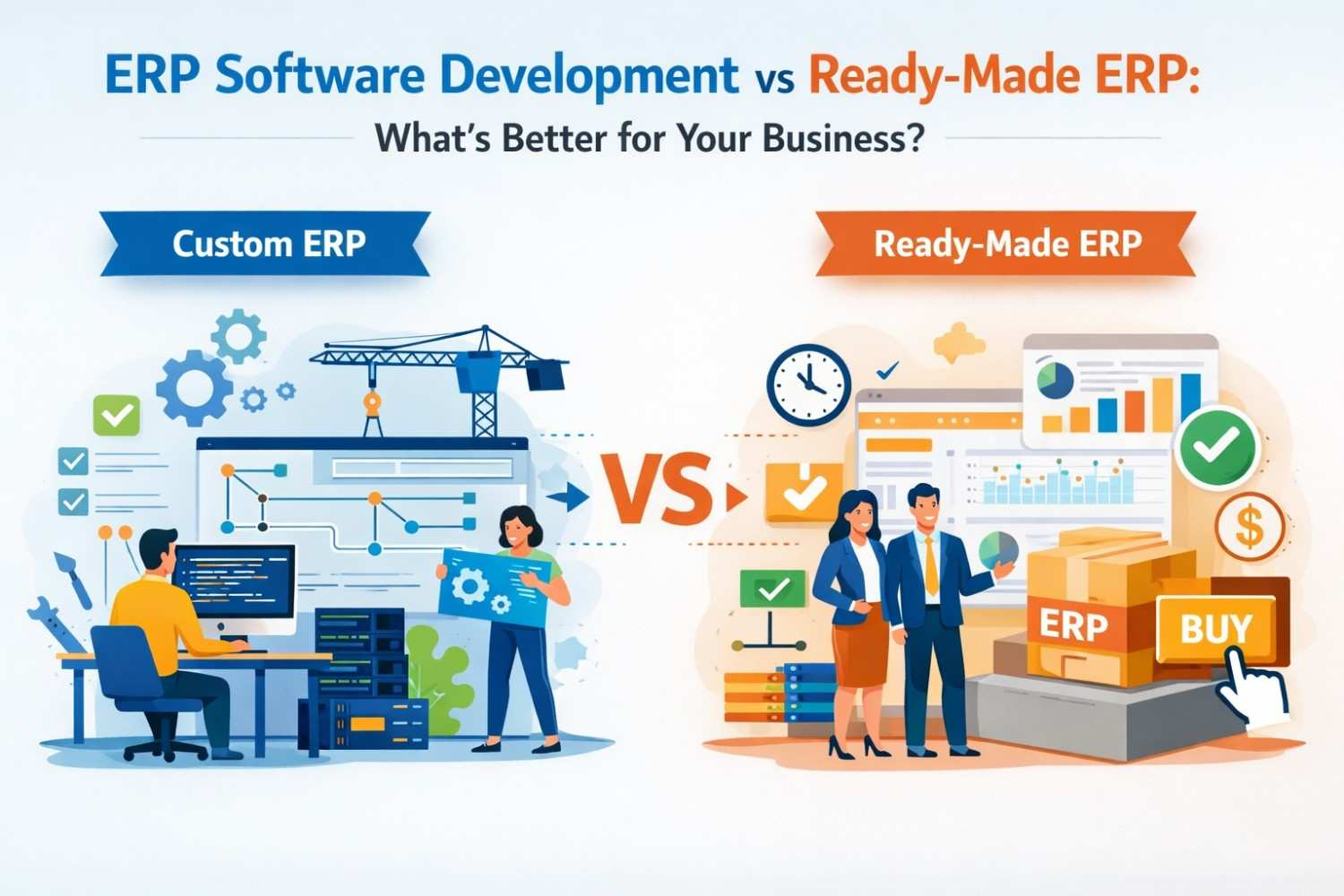
Every growing business eventually hits the same wall—systems that once felt “good enough” suddenly feel… not enough. Sales data lives in one place, finance in another, operations somewhere in between. This is usually the moment ERP enters the conversation. The real debate, however, isn’t whether an ERP system is needed, but which kind makes sense. Ready-made ERP solutions promise speed and simplicity, while custom-built options promise flexibility and control. Choosing between them isn’t just a tech decision—it’s a business philosophy decision.
Understanding ERP at a Business Level
ERP software is often described as a central nervous system for a company, and that analogy holds up surprisingly well. Finance, HR, inventory, sales, procurement, and reporting all connect through one shared platform. Instead of teams chasing spreadsheets or reconciling conflicting numbers, everyone works from a single source of truth. As organizations grow, manual coordination becomes risky and slow. ERP systems exist to reduce friction, improve visibility, and support smarter decisions. Without one, scaling operations often feels like adding floors to a building without reinforcing the foundation.
What Is Ready-Made ERP Software?
Ready-made ERP software refers to pre-built platforms designed for broad use across industries. These solutions come with standard modules, predefined workflows, and common reporting structures. Setup is typically faster because most features already exist. Vendors often market these systems as “best practice” tools, shaped by years of experience across many businesses. The appeal is obvious—install, configure, train, and move forward. For organizations with predictable processes, ready-made ERP can feel like moving into a furnished apartment instead of building a house from scratch.
Advantages of Ready-Made ERP
Speed is the biggest selling point of ready-made ERP systems. Implementation timelines are usually shorter, allowing businesses to see results faster. Initial costs are also lower compared to custom development, especially when licensing models fit the budget. These platforms are tested across thousands of users, reducing the risk of major functional gaps. Regular updates, vendor support, and compliance features add reassurance. For companies that align closely with standard business processes, ready-made ERP can deliver stability without demanding heavy internal involvement or long-term technical planning.
Limitations of Ready-Made ERP
Flexibility is where ready-made ERP systems often struggle. Processes must adapt to the software rather than the other way around, which can frustrate teams. Customization options exist but usually come with limitations or additional costs. Feature overload is another common issue—many tools go unused while critical gaps remain. As businesses grow or diversify, scaling can feel restrictive. Over time, organizations may realize they’ve invested heavily in software that solves yesterday’s problems while quietly creating tomorrow’s bottlenecks.
What Is ERP Software Development?
Custom ERP solutions are built specifically around a company’s workflows, data structures, and long-term goals. Instead of adapting operations to a predefined system, the software adapts to the business. ERP Software Development allows organizations to design modules that reflect how teams actually work, not how a vendor assumes they should. This approach requires deeper planning and collaboration but delivers a system that feels intuitive from day one. Custom ERP often becomes part of the company’s competitive advantage rather than just another operational tool.
Benefits of Custom ERP Solutions
Tailored ERP systems offer unmatched alignment with business processes. Every feature exists for a reason, supporting efficiency instead of adding complexity. Scalability is built into the architecture, making growth smoother over time. Integrations with existing tools happen naturally rather than through workarounds. Data ownership remains fully in-house, improving security and control. Over the long term, custom ERP systems often reduce operational friction and eliminate recurring licensing costs, turning technology into a strategic asset rather than a recurring expense line.
Challenges of Building a Custom ERP
Custom ERP development demands commitment. Initial costs are higher, and development timelines are longer than buying off-the-shelf software. Clear requirements are essential, as unclear goals can lead to delays or scope creep. Ongoing maintenance requires a reliable development partner or internal technical expertise. That said, these challenges are often temporary. Once the system stabilizes, businesses usually gain flexibility and control that ready-made ERP solutions rarely provide, especially in complex or rapidly evolving operational environments.
Cost Comparison: Short-Term vs Long-Term
At first glance, ready-made ERP appears cheaper. Licensing fees and faster deployment make it attractive for budget-conscious organizations. Over time, however, costs accumulate through renewals, add-ons, and customization charges. Custom ERP requires higher upfront investment but avoids recurring license expenses. Maintenance costs are predictable and aligned with actual usage. When evaluated over five to ten years, many businesses discover that custom solutions offer better financial clarity and stronger ROI, especially when operational efficiency and reduced dependency are factored in.
Scalability and Business Growth
Growth rarely follows a straight line. New markets, services, teams, and regulations introduce complexity quickly. Ready-made ERP systems scale within predefined limits, which may restrict innovation. Custom systems scale alongside the business, adapting to new requirements without structural compromises. Business ERP Software built with growth in mind supports expansion without forcing process redesigns every few years. For companies with aggressive or unpredictable growth plans, scalability often becomes the deciding factor rather than initial convenience.
Security, Compliance, and Data Ownership
ERP systems store some of the most sensitive business data—financials, customer information, payroll, and operational metrics. Ready-made ERP platforms rely on shared security frameworks designed for general use. Custom ERP allows organizations to define security rules, access controls, and compliance measures specific to their industry. Data ownership is clearer, and regulatory alignment becomes easier. For businesses operating in highly regulated environments, custom ERP often provides peace of mind that standardized platforms struggle to guarantee.
How to Decide What’s Right for Your Business
The right ERP choice depends on operational complexity, growth vision, and internal readiness. Smaller companies with standardized workflows may benefit from ready-made ERP solutions. Businesses with unique processes, integrations, or long-term scalability goals often lean toward custom development. The decision should reflect where the organization is heading, not just where it stands today. ERP selection works best when viewed as a strategic investment rather than a short-term software purchase.
A Real-World Observation
Many businesses begin with ready-made ERP because it feels safe and familiar. Over time, cracks appear—manual workarounds, unused features, frustrated teams. Eventually, the conversation shifts from “How do we make this work?” to “Why are we working around our own system?” That moment often triggers a move toward custom solutions. The lesson repeats itself across industries: software should support growth, not quietly resist it.
Conclusion
ERP systems shape how businesses operate, scale, and compete. Ready-made solutions offer speed and simplicity, while custom ERP delivers precision and adaptability. Neither option is universally better—the best choice aligns with business reality and future ambition. Thoughtful ERP decisions reduce friction, empower teams, and support sustainable growth. When software evolves alongside the organization, ERP stops being a constraint and becomes a catalyst for smarter, more confident business operations.
Frequently Asked Questions
Is custom ERP suitable for small businesses?
Yes, especially for small businesses with specialized workflows or rapid growth plans.
Can ready-made ERP be customized later?
Limited customization is possible, but deep changes often increase costs and complexity.
How long does ERP implementation usually take?
Ready-made ERP may take months, while custom ERP can take longer depending on scope.
Which ERP option offers better ROI?
Long-term ROI often favors custom ERP when scalability and efficiency matter.
How important is choosing the right ERP partner?
Extremely important, as ERP success depends on planning, execution, and ongoing support.

 Arabic
 French
 Spanish
 Portuguese
 Deutsch
 Turkish
 Dutch
Dutch
 Italiano
 Russian
 Romaian
 Portuguese (Brazil)
 Greek
Greek
