


 Pro Benefits
 Sobre
Sobre
 Termos
 Privacidade
 Notificações
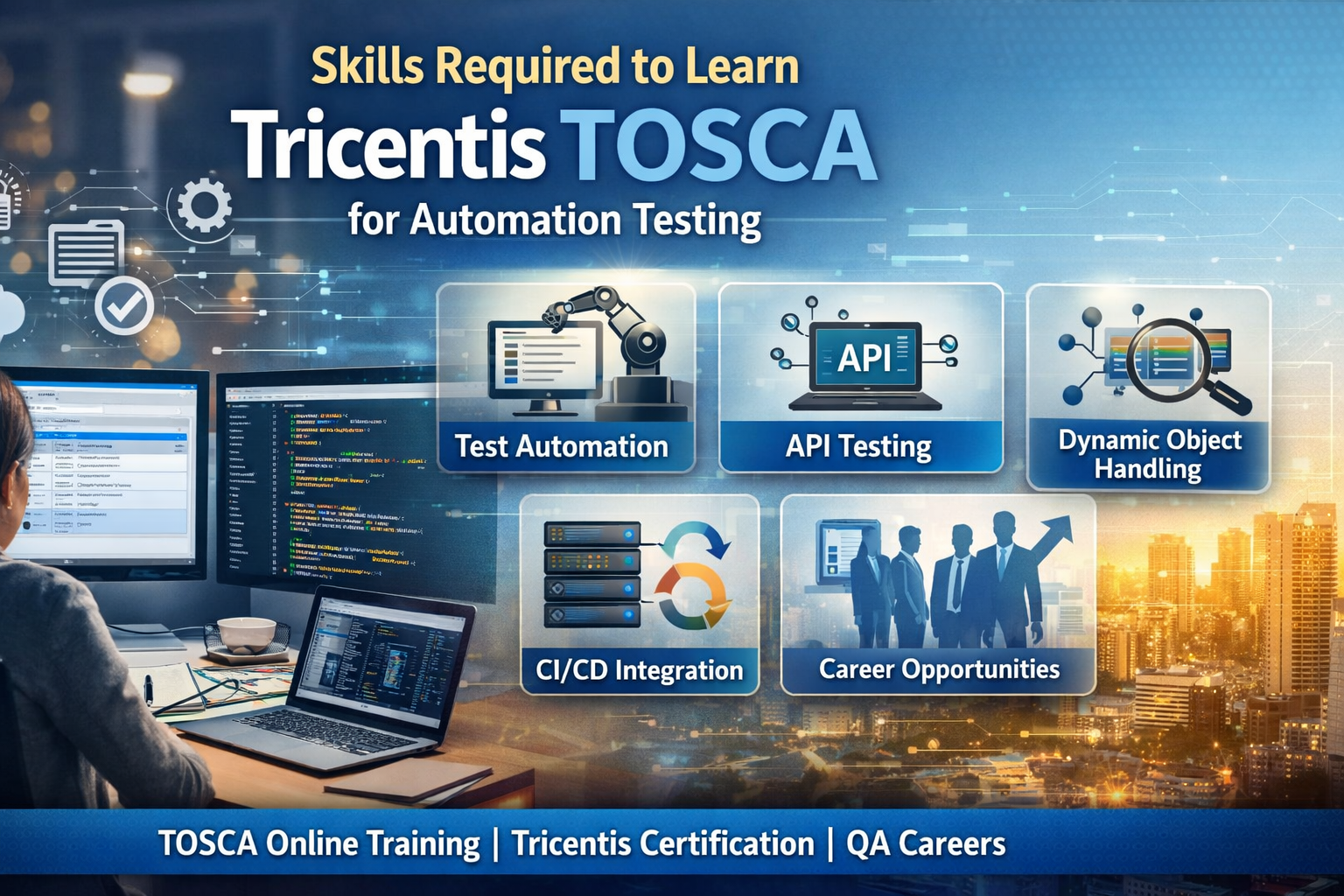
Skills Required to Learn Tricentis Tosca for Automation Testing
What is Tricentis Tosca?
Tricentis Tosca is a model-based test automation tool widely used in enterprise software testing. It enables organizations to automate end-to-end testing across applications, including web, desktop, mobile, and API interfaces. Tosca focuses on risk-based testing by providing reusable modules, dynamic object handling, and integration with CI/CD pipelines. Professionals can utilize Tricentis TOSCA Online Training to gain proficiency in its structured approach to automated testing. Tosca also supports test case design, execution, and reporting while integrating with tools such as Jira, Jenkins, and SAP.
How Does Tosca Automation Testing Work in Real-World IT Projects?
In enterprise IT projects, Tosca automation testing functions as a framework for ensuring software quality throughout the development lifecycle. The workflow typically involves:
-
Requirement Analysis: Testers identify business requirements and critical scenarios.
-
Test Case Design: Using Tosca's model-based approach, testers create modular and reusable test cases.
-
Automation Execution: Automated scripts interact with the application under test, handling dynamic objects and exceptions.
-
Reporting and Analysis: Tosca generates execution reports, highlighting defects and risk areas.
-
Continuous Integration: Test cases integrate into CI/CD pipelines for frequent execution during Agile sprints.
Tosca reduces repetitive manual testing while maintaining high coverage across complex applications, making it suitable for large-scale enterprise environments.
Why is Learning Tricentis Tosca Important for Working Professionals?
Tosca automation is increasingly sought after in software quality assurance due to its:
-
Enterprise Adoption: Widely used in banking, insurance, healthcare, and telecom sectors.
-
Efficiency: Reduces test maintenance with reusable modules and object-independent automation.
-
Integration Capabilities: Works with DevOps pipelines and ALM tools.
-
Risk-Based Testing: Prioritizes testing efforts based on business impact.
Working professionals who master Tosca can streamline testing, enhance software reliability, and improve team productivity, making them valuable contributors in IT project teams.
What Skills Are Required to Learn Tricentis Tosca?
To effectively learn Tosca, candidates should acquire a mix of technical, analytical, and soft skills. Below is a structured breakdown:
1. Basic Software Testing Knowledge
-
Understanding of SDLC and STLC phases
-
Knowledge of manual testing concepts like test cases, test suites, and defect lifecycle
-
Familiarity with testing types: functional, regression, integration, and API testing
2. Test Automation Fundamentals
-
Understanding automation principles: reusable scripts, data-driven testing, keyword-driven testing
-
Awareness of automation challenges such as flakiness, synchronization, and test maintenance
3. Tosca-Specific Technical Skills
-
Model-Based Test Automation: Creating reusable modules and components
-
Tosca Commander: Navigating Tosca’s user interface for test case design and execution
-
Dynamic Object Handling: Identifying dynamic UI elements and configuring steering parameters
-
Test Case Design Techniques: Equivalence class partitioning, boundary value analysis, decision tables
-
API and Service Testing: Basic knowledge of REST/SOAP APIs
-
Data-Driven Testing: Using external data sources like Excel, databases, or XML files
4. Scripting and Programming Knowledge
-
Understanding basic scripting concepts (VBScript or Tosca’s TBox scripting)
-
Optional: Python or Java knowledge for API integration and advanced automation scenarios
5. CI/CD and DevOps Awareness
-
Familiarity with Jenkins, Azure DevOps, or GitHub Actions
-
Understanding integration of automated tests in pipelines
-
Awareness of version control and collaboration best practices
6. Analytical and Problem-Solving Skills
-
Ability to break down complex workflows into reusable modules
-
Identifying root causes of automation failures
-
Optimizing test coverage while reducing redundancy
7. Soft Skills
-
Communication for reporting defects and collaborating with developers
-
Detail-oriented mindset to identify UI anomalies and process gaps
-
Adaptability to work in Agile or DevOps environments
How is Tosca Used in Enterprise Environments?
Tosca is commonly applied in enterprises for testing applications across multiple platforms:
|
Application Type |
Tosca Application Example |
Notes |
|
Web |
Salesforce, SAP Fiori |
Supports dynamic element handling |
|
Desktop |
SAP GUI, Windows applications |
Uses model-based test automation |
|
Mobile |
Android/iOS apps |
Integrates with Appium |
|
API |
REST/SOAP services |
Supports service virtualization and data-driven testing |
|
ERP |
SAP, Oracle EBS |
End-to-end enterprise workflow testing |
In practice, a QA team might design reusable modules for login, data entry, and report generation, then combine them into business scenario test cases. Automated execution ensures consistent validation across environments and releases.
What Job Roles Use Tosca Daily?
Tricentis Tosca skills are valuable in multiple roles within IT testing and automation:
|
Job Role |
Typical Responsibilities |
|
Test Automation Engineer |
Designs and executes automated test scripts using Tosca |
|
QA Analyst / QA Tester |
Creates reusable test cases, maintains automation suites |
|
DevOps Engineer |
Integrates Tosca tests into CI/CD pipelines |
|
Business Analyst / BA Tester |
Designs test scenarios, maps requirements to test modules |
|
Test Lead / QA Manager |
Oversees automation strategy and team performance |
What Careers Are Possible After Learning Tricentis Tosca?
Professionals who complete Tricentis TOSCA Online Training and obtain Tricentis Certification can pursue:
-
Automation Test Engineer – Designing and executing automated test scripts
-
Tosca Consultant – Implementing Tosca frameworks and advising clients
-
QA Lead / Test Lead – Managing teams and end-to-end automation strategy
-
DevOps QA Engineer – Integrating automation in CI/CD pipelines
-
Business Process Tester – Automating complex business workflows across ERP or CRM systems
These roles exist in enterprises with large-scale software projects, typically requiring proficiency in Tosca’s modular testing, reporting, and risk-based automation features.
Learning Path and Skill Mapping for Tosca
|
Skill Category |
Beginner Level |
Intermediate Level |
Advanced Level |
|
Software Testing Basics |
Manual test case creation |
Test suite design |
Risk-based testing and optimization |
|
Tosca Tool Navigation |
Tosca Commander interface |
Module creation and reusable components |
Complex workflow automation, API testing |
|
Data Handling |
Excel or CSV integration |
Database connections |
Data-driven and parameterized automation |
|
Dynamic Object Handling |
Static element identification |
Steering parameters |
Recovery scenarios for unstable UIs |
|
CI/CD Integration |
Understanding pipelines |
Integrating basic test cases |
Full DevOps pipeline integration |
|
Reporting |
Execution logs |
Detailed reports with business impact |
Metrics-driven dashboards for QA strategy |
Practical Tips for Learning Tosca
-
Start with manual testing fundamentals to understand workflows.
-
Learn Tosca Commander basics before attempting automation.
-
Practice creating reusable modules and combining them into business scenarios.
-
Explore dynamic object handling to manage frequently changing UI elements.
-
Gain exposure to API testing to broaden testing scope.
-
Integrate simple test cases into CI/CD pipelines to understand real-world deployment.
-
Participate in mock projects or sandbox environments to simulate enterprise scenarios.
Frequently Asked Questions (FAQ)
Q1: Is programming knowledge mandatory for learning Tosca?
A: No, Tosca primarily uses a model-based, low-code approach. Basic scripting knowledge (VBScript) can help with advanced automation scenarios.
Q2: Can Tosca test APIs and web services?
A: Yes, Tosca supports REST and SOAP API testing, including service virtualization and data-driven execution.
Q3: What is the difference between manual and Tosca automation testing?
A: Manual testing relies on human execution of test cases, while Tosca automates repetitive workflows using reusable modules, reducing human error and increasing efficiency.
Q4: How long does it take to learn Tosca?
A: For a working professional with testing experience, foundational skills can be acquired in 4–6 weeks, with advanced proficiency requiring 2–3 months of hands-on practice.
Q5: Which industries use Tosca most?
A: Banking, insurance, healthcare, telecom, and large-scale enterprise ERP/CRM implementations widely adopt Tosca.
Conclusion
Key Takeaways:
-
Tricentis Tosca is a model-based test automation tool for enterprise software testing.
-
Core skills include software testing fundamentals, Tosca module design, dynamic object handling, API testing, and CI/CD integration.
-
Professionals can pursue careers as automation engineers, Tosca consultants, or QA leads.
-
Hands-on practice and certification via Tricentis TOSCA Online Training enhance employability in enterprise environments.
Explore H2K Infosys courses to gain hands-on experience in Tosca automation testing and advance your career in QA and automation.

 English
 Arabic
 French
 Spanish
 Deutsch
 Turkish
 Dutch
Dutch
 Italiano
 Russian
 Romaian
 Portuguese (Brazil)
 Greek
Greek
