


 Pro Benefits
 About
About
 Términos
 Privacidad
 Notificaciones
🌟 Complete Guide to the RoSCTL Scheme – Benefits, Process, Application, and More 🚢
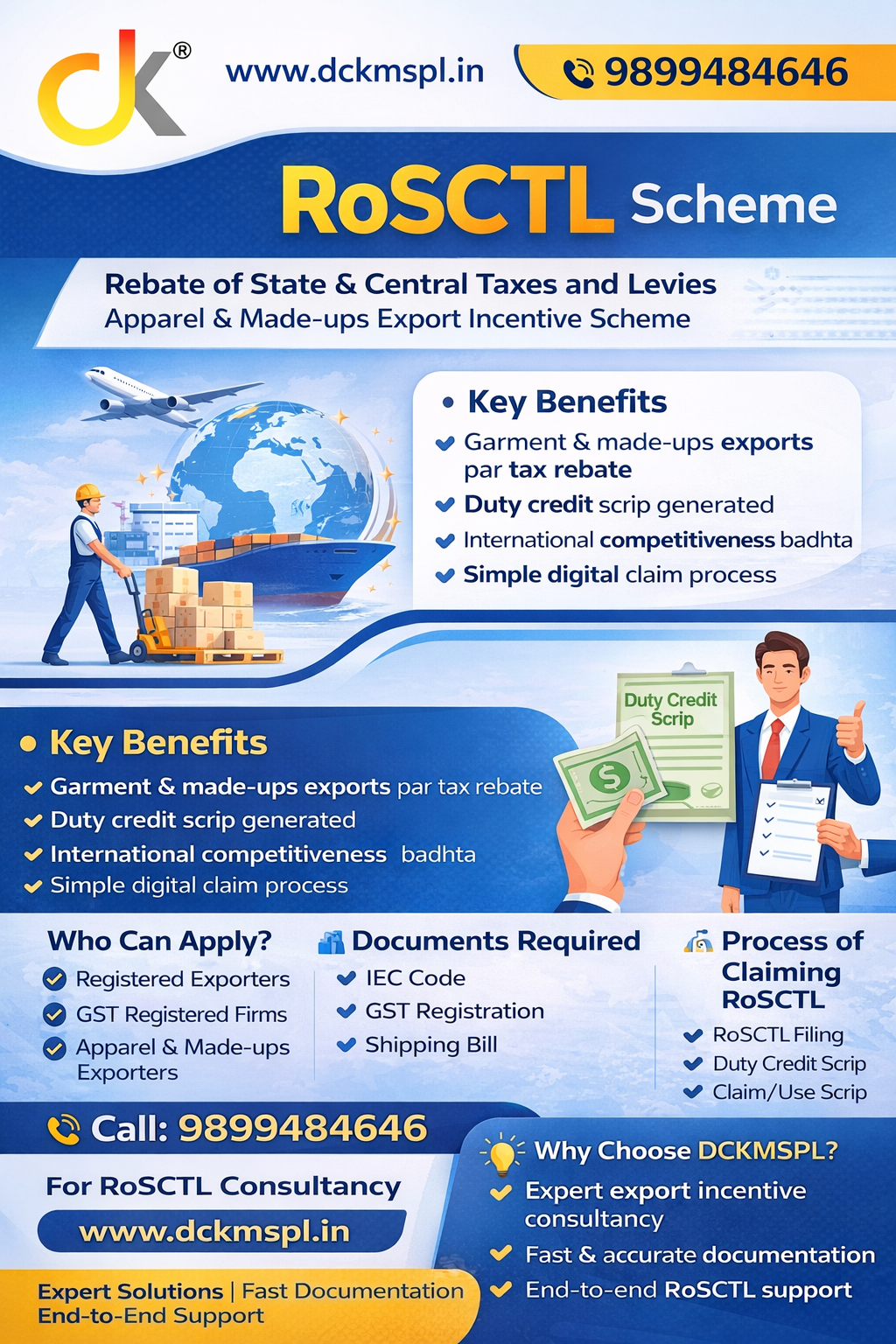
Exporters in India 🇮🇳, especially in the textile, apparel, and made-up products sectors, often look for government initiatives that help them enhance their global competitiveness. One of the most important programs for them is the RoSCTL Scheme. This comprehensive guide will explore everything about RoSCTL, including its full form, benefits, eligibility, application process, important tips, comparison with other schemes, and FAQs.
📌 What is the RoSCTL Scheme?
RoSCTL stands for Rebate of State and Central Taxes and Levies Scheme.
It is an export incentive program introduced by the Government of India to support exporters in garments, apparel, and textile made-ups. The scheme reimburses taxes and levies that are part of the manufacturing or production process but are not refunded under other tax mechanisms like GST or export benefits.
💡 The primary goal of RoSCTL is to reduce hidden costs for exporters so that Indian products can compete effectively in international markets 🌍.
🌐 Why Was RoSCTL Introduced?
The scheme was introduced to address several challenges faced by exporters:
-
🔹 High cost of production due to unrefunded taxes and levies
-
🔹 Global competitiveness of Indian textile and garment products
-
🔹 Job creation in the textile and apparel industry
-
🔹 Transparency and WTO compliance, ensuring India’s export incentives align with international rules
-
🔹 Replacement of outdated export rebate schemes
Simply put, RoSCTL allows exporters to recover embedded taxes, which helps in offering better prices globally while maintaining profitability.
📌 Products Eligible for RoSCTL
RoSCTL primarily focuses on textile, apparel, and made-up products, including:
-
👚 Garments and apparel
-
🛏 Textile made-ups, such as bed linen, curtains, towels, and sheets
-
🧵 Other finished textile products that fall under the relevant HS codes
Exporters of these products can claim rebate under the RoSCTL scheme when shipping goods internationally.
🎯 Benefits of the RoSCTL Scheme
The RoSCTL Scheme offers numerous benefits for exporters, making it a critical tool for international trade:
✅ 1. Tax Refund on Export
The scheme allows exporters to claim reimbursement for state and central taxes and levies embedded in exported products. This includes taxes on electricity, fuel, transport, and other indirect costs. By recovering these costs, exporters can enhance profit margins and maintain competitive pricing.
✅ 2. Transferable Duty Credit Scrips
Instead of cash refunds, the government provides duty credit scrips that exporters can:
-
💼 Use to pay import duties
-
🔄 Transfer or sell to other businesses
-
🏦 Utilize for cash flow flexibility
This feature adds significant flexibility for businesses, allowing them to manage their trade operations efficiently.
✅ 3. Enhanced Global Competitiveness
By reducing the burden of embedded taxes, exporters can offer products at competitive prices internationally. This strengthens India’s position as a reliable supplier of textiles and garments in global markets.
✅ 4. Extended Validity of Scrips
Once issued, the duty credit scrips under RoSCTL are valid for a considerable period, providing exporters ample time to plan their usage or sell them to other companies.
✅ 5. Boost to Employment and Industry Growth
The textile and apparel sector is one of India’s largest employers. By supporting exports, the RoSCTL scheme helps in generating employment, supporting small and medium enterprises, and promoting industrial growth.
📋 Eligibility Criteria for RoSCTL
To apply for RoSCTL benefits, exporters must meet the following conditions:
-
Exporter should be a manufacturer-exporter or a merchant exporter
-
Products shipped must fall under eligible categories (textile, garments, made-ups)
-
Export documents, such as shipping bills, must correctly indicate the RoSCTL scheme code
-
Exports must be made within the active period of the scheme
-
Taxes and levies should not have been refunded under other schemes for the same shipment
Proper documentation must be maintained to comply with government requirements.
📝 Documents Required for RoSCTL
Exporters must prepare and submit the following documents:
-
Digital Signature Certificate (DSC)
-
Importer Exporter Code (IEC)
-
Shipping bills or export documents
-
Export declaration forms
-
Registration Cum Membership Certificate (RCMC)
-
Proof of payment of eligible taxes and levies
Maintaining these documents is crucial for audits and compliance checks.
🛠️ Application Process for RoSCTL
The application process for the RoSCTL scheme is straightforward and entirely online:
✨ Step 1: Prepare Export Documentation
Ensure all export documents are accurate, including HS codes, product description, and applicable taxes or levies.
✨ Step 2: Submit Online Application via DGFT
-
Fill the online application form on the DGFT portal
-
Upload all required documents
-
Submit the application using a valid Digital Signature Certificate
Applications must be filed within the permitted period after shipment.
✨ Step 3: Receive Duty Credit Scrip
Upon approval, exporters are issued a duty credit scrip indicating the rebate amount.
✨ Step 4: Register Scrip at Customs
Register the duty credit scrip with the relevant customs office to activate it for use.
✨ Step 5: Utilize, Transfer, or Sell Scrip
Exporters can:
-
Use the scrip for paying import duties
-
Transfer it to other exporters or businesses
-
Sell it to monetize the benefit
This flexibility is a major advantage of the RoSCTL scheme.
📊 How RoSCTL Works – Example Scenario
An Indian exporter ships textiles or garments to an international market. Under the RoSCTL scheme, the exporter receives a duty credit scrip covering the embedded taxes and levies.
-
The exporter can use the scrip to pay import duties on other shipments
-
Alternatively, they can sell the scrip to other businesses, generating additional income
-
This helps reduce costs, improve cash flow, and maintain competitiveness in the global market
Read More - 🌍 RoDTEP Scheme: Rates, Guidelines, Eligibility, Features, Benefits
🆚 Comparison with Other Export Schemes
RoSCTL vs RoSL
-
RoSL only refunded state levies
-
RoSCTL refunds both state and central taxes, offering a broader benefit
RoSCTL vs MEIS
-
MEIS was withdrawn for textile and apparel sectors
-
RoSCTL replaced it and is fully WTO-compliant, avoiding trade restrictions
RoSCTL vs RoDTEP
-
RoDTEP covers a wider range of products and taxes
-
RoSCTL focuses specifically on textiles, garments, and made-ups, offering dedicated benefits to these exporters
❗ Important Points to Keep in Mind
-
Claim must be filed within the permitted time after shipment
-
Export documentation must be accurate and complete
-
Scrips have limited validity and must be used, transferred, or sold within this period
-
Exporters cannot claim the same taxes under two schemes
Following these points ensures smooth processing of applications.
🌟 Summary – Why RoSCTL Matters
The RoSCTL scheme is a game-changer for Indian exporters in textiles and apparel:
-
Reduces hidden costs and taxes
-
Increases global competitiveness
-
Encourages employment and industry growth
-
Provides flexible duty credit scrips for multiple uses
-
Aligns with global trade rules
Exporters leveraging RoSCTL can maximize efficiency, profitability, and international market presence while staying compliant with government regulations.
❓ Frequently Asked Questions (FAQs)
1️⃣ What is the full form of RoSCTL?
RoSCTL stands for Rebate of State and Central Taxes and Levies Scheme. It is an export incentive scheme that refunds indirect taxes to exporters, mainly in the textile and apparel sector.
2️⃣ Who is eligible to apply for RoSCTL?
Eligibility includes manufacturer-exporters and merchant exporters of eligible textiles, garments, and made-up products. Exporters must submit complete documentation and declare taxes under the scheme.
3️⃣ Can an exporter claim RoSCTL and other incentives together?
No. Exporters cannot claim the same taxes under multiple incentive schemes for the same shipment. Only one scheme can be used for a particular export transaction.
4️⃣ How long is a RoSCTL scrip valid?
The scrip remains valid for a considerable period, providing exporters time to plan usage or sell it.
5️⃣ What happens if documents are missing?
Incomplete or inaccurate documents can lead to rejection of the application. Maintaining proper records is mandatory for compliance and audits.

 English
 Arabic
 French
 Portuguese
 Deutsch
 Turkish
 Dutch
Dutch
 Italiano
 Russian
 Romaian
 Portuguese (Brazil)
 Greek
Greek
