


 Pro Benefits
 About
About
 Koşullar
 Gizlilik
 Child Safety & Protection
 Bildirimler
 Ayrush Global It Services Pvt Ltd
Level-Up Fast: Real Skills for Real Jobs with Mechanical Certification Courses
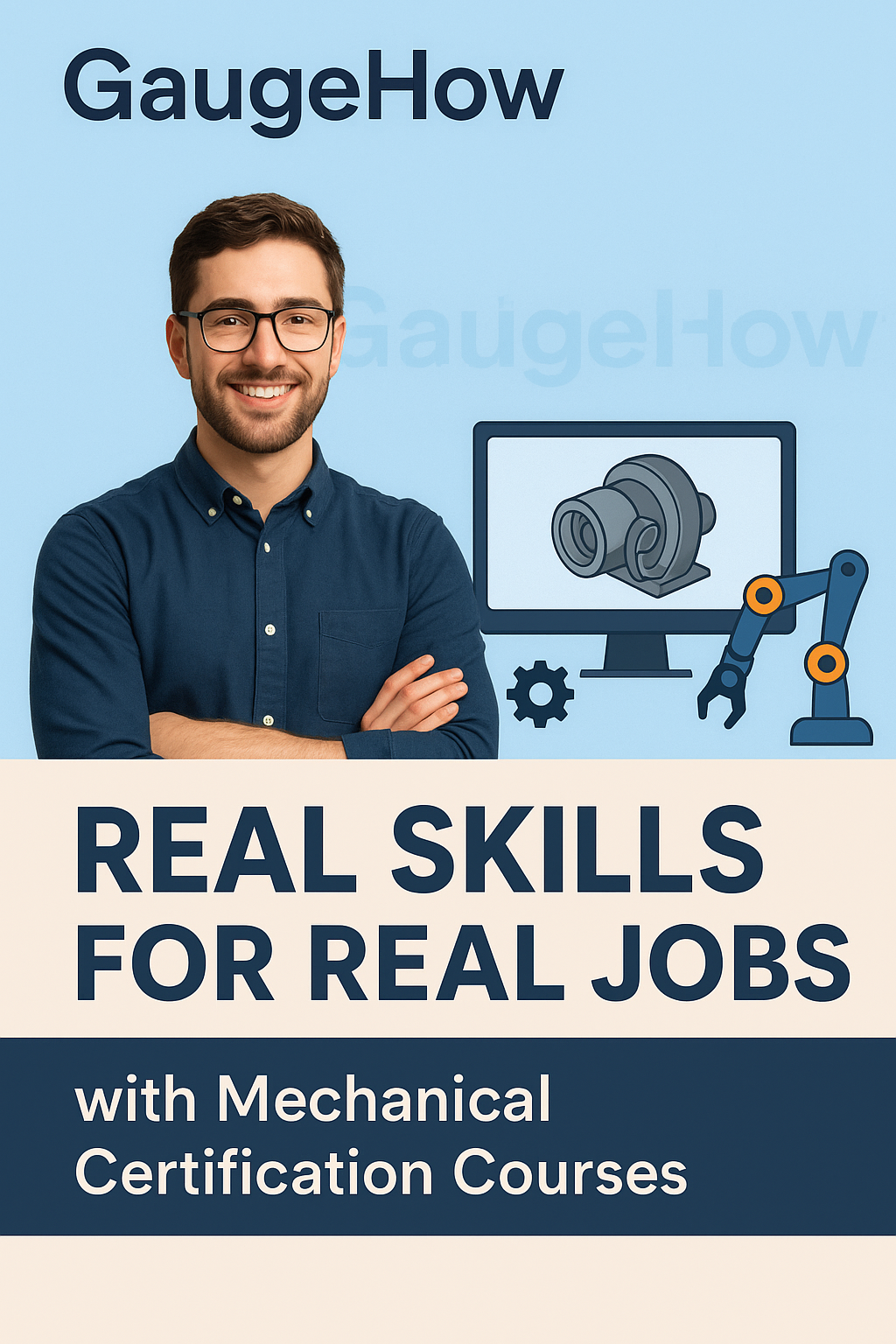
If you’re tired of theory-heavy courses that don’t prepare you for shop-floor realities, this is for you. At Gauge How we focus on skills that employers actually ask for — not just certificates. From hands-on metrology to practical coding for automation, the goal is simple: make you industry-ready, fast.
Why this matters? Because companies want people who can open a drawing, understand tolerance, run a CMM, and also write a quick script to automate a test — all in the same day. Our course mix reflects that real world need.
What you’ll get — quick snapshot
- Practical projects that mimic real industry tasks.
- Tools & workflows used in design, inspection and production.
- Mentor tips from people who hire engineers.
Core topics I want to highlight here:
First, Python for Mechanical Engineers — yes, python is no longer optional. It’s used for automation, data logging, simple robotics and even preprocessing FEA inputs. Our python course is focused on things mechanical engineers actually use — not abstract CS theory.
Second, mastering Engineering Metrology changes how you are viewed in interviews and on the floor. Knowing how to interpret measurement uncertainty, choose the right gauge, and run a CMM as per standards gives you a huge advantage. This is not just “measurement” — it’s decision making under tolerances.
Third, if you love reverse-engineering and product rediscovery, check out Computer-Aided Reverse Engineering. We teach techniques to capture geometry, clean scans, and rebuild manufacturable CAD — projects designed to simulate actual product development tasks.
And if you’re hunting for the right program, our site lists practical mechanical certification courses that are affordable and focused on job skills — see more at Gauge How. These courses are designed for entry-level engineers and students who want to stop guessing and start doing.
Interview prep — real Qs not fluff
If interviews make you nervous, we prepared a focused list of mechanical engineering interview questions and common mechanical engineering questions asked by hiring managers. These aren’t the typical generic questions — they reflect what employers test on: interpretation of drawings, tolerance stackups, root cause thinking, and basic programmatic automation.
Why choose us? A few honest reasons
- Courses built by practitioners — not “instructors” who never left the campus.
- Project based learning — you actually build things.
- Lifetime access (so you can relearn before interviews).
- Student friendly pricing — no breaking the bank.
A small note — this content is human written, no auto generated text here, and yes, we keep it a bit raw and real (so you might see small typos, or odd spacing — thats intentional, no AI polish). We want it to feel honest.
How to start
Visit Gauge How, pick the topic that matches your role — whether it’s Python for Mechanical Engineers, metrology, or reverse engineering — and jump into a project. Join a community of learners who share solutions, and get feedback from industry mentors.
Final thought — the job market rewards people who can do stuff. Theory is fine, but skill pays the bills. Learn to measure properly, code a little, and rebuild parts from scans — you’ll be surprised how quickly doors open.
Details
Visit us : Indore, Madhya Pradesh, India
Contact: +919685671890
Email: info@gaugehow.com
Website: https://gaugehow.com/

 English
 Arabic
 French
 Spanish
 Portuguese
 Deutsch
 Dutch
Dutch
 Italiano
 Russian
 Romaian
 Portuguese (Brazil)
 Greek
Greek
