


 Pro Benefits
 About
About
 Voorwaarden
 Privacy
 Child Safety & Protection
 Meldingen
 Ayrush Global It Services Pvt Ltd
How Test Automation Should Evolve With System Architecture?
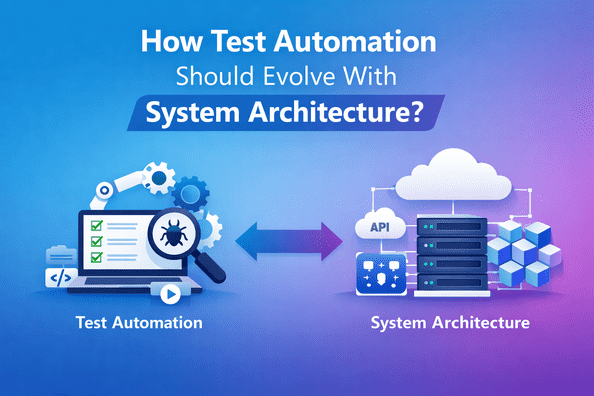
Test automation is not a one-time investment. As system architecture evolves, test automation must evolve with it—or it quickly becomes a liability instead of a quality enabler. Many teams struggle not because they lack tests, but because their automation strategy no longer matches how their systems are built and deployed.
Understanding how test automation should adapt to architectural changes is critical for maintaining confidence, speed, and reliability as software systems grow in complexity.
Why Architecture Changes Break Test Automation
Early-stage applications often start as monoliths with tightly coupled components and predictable workflows. In such environments, test automation typically focuses on UI tests or end-to-end flows that validate the system as a whole.
As systems evolve into modular monoliths, microservices, or event-driven architectures, those same tests begin to fail frequently or provide misleading feedback. Changes in one service can break unrelated tests, environments become harder to control, and execution time increases significantly.
This mismatch between architecture and test automation is one of the main reasons teams lose trust in their test suites.
Test Automation in Monolithic Architectures
In monolithic systems, test automation often emphasizes end-to-end validation. Since all functionality runs within a single deployable unit, it is feasible to validate full user journeys with fewer external dependencies.
At this stage, test automation should focus on:
-
Core business workflows
-
High-risk feature paths
-
Regression scenarios that affect multiple modules
However, even in monoliths, relying exclusively on UI-level automation creates fragility. As codebases grow, test automation needs to shift gradually toward API-level and service-level tests to maintain speed and stability.
Adapting Test Automation for Microservices
Microservices architectures fundamentally change how test automation should be designed. Each service evolves independently, with its own deployment cycle and dependencies.
In this context, test automation must become more decentralized. Instead of validating entire systems through end-to-end tests, teams focus on:
-
Service-level functional tests
-
Contract testing between services
-
Targeted integration tests for critical paths
This approach reduces flakiness and allows teams to validate changes closer to where they occur. Test automation becomes faster, more reliable, and easier to scale across teams.
Handling Dependencies and Asynchronous Systems
Modern architectures increasingly rely on asynchronous communication, message queues, and event streams. Traditional request-response testing models are often insufficient for these systems.
Test automation should evolve to validate:
-
Event production and consumption
-
Message ordering and idempotency
-
Failure handling and retries
-
System behavior under partial outages
This requires tools and frameworks that can simulate asynchronous workflows and validate system behavior over time rather than relying on immediate responses.
Shifting Left Without Shifting Blindly
As architectures mature, teams often attempt to “shift left” by adding more tests earlier in the pipeline. While this is directionally correct, adding tests without architectural alignment can slow development.
Effective test automation evolves by:
-
Running fast, deterministic tests early
-
Deferring complex integration checks to later stages
-
Using risk-based selection instead of full-suite execution
This layered approach ensures that test automation supports rapid feedback without overwhelming CI pipelines.
Aligning Test Automation With CI/CD Pipelines
Architecture evolution usually goes hand-in-hand with CI/CD adoption. Test automation must integrate seamlessly into these pipelines to remain effective.
Well-aligned test automation:
-
Runs automatically on every relevant change
-
Provides actionable feedback to developers
-
Scales execution based on pipeline stage
-
Avoids blocking deployments unnecessarily
When test automation aligns with pipeline design, it becomes a facilitator of continuous delivery rather than a bottleneck.
Keeping Test Automation Maintainable Over Time
As systems evolve, so does test automation debt. Tests written for outdated architectures often linger, increasing maintenance costs and noise.
Teams should periodically reassess their test automation strategy by:
-
Retiring tests that no longer provide value
-
Refactoring tests to match new service boundaries
-
Replacing brittle end-to-end tests with focused validations
-
Ensuring test ownership aligns with service ownership
This ongoing evolution keeps test automation relevant and sustainable.
Measuring Success Beyond Test Count
A common mistake is measuring test automation success by the number of tests or coverage percentages. As architecture evolves, these metrics lose relevance.
More meaningful indicators include:
-
Reduction in production regressions
-
Pipeline stability and execution time
-
Developer confidence in automated feedback
-
Ability to deploy changes independently
Test automation that evolves with architecture improves these outcomes, even if the total number of tests decreases.
Conclusion
Test automation should never be static. As system architecture evolves from monoliths to distributed, event-driven systems, automation strategies must adapt accordingly. Tests need to move closer to the code they validate, reflect real system behavior, and integrate seamlessly with CI/CD workflows.
When test automation evolves alongside architecture, it stops being a fragile safety net and becomes a strategic asset—enabling teams to scale delivery without sacrificing reliability or confidence.
 Dutch
Dutch
 English
 Arabic
 French
 Spanish
 Portuguese
 Deutsch
 Turkish
 Italiano
 Russian
 Romaian
 Portuguese (Brazil)
 Greek
Greek
