


 Pro Benefits
 Sobre
Sobre
 Termos
 Privacidade
How Does AI and Automation Influence the Future of Data Analysts?
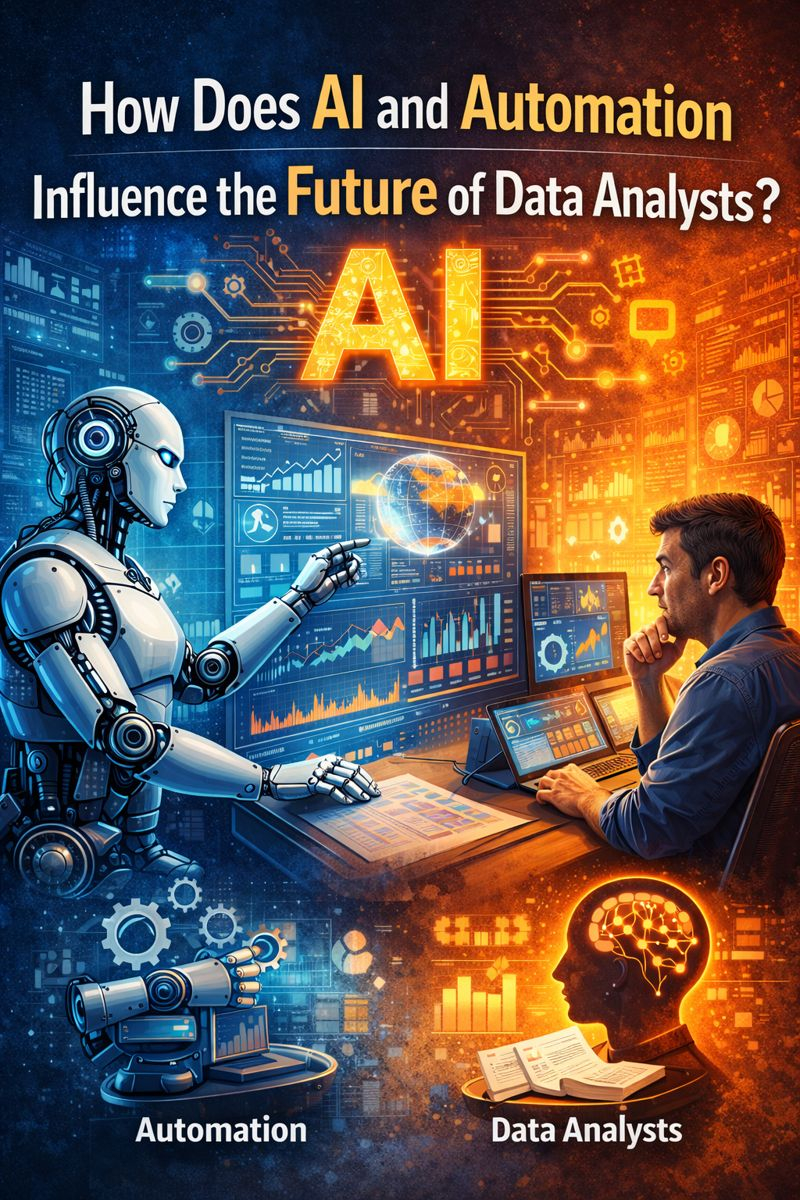
Data is growing at an unbelievable speed. Every business action, customer interaction, and digital process creates data. To handle this massive flow of information, companies are turning to artificial intelligence (AI) and automation. This shift has raised an important question: How does AI and automation influence the future of data analysts?
Many people fear that automation will replace human roles. In reality, AI is reshaping data analytics in a way that makes analysts more important, not less. This blog explains the changes in simple language, clears common doubts, and shows how data analysts can grow alongside AI.
Understanding AI and Automation in Data Analytics
AI in data analysis means using intelligent systems that can learn from data, detect patterns, and provide insights automatically. Automation focuses on handling repetitive tasks without manual effort.
Together, AI and automation help:
-
Process large datasets quickly
-
Reduce human errors
-
Deliver faster insights
They are tools designed to assist analysts, not eliminate them.
How Data Analytics Worked Before AI
Earlier, data analysts spent most of their time on manual work:
-
Collecting data from different sources
-
Cleaning and formatting raw data
-
Creating charts and reports
This process was slow and often limited by time and resources. Insights were usually descriptive, explaining what had already happened.
Automation in Data Analytics: What Has Changed?
Automation in data analytics has transformed how work gets done.
Tasks Now Handled by Automation
-
Data collection and integration
-
Data cleaning and validation
-
Scheduled reports and dashboards
-
Basic trend identification
This saves time and allows analysts to focus on deeper analysis and strategy.
The New Relationship Between Data Analysts and AI
The idea that AI will replace analysts is a misunderstanding. The real change is collaboration.
The future belongs to data analysts AI working together.
How This Partnership Works
-
AI handles speed and scale
-
Humans handle meaning and context
-
Decisions become smarter and faster
AI answers the what, while analysts explain the why and what next.
How AI Is Influencing the Role of Data Analysts
The role of a data analyst is evolving rapidly.
What Analysts Do More Now
-
Interpret AI-generated insights
-
Connect data findings with business goals
-
Communicate insights to non-technical teams
What Analysts Do Less Now
-
Manual data cleaning
-
Repetitive reporting
-
Simple calculations
This shift makes the job more strategic and impactful.
Future of Data Analysts: Evolution, Not Replacement
The future of data analysts looks promising for those willing to adapt.
Analysts are becoming:
-
Business advisors
-
Insight translators
-
Strategic decision supporters
Instead of being technical support roles, analysts are now central to business growth.
Impact of AI on Jobs in Data Analytics
The impact of AI on jobs often sounds negative, but history shows that technology usually creates new opportunities.
Roles That May Decline
-
Manual data entry roles
-
Basic reporting positions
Roles That Are Growing
-
AI-assisted data analysts
-
Analytics consultants
-
Data strategy and governance roles
Jobs are changing, not disappearing.
Read more: Will Data Analysts Be Replaced by AI? The Truth Behind the Fear
Skills Data Analysts Need in the AI Era
To stay relevant, analysts must build new skills.
Important Skills for the Future
-
Understanding AI-driven analytics tools
-
Data visualization and storytelling
-
Business and domain knowledge
-
Critical thinking and communication
The ability to explain insights clearly is becoming just as important as technical skills.
How AI Improves Decision-Making for Businesses
AI-powered analytics helps businesses move from guesswork to clarity.
Key Benefits
-
Faster access to insights
-
Predictive analysis instead of just past reports
-
More accurate and consistent results
-
Better risk identification
With AI managing complex data, analysts can focus on making confident decisions.
Is AI a Threat to Human Judgment?
AI is powerful, but it has limits.
What AI Cannot Do Well
-
Understand emotional context
-
Make ethical decisions
-
Apply human intuition
This is why human oversight remains critical. AI supports decisions but should not replace judgment.
AI Making Data Analytics More Accessible
One major influence of AI is accessibility.
With AI-powered tools:
-
Non-technical users can explore data
-
Questions can be asked in simple language
-
Insights are easier to understand
This democratization of data makes analytics useful across all departments.
Challenges of AI and Automation in Analytics
Despite the benefits, challenges exist.
Key Concerns
-
Data privacy and security
-
Bias in AI models
-
Overdependence on automation
-
Skill gaps in teams
Organizations must use AI responsibly and ensure humans remain in control.
How Data Analysts Can Prepare for the Future
Preparation is the key to success.
Practical Steps
-
Learn how AI tools work
-
Focus on problem-solving skills
-
Improve communication and storytelling
-
Stay updated with industry trends
Adaptability will define successful analysts in the future.
Human + AI: The Future Analytics Model
The future of analytics is not humans versus machines.
The Ideal Model
-
AI handles repetitive and large-scale tasks
-
Humans provide insight and direction
-
Decisions are balanced and informed
This collaboration creates stronger analytics outcomes.
Conclusion
AI and automation are reshaping data analytics, but they are not replacing human analysts. Instead, they are transforming the role into something more strategic and meaningful. Routine tasks are being automated, while human skills like critical thinking, business understanding, and communication are becoming more valuable. The collaboration between data analysts AI creates a powerful balance of speed and insight. The future of data analysts is secure for those who are willing to learn and adapt. As AI-driven tools continue to evolve, platforms like supaboard.ai reflect how modern data analysis is becoming more intuitive, accessible, and insight-focused. The future belongs to humans and AI working smarter together.
FAQs:
Will AI replace data analysts in the future?
No. AI will change how analysts work, but human insight and decision-making remain essential.
Is automation in data analytics eliminating jobs?
Automation removes repetitive tasks but creates new roles focused on strategy and interpretation.
What skills do data analysts need in the AI era?
They need AI knowledge, data visualization skills, business understanding, and communication ability.
How does AI in data analysis improve decision-making?
AI delivers faster, more accurate, and predictive insights that support better decisions.
Is AI a threat or a support system for data analysts?
AI is a support system that increases efficiency and allows analysts to focus on high-value work.
Can beginners still enter the data analytics field?
Yes. With the right skills and learning mindset, beginners can build strong careers in analytics.

 English
 Arabic
 French
 Spanish
 Portuguese
 Deutsch
 Turkish
 Dutch
Dutch
 Italiano
 Russian
 Romaian
 Greek
Greek
