


 Pro Benefits
 About
About
 Términos
 Privacidad
 Child Safety & Protection
 Notificaciones
 Ayrush Global It Services Pvt Ltd
How Is AI Changing Data Analysis Today?
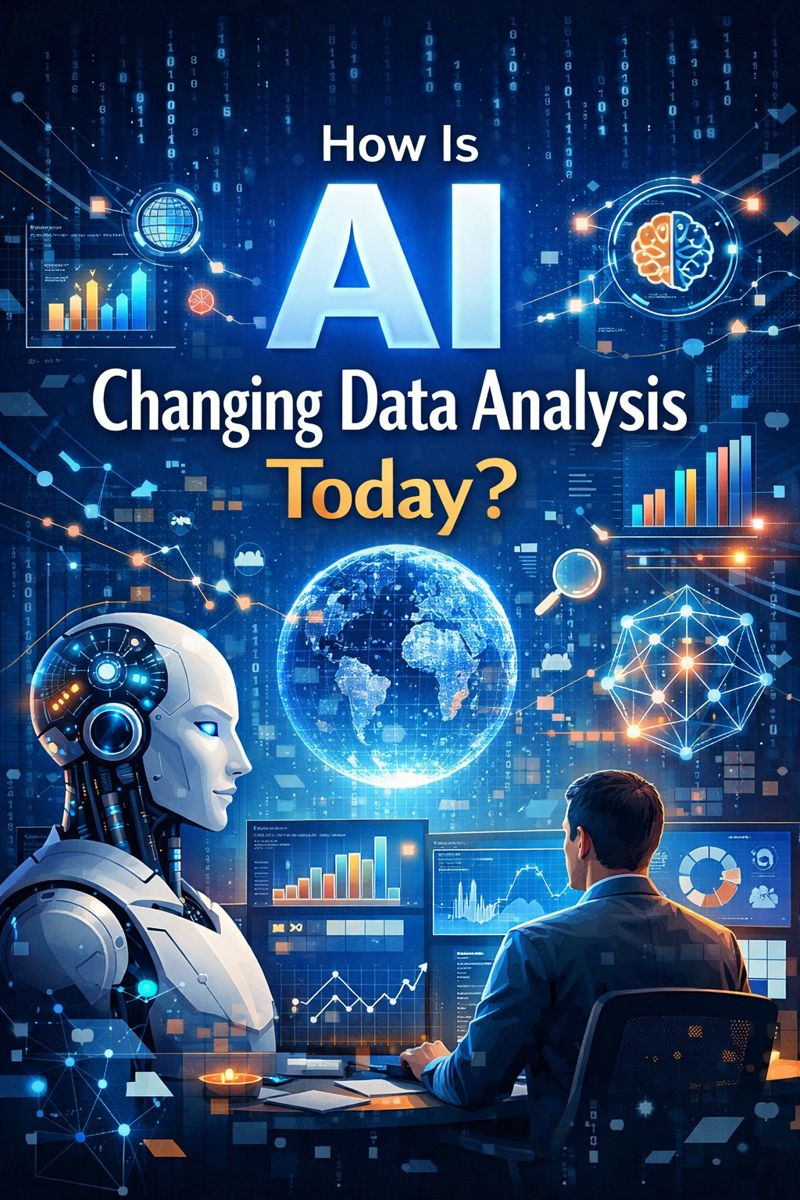
Data analysis is no longer limited to manual reporting and spreadsheet-based insights. With the rapid adoption of artificial intelligence, the way organizations collect, process, and interpret data has changed significantly. Today, the collaboration between data analysts AI is reshaping how businesses make decisions, identify trends, and plan for the future.
Rather than replacing professionals, AI in data analysis is enhancing analytical capabilities by automating repetitive tasks and enabling faster insights. This shift is influencing not only business strategies but also the future of data analysts, making adaptability and upskilling more important than ever.
The Evolution of Data Analysis in the AI Era
In the past, data analysts spent a large portion of their time on data cleaning, preparation, and routine reporting. These tasks were time-consuming and often limited the depth of analysis.
With the rise of automation in data analytics, many of these processes are now handled by intelligent systems. This allows data analysts to focus more on interpreting results, understanding business context, and delivering meaningful insights. The integration of AI has transformed data analysis from a reactive function into a strategic one.
How AI in Data Analysis Is Improving Efficiency
AI in data analysis enables organizations to work with large volumes of data more efficiently. AI systems can quickly identify patterns, detect anomalies, and generate insights that would take humans significantly longer to uncover.
Key improvements include:
-
Faster data processing
-
Reduced manual effort
-
More consistent analysis
-
Better support for real-time decision-making
By automating routine work, AI allows data analysts to deliver higher-value outcomes.
Automation in Data Analytics and Its Role in Modern Workflows
Automation in data analytics plays a critical role in modern business environments. Tasks such as data integration, basic reporting, and trend detection can now be automated, improving speed and accuracy.
However, automation does not eliminate the need for human expertise. Data analysts are still essential for interpreting results, validating insights, and aligning analysis with business goals. Automation enhances productivity, but strategic thinking remains a human responsibility.
Understanding the Impact of AI on Jobs in Data Analytics
The impact of AI on jobs is a common concern, especially among professionals entering the analytics field. While AI automates certain tasks, it also changes job responsibilities rather than removing roles entirely.
For data analysts, AI reduces repetitive work and increases the demand for skills such as critical thinking, communication, and decision support. Organizations increasingly value analysts who can translate AI-generated insights into actionable strategies.
Read more: Will Data Analysts Be Replaced by AI? The Truth Behind the Fear
The Future of Data Analysts in an AI-Driven World
The future of data analysts depends on their ability to adapt to AI-powered tools. Analysts who embrace AI gain a competitive advantage by working more efficiently and providing deeper insights.
Future-focused data analysts will prioritize:
-
Understanding AI-driven outputs
-
Interpreting complex insights
-
Communicating findings to stakeholders
-
Supporting data-driven decisions
AI acts as an enabler, not a replacement, for analytical expertise.
Why Data Analysts and AI Work Better Together
The collaboration between data analysts AI combines the strengths of both. AI provides speed, scalability, and automation, while analysts contribute context, judgment, and business understanding.
Together, they enable:
-
Faster insights
-
Improved accuracy
-
Better strategic planning
-
More informed decision-making
This partnership is shaping the present and future of data analysis.
Preparing for AI-Driven Data Analysis
To stay relevant, professionals and organizations must adapt to AI in data analysis by investing in the right tools and skills. Embracing automation in data analytics while strengthening analytical thinking is key to long-term success.
As AI continues to evolve, data analysts who learn to work alongside intelligent systems will remain in high demand.
Conclusion
So, how is AI changing data analysis today? It is transforming workflows, redefining roles, and enhancing decision-making. The collaboration between data analysts AI is creating more efficient, accurate, and strategic analytics processes.
While discussions around the impact of AI on jobs continue, the reality is clear: the future of data analysts lies in adaptability, continuous learning, and effective use of AI in data analysis supported by automation in data analytics.
FAQs
Q. How is AI changing data analysis today?
AI is changing data analysis by automating repetitive tasks, improving speed and accuracy, and enabling deeper insights for better decision-making.
Q. Will AI replace data analysts?
No. AI supports data analysts by handling routine work, while analysts focus on interpretation, strategy, and business context.
Q. What is the future of data analysts?
The future of data analysts involves working closely with AI tools, focusing on strategic analysis and communication.
Q. What is the impact of AI on jobs in analytics?
The impact of AI on jobs is more about role transformation than job loss, with increased demand for advanced analytical skills.
Q. Why is automation in data analytics important?
Automation in data analytics improves efficiency, reduces errors, and allows analysts to focus on high-value insights.
 Spanish
 English
 Arabic
 French
 Portuguese
 Deutsch
 Turkish
 Dutch
Dutch
 Italiano
 Russian
 Romaian
 Portuguese (Brazil)
 Greek
Greek
