


 Sobre
Sobre
 Termos
 Privacidade
Why Green Energy Adoption Is Becoming a Key Benchmark for Leading Data Centers
Every time you stream a movie, send an email, or use a cloud-based app, you are connecting to a physical building somewhere in the world—a data center. These facilities are the unsung engines of our modern digital life. As our reliance on digital services grows exponentially, so does the amount of power these engines require.
In the past, the primary measure of a top-tier facility was simply uptime: could it stay online no matter what? While reliability is still non-negotiable, a new, equally critical benchmark has emerged: sustainability.
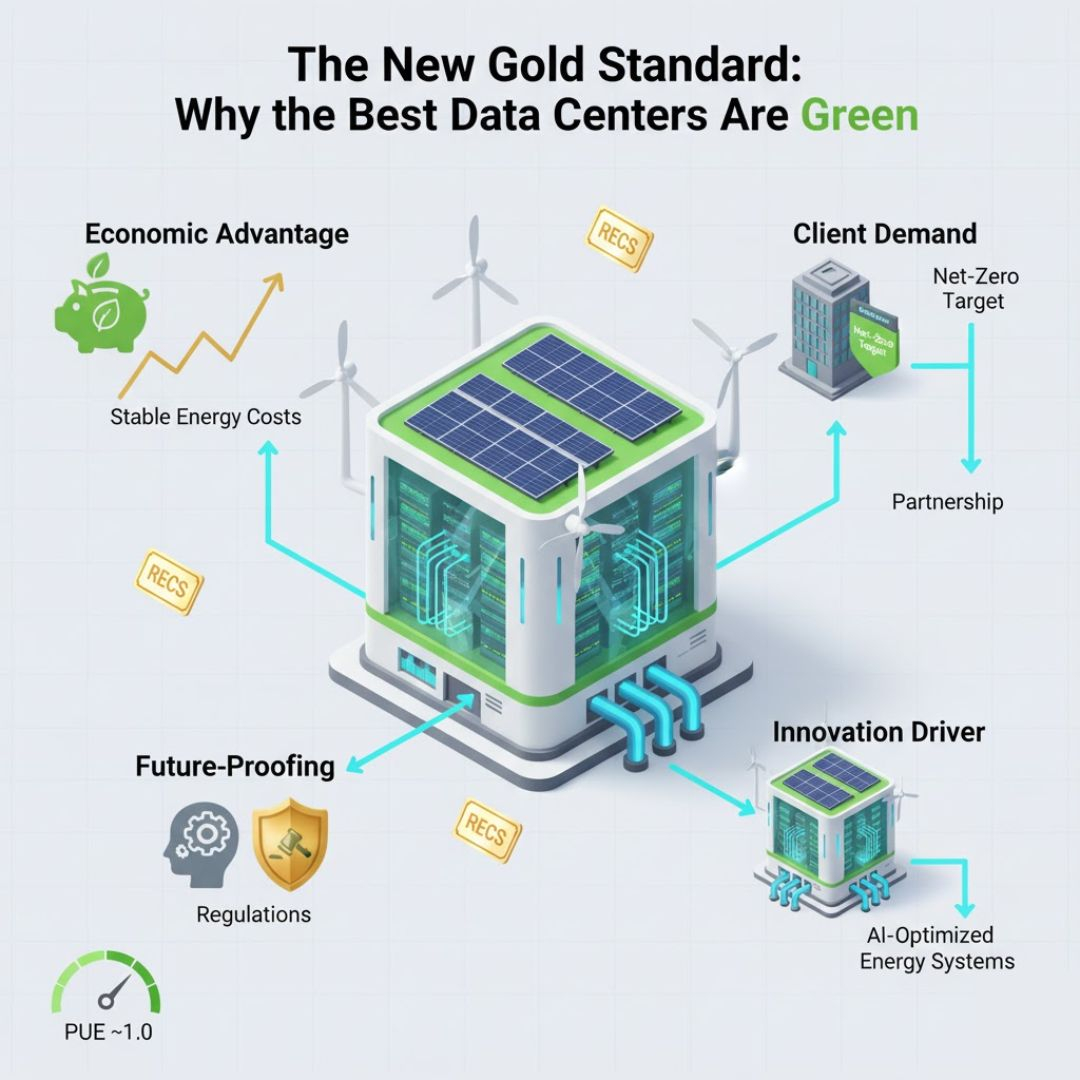
Today, leading data centers are rapidly shifting toward green energy. This isn't just about good public relations or following a trend. It is a fundamental strategic shift driven by economics, client demand, and future-readiness. Let’s explore why renewable energy adoption is now a primary standard for judging excellence in the industry.
The Economic Smart Choice
For a long time, there was a misconception that going green was an expensive luxury. That narrative has changed dramatically over the last decade.
Renewable energy sources, particularly wind and solar, have become incredibly cost-competitive. In many regions, they are now the most affordable form of new electricity generation.
Beyond just the raw cost of power, green energy offers something incredibly valuable to data center operators: price stability. Traditional energy markets can be volatile, swinging wildly based on global events. By locking in long-term renewable energy contracts (often called Power Purchase Agreements or PPAs), data centers can secure stable, predictable energy pricing for ten to twenty years. For facilities that use massive amounts of power, this financial predictability is a huge operational advantage.
Meeting the Demands of Modern Clients
Perhaps the biggest driver of this shift comes directly from the customers these data centers serve.
Major global enterprises—from tech giants to financial institutions—have set their own ambitious sustainability goals. Many have committed to becoming "carbon neutral" or "net-zero" by specific dates.
Here is the catch: an enterprise cannot reach its own net-zero goals if its vendors are not also green. When a company moves its servers to a colocation facility or uses cloud services, the energy that facility uses becomes part of that company's carbon footprint (specifically, what is known as "Scope 3" emissions).
Therefore, these companies are actively seeking out partners who can help them meet their targets. Today, the best data center providers understand that top-tier performance must be paired with verified environmental responsibility if they want to attract and retain these high-value clients.
Staying Ahead of Regulatory Curves
Governments worldwide are recognizing the immense energy demand of the digital sector. In response, we are seeing a growing trend of new regulations and standards aimed at improving industrial energy efficiency and reducing carbon emissions.
Forward-thinking data centers are not waiting for these regulations to become mandatory. By adopting green energy and high-efficiency standards now, they are future-proofing their operations. This proactive approach means they won't face sudden, expensive retrofits or penalties down the road. It positions them as mature, stable long-term partners for their clients.
Driving Innovation through Efficiency
Commitment to green energy often goes hand-in-hand with broader innovation. When a facility is focused on sustainability, they look at every watt of power used.
This focus drives incredible advancements in facility design, particularly in cooling. Cooling servers can sometimes take almost as much energy as the servers themselves. Sustainable data centers are leading the way in:
-
Liquid Cooling: Using specialized fluids to move heat away from processors far more efficiently than air.
-
Free Cooling: utilizing naturally cool outside air in suitable climates to reduce reliance on energy-hungry chillers.
-
AI Optimization: Using smart algorithms to fine-tune cooling systems in real-time, ensuring energy is only used exactly where and when it is needed.
The New Standard of Excellence
Sustainability has matured from a "nice-to-have" feature into a core pillar of operational excellence. It signals that a data center operator is forward-thinking, financially savvy, and aligned with the long-term needs of the global market.
When evaluating infrastructure partners today, you will find that the most impressive facilities are those that can demonstrate not just how powerful they are, but how responsibly they wield that power.
Conclusion
The data center industry is at a pivotal moment. As guardians of the world's digital information, these facilities have a unique responsibility and opportunity to lead the energy transition. Green energy adoption has firmly established itself as a key benchmark for success. It ensures long-term viability, meets crucial client demands, and drives the kind of technological innovation that keeps the industry moving forward. For any business looking for a digital home, choosing a sustainable partner is no longer just an ethical choice—it’s a smart business decision.
Frequently Asked Questions (FAQs)
What qualifies as "green energy" for a data center?
Green energy typically refers to electricity generated from renewable, non-depleting sources. For data centers, this most commonly includes solar power, wind power, hydroelectric energy, and sometimes geothermal energy.
How do data centers prove they are using green energy?
Facilities often use Renewable Energy Certificates (RECs) or Guarantees of Origin (GOs). These are verifiable certificates that prove a certain amount of renewable energy was generated and added to the grid on their behalf to match their consumption.
What is PUE and why does it matter for sustainability?
PUE stands for Power Usage Effectiveness. It is a standard metric that measures how efficiently a data center uses energy. It is calculated by dividing the total amount of power entering the data center by the power used to run the IT equipment itself. A score closer to 1.0 means the facility is very efficient, wasting little energy on cooling or overhead.
Can existing data centers switch to green energy?
Yes. While it is easier to design a new facility for sustainability from the ground up, existing data centers can switch their energy contracts to renewable sources and retrofit their cooling and electrical systems to be far more energy-efficient.
Is green energy less reliable for data centers?
Not when managed correctly. Data centers still connect to the main power grid for 24/7 reliability, but they purchase enough renewable energy to cover their usage. They also maintain robust on-site backup systems (like batteries and generators) to ensure 100% uptime regardless of the power source.

 English
 Arabic
 French
 Spanish
 Deutsch
 Turkish
 Dutch
Dutch
 Italiano
 Russian
 Romaian
 Portuguese (Brazil)
 Greek
Greek
