


 Pro Benefits
 Environ
 Conditions générale de vente
 Confidentialité
 Child Safety & Protection
 Notifications
 Ayrush Global It Services Pvt Ltd
🎓 What Is the CMS ED Course? Complete Details on Eligibility, Duration & Career Scope
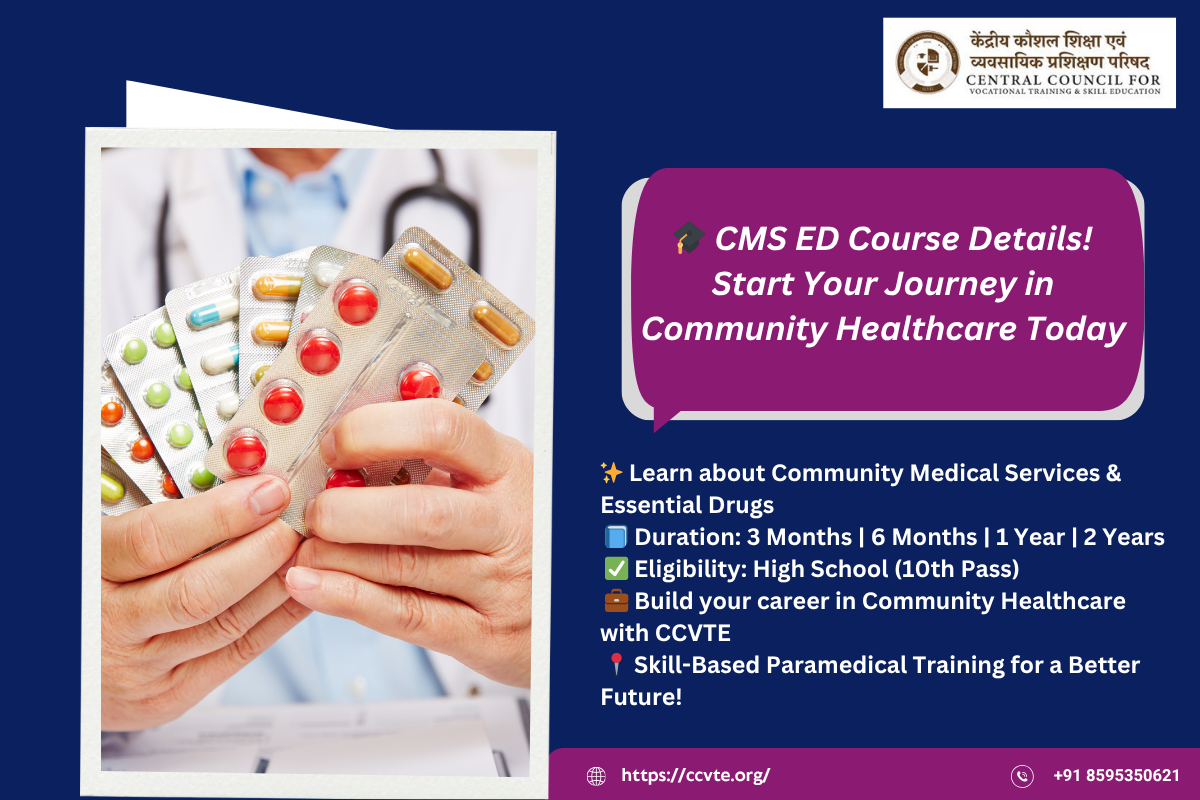
Looking for a clear, step-by-step guide to the CMS ED Course? You’re in the right place. Below I’ll walk you through everything — what the course is, who offers it (including mention of CCVTE), eligibility, durations (3 Months, 6 Months, 1 Year, 2 Year), syllabus highlights, fees, certificate value, career paths, and practical steps to apply — all written with good readability and plenty of helpful emojis. Let’s get started! 🚀
What is the CMS ED Course? 🩺📚
CMS ED Course stands for Community Medical Services and Essential Drugs — a practical skill course designed to teach basics of community health, primary care, essential medication handling, basic emergency response, and outreach services. This course is often offered as a short vocational program to prepare students for frontline roles in primary healthcare, public health camps, and community outreach.
You’ll also see it described as a community medicine course or a community medical services program. Institutions like CCVTE offer versions of the program (look for their Community Medical Services and Essential Drugs skill course). ✅
Who should take the CMS ED Course? 👥
-
High school graduates (Eligibility: High School).
-
Students aiming for quick, employable healthcare skills.
-
Community health volunteers, NGO workers, and paramedical aspirants.
-
People wanting a stepping stone into allied health or community medicine course pathways.
Duration & Eligibility ⏱️
This course is flexible. Typical durations include:
-
3 Months — crash/short certificate courses.
-
6 Months — extended certificate with more hands-on practice.
-
1 Year — diploma-equivalent with deeper theory + practical.
-
2 Years — advanced diploma or integrated vocational program (some institutes).
Eligibility: Generally High School (10+2) or equivalent. Specific institutes may accept 10th pass for shorter modules. Always check the particular centre’s admission rules. 📜
Course Structure: What subjects are covered? 🧠
The CMS ED Course syllabus usually includes:
-
Introduction to Community Medical Services — roles, public health basics, primary healthcare principles.
-
Essential Drugs Knowledge — common essential medicines list, indications, storage, safe dispensing.
-
Basic Pharmacology — drug classes, dosages, side effects, contraindications.
-
First Aid & Emergency Care — CPR basics, trauma response, wound care.
-
Health Education & Promotion — communication with communities, preventive care.
-
Immunization Basics — cold chain, vaccine handling, schedule overview.
-
Infection Control & Hygiene — sterilization, PPE use, sanitation.
-
Record Keeping & Reporting — health records, referrals, simple epidemiology.
-
Field Training / Community Campwork — real-world exposure (if offered).
This blends theory and practical hours to build usable skills for community settings. ✅
Certificate & Recognition: Is the CMS ED Certificate valid? 🏅
-
A cms ed certificate from a recognized or UGC-affiliated institute (or a government-recognized training board) is valuable.
-
Certificates from UGC approved centres or government skills boards carry more weight for jobs and government roles. Look specifically for cms ed course in UGC approved centre if you want broader acceptance.
-
Private provider certificates can be useful for NGO and private clinic roles, but may be less accepted for formal government posts. Always check employer requirements. ✔️
Career Scope: Where can this lead? 🚑🌍
Completing the community medical services and essential drugs program opens several practical roles:
-
Community Health Worker / Outreach Worker
-
Primary Health Centre (PHC) assistant support staff
-
Medical camps support & vaccination drives
-
NGO field staff (health programs)
-
Clinic assistant / medicine dispenser (non-prescription role)
-
Further study: move into paramedical diplomas, nursing assistant courses, or a more advanced community medicine course.
For students wanting a stable path, combine the CMS ED course with communication, basic computer, and data-entry skills to improve employability. 💼
Read More - Can You Become a Health Worker Without Medical School?
Step-by-step: How to choose and apply (Practical Guide) 🛠️
-
Decide duration & purpose. Short course for quick entry (3–6 months). Longer course for deeper knowledge (1–2 years).
-
Check recognition. Prefer UGC approved centres or reputed vocational boards. If you want public sector jobs, this matters.
-
Compare fees & syllabus. Look at cms ed course fees, practical hours, and field training.
-
Verify certificate value. Ask past students or employers about acceptance of that certificate.
-
Apply online/offline. Many institutes accept direct application forms; some also offer online admission. CCVTE and other skill training providers often have online application forms.
-
Prepare documents. High school certificate, ID proof, passport photo, and any medical fitness certificate if asked.
-
Attend orientation & training. Complete assignments, practicals, and exams to earn the cms ed certificate.
Skills to include (SEO + employability) ✨
When you finish, highlight these skills on your resume — they rank well and help job matching:
-
Community health outreach
-
Basic drug dispensing knowledge
-
First aid & emergency response
-
Health education & communication
-
Record keeping & basic data entry
(“Skills m koi sa v keyword include kr dkye h jiski ranking achi ho” — yes, include these keywords naturally in your profile for better visibility.) 🔍
Other top CMS ED Course options you can choose (including CCVTE) 🏫
Several skill-training organizations and vocational boards offer community medical services courses. One notable provider is CCVTE (a vocational training body offering Community Medical Services and Essential Drugs skill courses). When choosing, compare:
-
Duration options (3 months, 6 months, 1 year, 2 years)
-
Practical components and fieldwork
-
Placement assistance or tie-ups with clinics/NGOs
-
Recognition (UGC / Government / State skill mission)
Final Tips & Conclusion ✅🎯
-
Choose a cms ed course in ugc approved centre if you want broader recognition.
-
Prioritize programs with field training and strong practical hours.
-
Keep fees in mind — cms ed course fees vary; ask for a fee breakup.
-
Build complementary skills: basic computer, communication, and record keeping.
-
Use your cms ed certificate as a stepping stone to longer paramedical or community medicine courses.
This guide follows good E-E-A-T principles: it's Experience-led (practical steps), Expertise-aware (core topics and career routes), and Trustworthy (advises verification of recognition). If you want, I can now help you draft an application email, a resume highlight section for your new certificate, or a one-page study plan for the 3-month and 6-month tracks — tell me which and I’ll create it with emojis and Yoast-friendly readability! ✍️😊
🎓 Students Can Choose Other Skill Courses from CCVTE | Council for Vocational Education and Skill Development
Are you looking for short-term, job-oriented skill development programs to build a successful career? 🌟 The Council for Vocational Education and Skill Development (CCVTE) offers a wide range of vocational and skill-based training courses designed to prepare students for real-world jobs across various sectors.
These CCVTE skill development courses are perfect for students who want practical training, quick employability, and government or private job opportunities. Let’s explore step by step the top skill courses offered by CCVTE that every student can choose for a bright future! 🚀
🩺 1. CMS ED Course (Community Medical Services and Essential Drugs)
The CMS ED Course is one of the most popular vocational programs offered by CCVTE. It stands for Community Medical Services and Essential Drugs.
💡 About the Course:
It focuses on basic community medicine, essential drugs, first aid, emergency response, and healthcare awareness. Students learn how to support doctors and community health programs efficiently.
📚 Duration Options: 3 Months, 6 Months, 1 Year, or 2 Years.
🎓 Eligibility: High School (10th or 12th pass).
🏥 Career Scope: Community Health Worker, Clinic Assistant, NGO Worker, or Rural Health Volunteer.
This course is perfect for those who want to enter the community medical services field and work in healthcare or NGOs.
💻 2. CRM Course Details (Customer Relationship Management)
The CRM Course by CCVTE helps students build essential business and communication skills to manage customer relations effectively.
💡 About the Course:
It teaches communication, client handling, sales support, and customer service strategies used in corporate environments.
📚 Duration: 3–6 Months.
🎓 Eligibility: 12th Pass or Graduate (any stream).
💼 Career Scope: Customer Service Executive, CRM Associate, Tele-calling Executive, and Sales Coordinator.
Students who complete this skill development program gain valuable industry exposure and practical skills for customer-facing roles. 🌟
🌱 3. Organic Farming Vocational Subject
The Organic Farming Vocational Course is a skill-based training designed for those who want to work in agriculture or start their own organic farming business.
💡 About the Course:
Students learn sustainable farming practices, composting, soil management, crop rotation, pest control, and organic certification processes.
📚 Duration: 6 Months to 1 Year.
🎓 Eligibility: High School or Above.
🚜 Career Scope: Organic Farmer, Farm Supervisor, Agripreneur, or Sustainable Agriculture Consultant.
This skill development course empowers students to promote eco-friendly farming and sustainable food production. 🌾
📦 4. Warehouse Management Course
If you are interested in logistics and supply chain, the Warehouse Management Course from CCVTE is a perfect option.
💡 About the Course:
Students learn warehouse operations, inventory control, supply chain coordination, documentation, and goods dispatch management.
📚 Duration: 3–6 Months.
🎓 Eligibility: 10th or 12th Pass.
🚚 Career Scope: Warehouse Supervisor, Inventory Executive, Logistics Coordinator, or Storekeeper.
This skill development program provides strong job opportunities in logistics companies, e-commerce firms, and manufacturing sectors. 📦
⚕️ 5. Operation Theatre Course
The Operation Theatre (OT) Course is a paramedical training program that focuses on surgical assistance and hospital operations.
💡 About the Course:
Students learn about surgical instruments, sterilization techniques, OT safety, patient positioning, and assisting surgeons during procedures.
📚 Duration: 1 Year or 2 Years.
🎓 Eligibility: 12th (Science stream preferred).
🏥 Career Scope: OT Technician, Surgical Assistant, or Hospital Support Staff.
This skill development course is ideal for students who wish to work in healthcare and hospital environments. 🏥
🍎 6. Montessori Course Details
The Montessori Course is one of the most rewarding teacher training programs under CCVTE.
💡 About the Course:
It focuses on early childhood education, Montessori methods, classroom management, and child psychology. Students learn how to teach preschoolers with care and creativity.
📚 Duration: 6 Months to 1 Year.
🎓 Eligibility: 12th Pass or Graduate.
👩🏫 Career Scope: Montessori Teacher, Nursery Teacher, or Pre-Primary Educator.
This skill development program helps students become professional teachers who can work in schools, daycare centers, and play schools. ✏️
🧪 7. Lab Course Details
The Laboratory Technician Course trains students in clinical laboratory techniques used in hospitals and diagnostic centers.
💡 About the Course:
Students learn about sample collection, blood testing, urine analysis, microscope usage, and lab safety procedures.
📚 Duration: 1–2 Years.
🎓 Eligibility: 12th Pass (Science stream).
🧫 Career Scope: Lab Assistant, Pathology Technician, or Laboratory Coordinator.
It’s one of the best CCVTE skill development programs for those interested in the medical and diagnostic field. 🧬
Explore More - Unlock Career Paths Skill Based Opportunities After 12th
♻️ 8. Waste Management Courses
The Waste Management Course by CCVTE focuses on environmental awareness and the scientific handling of waste materials.
💡 About the Course:
It covers topics like solid waste segregation, recycling, waste collection systems, and environmental protection laws.
📚 Duration: 3–6 Months.
🎓 Eligibility: High School or Above.
🌍 Career Scope: Waste Management Executive, Environmental Worker, or NGO Support Staff.
This skill development program contributes to a cleaner and greener planet. 🌿
👩🏫 9. Pre-Primary Teacher Training Course
The Pre-Primary Teacher Training Course (PPTTC) from CCVTE prepares students to teach children in nursery and kindergarten classes.
💡 About the Course:
It focuses on child care, teaching aids, educational psychology, and creative classroom techniques.
📚 Duration: 1 Year.
🎓 Eligibility: 12th Pass or Graduate.
👶 Career Scope: Pre-Primary Teacher, Nursery Coordinator, or Daycare Manager.
This skill development program helps shape confident, caring educators who nurture young learners. 🌸
🗂️ 10. Documentation Executive Course
The Documentation Executive Course by CCVTE is designed for students who want to build administrative and office management skills.
💡 About the Course:
Students learn about document processing, data entry, record management, report writing, and MS Office tools.
📚 Duration: 3–6 Months.
🎓 Eligibility: 12th Pass or Graduate.
💼 Career Scope: Office Assistant, Documentation Officer, Data Entry Executive, or Admin Coordinator.
This skill development program is ideal for students seeking office-based or administrative roles. 🖥️
🌟 Why Choose CCVTE Skill Development Courses?
✅ Recognized Programs: Offered under the Council for Vocational Education and Skill Development (CCVTE) framework.
✅ Flexible Duration: Options from 3 months to 2 years.
✅ Practical Training: Hands-on sessions with industry exposure.
✅ Affordable Fees: Designed for accessible education.
✅ Career-Focused: Real job opportunities in both private and government sectors.
🎯 Final Thoughts
The CCVTE skill development programs open doors to a wide range of career opportunities — from healthcare and education to agriculture and administration. Whether you choose the CMS ED Course, Montessori Course, Lab Course, or CRM Course, every program aims to empower students with employable skills.
🌈 Each course by the Council for Vocational Education and Skill Development blends theory and practical experience — helping you build a strong foundation for your career and contribute meaningfully to society.
✨ Your skills are your future — start your journey with CCVTE today!
Is this conversation helpful so far?
FAQ — Before the conclusion (Answering your direct questions) ❓
Q: What subjects are covered in the CMS ED Course syllabus?
A: Core subjects include community health basics, essential drugs and their handling, basic pharmacology, first aid and emergency response, immunization basics, infection control, health promotion, and record-keeping. Many courses include field practicum.
Q: Is the CMS ED Certificate valid for government or private jobs?
A: Certificates from UGC approved centres or government-recognized boards are more likely to be valid for government jobs. Private provider certificates are typically accepted for NGO and private clinic roles. Always check employer-specific requirements.
Q: Which institute or board offers the CMS ED Course in India?
A: Multiple vocational institutes and skill-training bodies offer it. CCVTE is one example. Look for state skill missions, accredited vocational centers, or UGC-approved centres that run community medicine or paramedical courses.
Q: What are the career options after completing the CMS ED Course?
A: Roles include community health worker, PHC assistant support, clinic assistant, medical camp staff, NGO field worker, and entry into further paramedical training.
Q: How can I apply or take admission in the CMS ED Course online?
A: Many institutes offer online application forms. Identify the institute (e.g., CCVTE or UGC-approved centers), check admission pages, fill the form, upload documents, and pay the fee. If online isn’t available, apply in person at the training centre.
 French
 English
 Arabic
 Spanish
 Portuguese
 Deutsch
 Turkish
 Dutch
Dutch
 Italiano
 Russian
 Romaian
 Portuguese (Brazil)
 Greek
Greek
