


 Pro Benefits
 Sobre
Sobre
 Termos
 Privacidade
What Is Academic Credit Transfer and How Does It Work in India?

The Indian education system has undergone significant changes in recent years, especially with the introduction of flexible learning models. One of the most transformative reforms among them is the Academic credit transfer in India. This system allows students to move from one college or university to another without losing their academic progress. It’s a progressive step towards making higher education more student-centered, flexible, and inclusive.
At its core, the credit transfer system in India enables learners to carry forward the credits they have already earned in one institution to another recognized university or program. This approach is reshaping how students pursue degrees, especially those who face unavoidable interruptions in their studies due to relocation, personal circumstances, or the need to change courses.
The Concept of Academic Credit Transfer
To understand how the Academic credit transfer in India works, it’s important to first grasp what “credits” mean in higher education. Under the credit system in higher education, each subject or course is assigned a certain number of credits based on its academic load — including the hours of study, lectures, assignments, and practical work. When a student completes a course, those credits are added to their academic record.
The innovation came with the Academic Bank of Credits (ABC), a digital platform established by the University Grants Commission (UGC). This system works like a bank account for students — instead of storing money, it stores their earned credits. When students complete a course at one institution, the credits are deposited in their ABC account. Later, if they transfer to another college or university, the new institution can access these records and accept the credits as valid proof of prior learning.
This system is backed by the UGC credit transfer policy, ensuring that credits are recognized across different universities, both public and private, that are registered under the ABC framework.
How Does the Credit Transfer System Work?
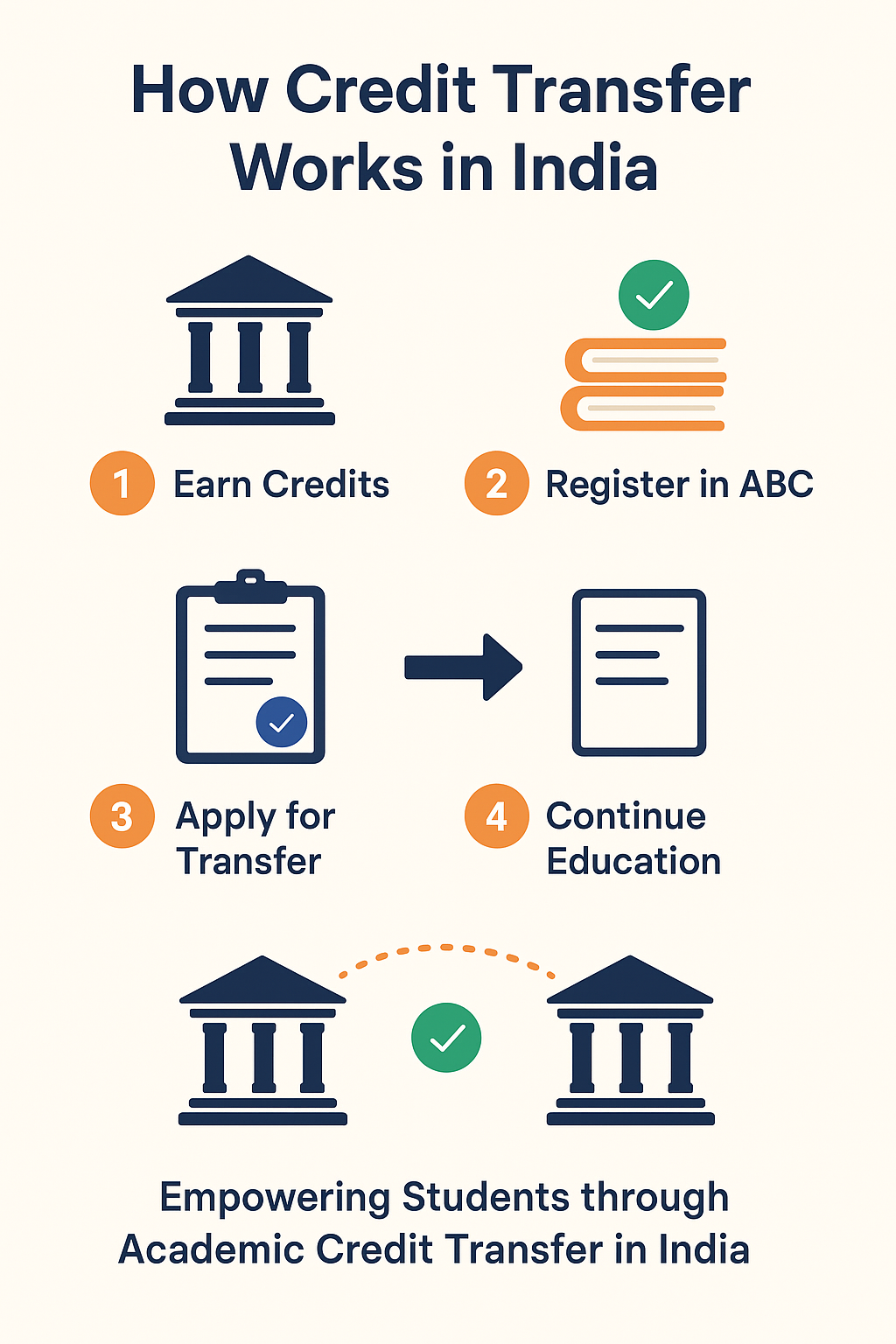
The credit transfer system in India operates through a structured and transparent process designed to maintain quality and consistency. Here’s how it works in practice:
When a student enrolls in a university, every completed course earns a fixed number of credits. If the student decides to change institutions, these credits are stored digitally in their Academic Bank of Credits account. The new institution, upon verification through the UGC credit transfer policy, reviews these credits to determine their equivalence with the existing course structure. If the content, syllabus, and evaluation pattern match, the credits are accepted and counted toward the student’s degree requirements.
This mechanism avoids duplication of effort — students don’t have to repeat the same courses, saving both time and tuition costs. It also supports academic mobility, allowing learners to explore interdisciplinary studies, switch specializations, or even move between traditional and open universities.
The Role of UGC and NEP 2020
The University Grants Commission (UGC) plays a crucial role in implementing the Academic credit transfer in India. The framework was formalized after the introduction of the National Education Policy (NEP) 2020, which emphasized flexibility, multiple entry and exit options, and lifelong learning.
Under NEP 2020, students can complete a part of their education at one institution and later continue at another without losing progress. For example, a student might complete two semesters in one college, take a break for professional reasons, and later rejoin another institution to finish their degree — all through Degree Credit Transfer using the ABC platform.
This approach aligns Indian education with international standards, where credit-based learning and transfer systems have long been the norm. It also encourages universities to collaborate, innovate, and standardize curricula for better compatibility.
Benefits for Students
The benefits of the Academic credit transfer in India go far beyond convenience. It empowers students to take control of their academic journey. They can:
-
Switch institutions easily when relocating or seeking better academic opportunities.
-
Avoid repeating subjects already completed, saving valuable time.
-
Combine learning modes — such as online, distance, and offline education.
-
Build personalized learning paths aligned with career goals.
-
Earn degrees faster through cumulative credit recognition.
-
Continue education after breaks, promoting lifelong learning.
Moreover, it enhances higher education flexibility, giving students the confidence that their academic achievements are portable and secure within the credit system in higher education.
Challenges and Implementation Issues
Despite its promise, implementing the credit transfer system in India comes with a few challenges. Not all institutions are yet fully integrated with the Academic Bank of Credits, and variations in course design, evaluation methods, and credit weightage sometimes create mismatches.
Additionally, some universities may still be hesitant to adopt full-scale Degree Credit Transfer policies due to administrative complexities. However, with increasing digital adoption and policy push from UGC, these barriers are gradually being addressed.
Awareness is also key — many students remain unaware that they can use the Academic credit transfer in India to resume studies after a gap or transfer to another university without restarting from scratch. As more institutions register with the ABC and align their syllabi, the system will become more seamless and widely accepted.
The Future of Credit Transfer in Indian Higher Education
The future looks promising for Academic credit transfer in India. The UGC credit transfer policy and Academic Bank of Credits are revolutionizing how degrees are earned and recognized. With technology integration, every student can have a verified academic record accessible anywhere in the country.
This reform aligns perfectly with India’s broader vision for an open and inclusive education system that supports academic mobility and learning flexibility. In the near future, students will be able to move between colleges, states, and even learning modes effortlessly, without worrying about losing their academic efforts.
Final Thoughts
The Academic credit transfer in India is more than a policy — it’s a shift in mindset. It turns education into a continuous, adaptable journey rather than a rigid pathway. The Credit transfer system in India, powered by the UGC credit transfer policy and Academic Bank of Credits, ensures that learning never goes to waste. As India moves toward a more student-friendly academic model, this framework will play a key role in shaping a dynamic, interconnected, and globally compatible higher education ecosystem.
Frequently Asked Questions (FAQs)
Q1. What is Academic Credit Transfer in India?
It’s a system that allows students to carry forward the credits they have earned from one university to another. The process ensures smooth academic mobility and prevents the loss of academic progress when students change institutions.
Q2. What is the UGC Credit Transfer Policy?
The UGC credit transfer policy provides a national framework for recognizing, storing, and transferring academic credits through the Academic Bank of Credits (ABC). It ensures uniformity and quality in the credit system in higher education.
Q3. Can credits be transferred between different types of universities?
Yes, as long as both institutions are recognized by the UGC and registered with the Academic Bank of Credits. The new college must verify course equivalence before approving the Degree Credit Transfer.
Q4. How does the Academic Bank of Credits benefit students?
The Academic Bank of Credits (ABC) acts as a digital record of all earned credits. It promotes flexibility, allowing students to pause and resume their studies, switch colleges, or complete degrees at their own pace under the credit transfer system in India.
Read more: How Indian Students Can Transfer Credits Between Colleges?

 English
 Arabic
 French
 Spanish
 Portuguese
 Deutsch
 Turkish
 Dutch
Dutch
 Italiano
 Russian
 Romaian
 Greek
Greek
