


 Pro Benefits
 About
About
 Términos
 Privacidad
 Child Safety & Protection
 Notificaciones
 Ayrush Global It Services Pvt Ltd
How to Solve Missed Detection Problems with the Right Tag Reader
Introduction: The Silent Threat of Missed Detections
In fisheries monitoring, a missed detection is not just a minor inconvenience — it is a data point permanently erased from your research record. When a tagged fish passes an antenna and its identity goes unregistered, that fish effectively disappears from your study at that moment. Depending on how many detections are missed and how systematically they occur, the cumulative effect on survival estimates, migration timing analyses, and population assessments can be severe enough to invalidate entire study components.
The frustrating reality is that missed detections often go unrecognized. Researchers interpret detection gaps as biological events — mortality, emigration, or behavioral avoidance — when the true cause is equipment-related. A properly selected and configured tag reader matched to your specific research environment is the most effective solution to this pervasive problem.
This article examines the specific causes of missed detections in fisheries monitoring and provides a detailed framework for selecting the right tag reader to eliminate them.
Understanding Why Missed Detections Happen
Before selecting solutions, it is essential to understand the mechanisms behind missed detections. They do not all share the same cause, and a tag reader that addresses one failure mode may perform poorly against another.
1. Insufficient Read Range
Every tag reader has a functional read range — the maximum distance at which it can reliably energize a passive tag and receive its response signal. When fish pass through monitoring zones at distances exceeding the reader's effective range, the tag receives insufficient electromagnetic energy to power its response, and the detection event never occurs.
Read range is determined by antenna size and design, reader output power, tag frequency and sensitivity, and environmental conditions. In wide river channels or high-flow conditions where fish may transit at unpredictable positions within the water column, inadequate read range produces systematic detection gaps that are particularly difficult to identify and correct.
2. Frequency Mismatch Between Tags and Readers
Passive integrated transponder tags operate on specific radio frequencies — primarily 125 kHz half-duplex (HDX) or 134.2 kHz full-duplex (FDX-B). A tag reader configured for one frequency will not detect tags operating on the other. In multi-agency programs where tags and detection infrastructure have been sourced independently, frequency mismatch is one of the most common and consequential causes of missed detections.
3. Environmental Interference
Electromagnetic interference from nearby electrical infrastructure — power lines, pumping stations, industrial equipment, and even certain vegetation types — can suppress tag reader performance significantly. Metallic structures near antenna installations create signal reflections that reduce effective read range and produce false trigger events that mask genuine detection signals.
Water conductivity is another underappreciated interference source. High-conductivity water — common in estuarine environments and some agricultural watersheds — attenuates the electromagnetic field produced by the reader antenna, reducing read range by 30–50% compared to freshwater baseline performance in some documented cases.
4. Reader Configuration Errors
Incorrect gain settings, inappropriate multiplexer configurations, and poorly timed read cycles all reduce detection probability even when the physical tag reader hardware is fully capable. A tag reader operating with gain set too low fails to energize tags at its theoretical maximum range. A multiplexed system cycling through antenna channels too quickly may miss fast-moving fish that transit the detection zone during the brief window when their nearest antenna is inactive.
5. Hardware Degradation Over Time
Field-deployed tag reader systems are exposed to temperature extremes, moisture, physical vibration from river currents, and power supply fluctuations. Components that perform within specification at installation may degrade gradually, producing declining detection efficiency that researchers mistake for reduced tag performance or changing fish behavior.
Key Criteria for Selecting the Right Tag Reader
Multi-Frequency Capability
The single most important compatibility feature in a modern tag reader for fisheries applications is the ability to detect both HDX (125 kHz) and FDX-B (134.2 kHz) tags simultaneously. Multi-frequency readers eliminate the frequency mismatch problem entirely, ensuring that fish tagged under any standard protocol are detected regardless of which frequency their tags use.
This capability is particularly critical in river systems where fish from multiple tagging programs — hatchery releases, wild fish studies, and multi-agency collaborative projects — may be present simultaneously.
Adjustable Gain and Read Sensitivity
A tag reader with user-adjustable gain settings allows researchers to optimize detection sensitivity for specific deployment environments. Higher gain settings extend read range in open water environments but may increase noise susceptibility in high-interference locations. The ability to fine-tune this parameter in the field — rather than accepting fixed factory settings — is a meaningful operational advantage.
Independent testing by the USGS Columbia River Research Laboratory has demonstrated that gain optimization alone can improve detection efficiency by 15–22% in challenging field environments compared to default reader configurations.
Robust Environmental Sealing
Field-deployed tag reader systems must maintain performance across the full range of environmental conditions encountered during long-term monitoring programs. IP67 or IP68 waterproofing ratings for electronic enclosures, corrosion-resistant housing materials, and wide operating temperature ranges — typically -20°C to +60°C for serious research applications — are minimum specifications for equipment intended for year-round deployment in natural river environments.
Data Logging Precision and Storage
The tag reader's data logging capability determines the temporal and contextual resolution of detection records. Research-grade readers should capture tag code, detection timestamp accurate to at least one second, antenna identifier, signal strength, and reader status at each detection event. Onboard storage sufficient to maintain records through extended periods without data retrieval — particularly important for remote deployments — prevents data loss during communication outages.
Compatibility With Existing Detection Infrastructure
In established monitoring programs, new tag reader equipment must integrate with existing antenna arrays, multiplexers, power systems, and data management software. Readers that use proprietary communication protocols or non-standard data output formats create integration barriers that increase both cost and error risk during data aggregation.
VodaIQ designs tag reader systems with open communication standards and compatibility with established fisheries monitoring infrastructure, allowing research programs to upgrade reader capability without rebuilding their entire detection network from the ground up.
Fixed Versus Portable Tag Readers: Choosing the Right Configuration
Fixed Array Systems
Fixed tag reader systems — permanently installed at monitoring stations with continuous power supply and automated data logging — are the standard solution for high-throughput detection sites such as dam bypass channels, fish ladders, and smolt collection facilities.
Fixed systems support large antenna arrays covering the full cross-section of fish passage structures, maximizing the probability that every tagged fish transiting the site is detected. They operate continuously without researcher presence, accumulating detection records across the full diel cycle and across all seasonal fish movement periods.
Detection efficiency for properly installed fixed array systems in controlled fish passage structures regularly exceeds 95% — a benchmark documented across multiple NOAA Fisheries monitoring sites in the Columbia River Basin.
Portable Tag Readers
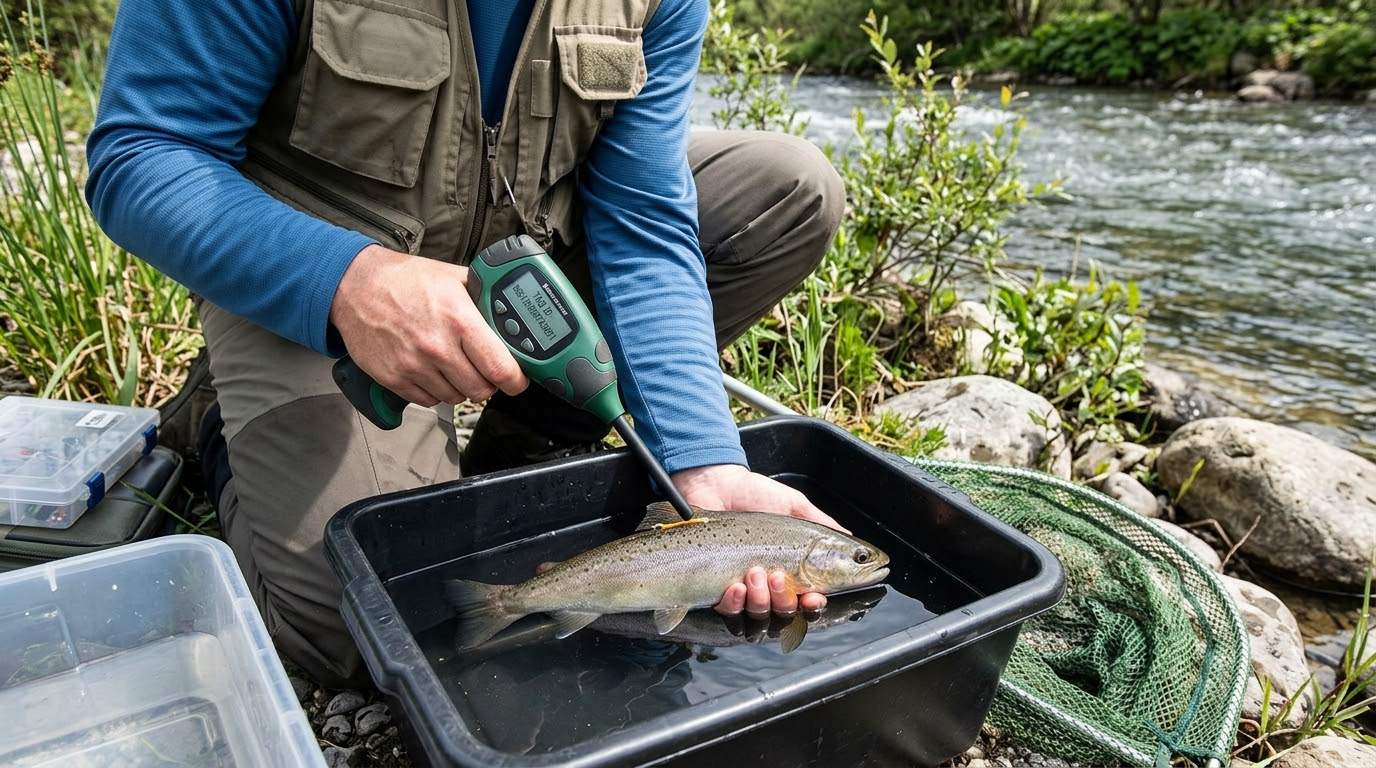
Portable handheld and backpack-mounted tag reader units serve different but equally important functions in fisheries monitoring programs. They are used for tag verification at the point of implantation, mobile stream surveys in non-instrumented river reaches, fish health assessments requiring individual identification without antenna infrastructure, and troubleshooting detection anomalies at fixed sites.
Portable readers must balance detection performance with field operability — battery life, weight, display readability in outdoor lighting conditions, and ruggedized construction for use in wet field environments are all practical specifications that affect their reliability as data collection tools.
Multiplexed Systems for Multi-Antenna Deployments
Where monitoring structures require coverage across multiple parallel channels or large cross-sectional areas, multiplexed tag reader systems allow a single reader unit to cycle sequentially through multiple antenna connections — providing broader spatial coverage than a single antenna-reader pair while managing infrastructure cost.
Proper multiplexer configuration — including appropriate channel dwell time calibrated to expected fish transit speeds — is essential for maintaining detection efficiency in multiplexed deployments. Inadequate dwell time is a documented cause of missed detections in fast-flow environments where fish transit the antenna detection zone in less than one full multiplexer cycle.
Operational Best Practices for Maximizing Detection Efficiency
Selecting the right tag reader is necessary but not sufficient. Operational practices significantly influence realized detection performance:
Regular Performance Verification: Deploy known-function test tags at monitoring stations on a scheduled basis to verify that detection efficiency remains consistent with baseline measurements. Unexpected drops in test tag detection rates trigger equipment investigation before biological data is affected.
Antenna Condition Monitoring: Physical damage to antenna cables, connector corrosion, and changes in antenna impedance all reduce detection performance without triggering obvious equipment alarms. Regular impedance checks and visual inspections prevent gradual performance degradation from going undetected.
Power Supply Stability: Tag reader performance is sensitive to power supply voltage fluctuations. Uninterruptible power supply systems and voltage regulation are standard requirements for fixed array deployments where power reliability cannot be guaranteed.
Environmental Interference Assessment: Conduct baseline electromagnetic interference surveys at new deployment sites before finalizing antenna placement. Repositioning antennas by even short distances can significantly reduce interference effects in some environments.
Data Retrieval Frequency: For fixed systems without real-time telemetry, establish data retrieval schedules that prevent storage buffer overflow. Lost data due to full storage buffers is an entirely preventable but surprisingly common source of detection record gaps in remote deployments.
Conclusion: The Right Tag Reader Makes Your Data Defensible
Missed detections are the most insidious form of data quality problem in fisheries monitoring — invisible in real time, potentially catastrophic in their cumulative effect on research conclusions, and easily misattributed to biological rather than technical causes.
The right tag reader — selected for frequency compatibility, environmental robustness, detection sensitivity, and integration capability — eliminates the technical sources of missed detection systematically. Combined with proper installation, calibrated configuration, and disciplined operational maintenance, a well-chosen tag reader transforms your detection infrastructure from a potential source of data uncertainty into a reliable foundation for defensible fisheries science.
In a research environment where data quality directly influences conservation decisions affecting endangered populations and multi-billion-dollar resource management programs, the investment in selecting the right tag reader is one of the most consequential choices a monitoring program will make.
 Spanish
 English
 Arabic
 French
 Portuguese
 Deutsch
 Turkish
 Dutch
Dutch
 Italiano
 Russian
 Romaian
 Portuguese (Brazil)
 Greek
Greek
