


 Pro Benefits
 Σχετικά
 Όρους
Όρους
 Ιδιωτικότητα
 Child Safety & Protection
 Ειδοποιήσεις
 Ayrush Global It Services Pvt Ltd
Agriculture Irrigation Pipes Manufacturers in India: What Goes Into Building Durable Irrigation Systems
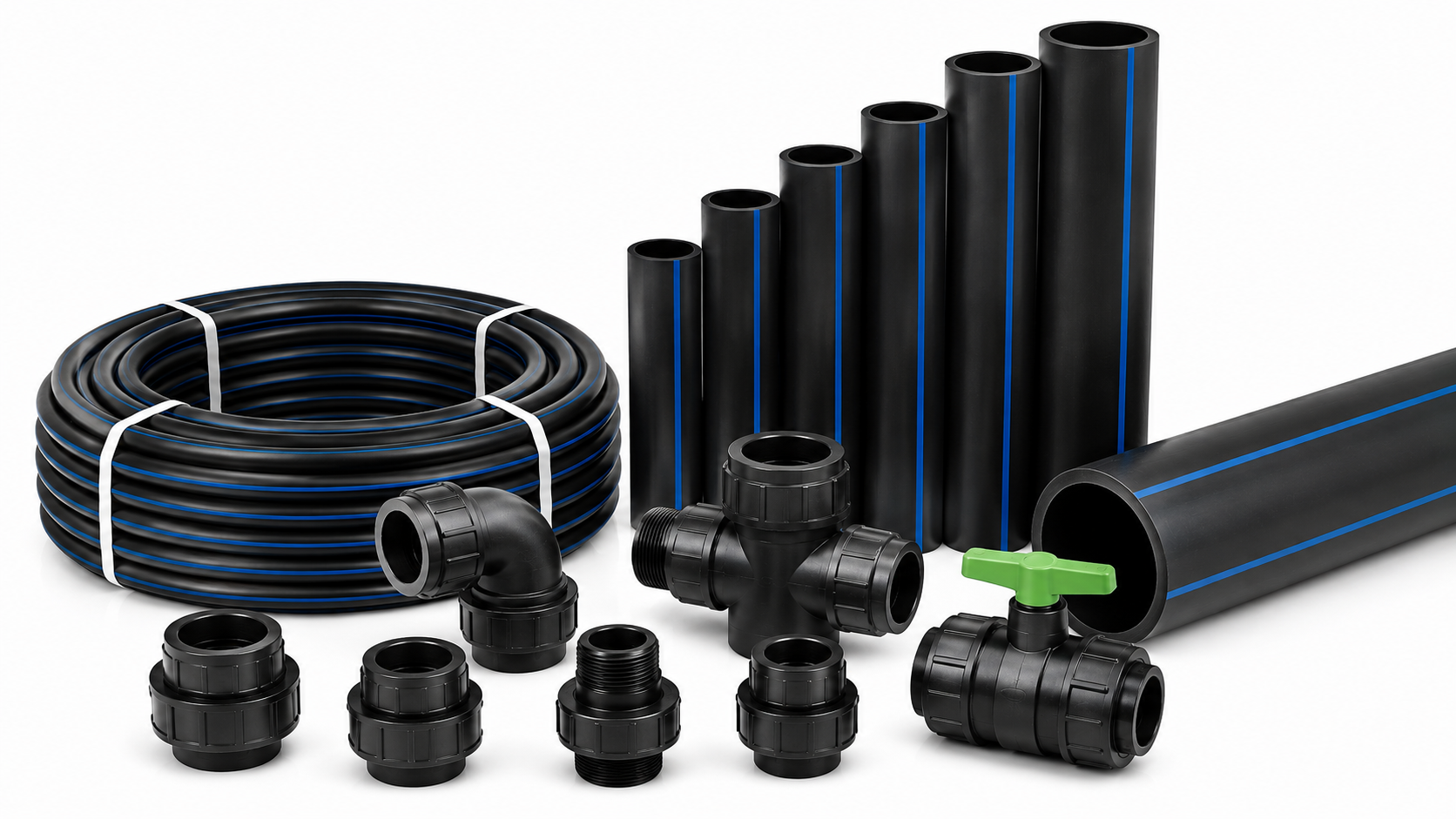
A mainline splits three weeks after installation, right in the middle of the sowing window. That's the call no procurement manager wants to take, and it usually traces back to one overlooked line item: pipes rated for a catalog, not for field pressure. Agriculture Irrigation Pipes bought on price alone tend to fail exactly when a farm can least afford it — mid-season, mid-flow, with a filter bank waiting downstream. Flowtek Pipes & Fittings, based in Kundli, Sonipat, Haryana, builds PVC and HDPE irrigation lines meant to survive that first pressure cycle and the several thousand that follow it.
This isn't a pitch for "premium" pipe. It's a walk-through of what actually separates a working irrigation network from one that leaks by August.
The Spec Detail Most Buyers Skip
Most enquiries start with diameter and price per meter. Fewer buyers ask about wall thickness ratio, and that's usually where the real difference sits.
Material Selection: PVC vs. HDPE
PVC handles buried mainlines well — it's rigid, solvent-welds cleanly, and keeps water loss low on straight runs. HDPE earns its place above ground, where vibration, thermal expansion, and uneven terrain would eventually crack a rigid pipe. Flowtek supplies both, because a farm rarely needs just one. Orchards and polyhouse plots typically run HDPE laterals off a PVC backbone; that mix is common enough across Delhi NCR farms that we build stock around it rather than treating it as a special order.
The Overlooked Number: SDR and Wall Thickness
Buyers compare pressure ratings. Almost nobody asks about SDR — the ratio of outer diameter to wall thickness — and that number determines how the pipe behaves under water hammer, not just steady pressure. A lower SDR means a thicker wall and a higher pressure allowance, which matters more on pump-to-filter stretches than the PN rating alone suggests. Which means two pipes with identical PN labels can perform very differently once a valve slams shut.
What a Bad Supplier Answer Sounds Like
Here's how to actually evaluate an Agriculture Irrigation Pipes Manufacturer before the purchase order goes out, not after.
-
Certification verification.Request the ISO certificate directly, not just a statement about certification.A poor response might simply say "we're certified" without providing evidence.Flowtek's certificates are available on our website under the Certificates section — please review them before allocating your budget, not after.
-
Batch traceability. Can a supplier trace a defective coil back to its production batch? A bad answer is silence, or a promise to "look into it."
-
Testing protocol, per batch. Pressure resistance, impact strength, temperature tolerance, dimensional accuracy, and leakage checks should run on every production batch, not a sample from last quarter.
-
MOQ and lead time, stated plainly. A bad answer is "depends" with no number attached to it.
-
Defect policy, written down. A supplier who says "we'll handle defects case by case" doesn't have a policy. That's a negotiation you'll lose after the shipment has already landed on your site.
Five Ways the Right Pipe Protects Your Margin
Durability isn't a marketing word here — it's a line item that either shows up as fewer service calls or as a re-order six months early.
Consistent wall thickness, checked through dimensional accuracy testing on every batch, is what keeps a mainline from bursting under seasonal pressure spikes — that's risk reduction, plain and simple. UV-stabilized resin matters more in Haryana's open-field sun than most spec sheets admit, and it's the difference between a pipe that lasts through five summers and one that turns brittle by the third. Carrying both PVC and HDPE in one supply relationship means terrain doesn't force a redesign halfway through a project, which protects the operational plan as much as the budget. Ready stock and fast dispatch cycles matter most exactly when they're hardest to plan around — right before sowing, when every delayed truck costs field days. A reliable Agriculture Irrigation Pipes Dealer network — Flowtek's spans 20 states and roughly 50 connected dealerships — means replacement parts and fittings are usually a local call away, not a freight delay away. And joints that lock and seal consistently cut water loss at the emitter end, which is where fertigation efficiency actually gets decided.
Why Location Is a Supply Chain Decision, Not Just an Address
Kundli sits inside the Sonipat industrial belt, close enough to the Delhi NCR periphery that dispatch to peri-urban farms and semi-urban clusters doesn't add a second freight leg. That geography plays an important role in a category where diameter, coil length, and fittings must all arrive together — a mainline order that lacks its couplings is essentially useless when it arrives on-site.Flowtek's logistics division tracks dispatch against regional demand patterns across metro, semi-urban, and rural pockets, rather than treating every pincode the same way.
Where We Come In
We manufacture Agriculture Irrigation Pipes and Agricultural Irrigation Pipe Fittings out of our Kundli, Sonipat facility, and we're ISO-certified for it. We do not just perform a pressure test and end the process — every production batch is tested for pressure resistance, impact strength, temperature tolerance, dimensional accuracy, and leakage before it is approved for shipping.Furthermore, we can trace a coil back to the exact batch it came from if a claim is made.This traceability is something most buyers do not think about until a problem occurs, and by that point, it is too late to create the system that could have prevented the issue.
We won't claim our pipe never fails. Extrusion runs have tolerances, transit has variables we don't control once a shipment leaves our dock, and we'd rather say that plainly than promise perfection we can't back up.
Ready to Place an Order?
Send us your required diameter, PN or SDR rating, coil or straight length, quantity, and delivery pincode — that's what we need to quote MOQ and a realistic lead time against your actual specification, not a generic price list. We reply within one working day with pricing and a dispatch window, and if your quantity qualifies for a bulk rate, we'll flag that in the same reply.
The Bottom Line
Agriculture Irrigation Pipes decisions get made on price far more often than they should be. The buyers who avoid mid-season failures are the ones who ask about SDR, batch testing, and defect policy before the purchase order, not after the first burst pipe. Flowtek builds PVC and HDPE irrigation systems in Kundli, Sonipat with that scrutiny in mind, because a pipe that only performs on the spec sheet isn't performing at all. The next irrigation season will test every shortcut taken this one — plan accordingly.
FAQs
What's the actual difference between PVC and HDPE irrigation pipe for farm use?
PVC is rigid and solvent-welds cleanly, which makes it efficient for buried, straight mainlines. HDPE flexes around obstacles and tolerates vibration and temperature swings better, so it's the better call for above-ground laterals near orchards or polyhouses. Most working systems use both rather than picking one.
Who counts as a reliable Agriculture Irrigation Pipes Manufacturer in India for a bulk order?
Look for ISO certification you can verify, batch-level testing records, and a stated MOQ and lead time rather than a vague "we'll confirm later." Flowtek is one of the Agriculture Irrigation Pipes Manufacturers in India that documents testing per production batch out of our Kundli, Sonipat facility.
What tests should Agriculture Irrigation Pipes Suppliers show before dispatch?
Reliable Agriculture Irrigation Pipes Suppliers in India should show pressure resistance, impact strength, temperature tolerance, dimensional accuracy, and leakage performance results, at minimum. If a supplier can't produce test records tied to your specific batch, that's a gap worth pressing on before payment, not after.
Does the Agriculture Irrigation Pipes Dealer network actually affect delivery time?
Yes — an Agriculture Irrigation Pipes Dealer in India with a wide dealer spread can usually get fittings and replacement sections to you faster than one shipping everything from a single warehouse. It won't fix a bad production schedule, but it does shorten the last mile.
What Agricultural Irrigation Pipe Fittings does a drip system typically need?
A drip system typically needs Agricultural Irrigation Pipe Fittings like elbows, tees, couplings, and reducers sized to match your mainline and lateral diameters, plus valves at zone splits. Skipping fitting compatibility checks is one of the more common ordering mistakes — a mismatched thread or socket size stalls installation even when the pipe itself is correct.
Can I get a custom SDR or PN rating for a large order?
Sometimes, but not instantly — custom runs need to be scheduled into a production batch, and that adds lead time versus stock-rated pipe. If your timeline is tight, it's worth asking upfront whether custom specification is even feasible before the rest of the order gets planned around it.
What happens if pipes arrive damaged in transit?
Document the damage with photos at the point of delivery and raise it against the shipment reference before the goods leave the truck, not days later. We can't promise an instant replacement dispatch on every claim — it depends on stock at the time — but a documented claim moves faster than an undocumented one.
 Greek
Greek
 English
 Arabic
 French
 Spanish
 Portuguese
 Deutsch
 Turkish
 Dutch
Dutch
 Italiano
 Russian
 Romaian
 Portuguese (Brazil)
