


 Pro Benefits
 About
About
 Termini e Condizioni
 Privacy
 Child Safety & Protection
 Notifiche
 Ayrush Global It Services Pvt Ltd
Generative AI in Medicine: A Comparative Guide to GANs, Diffusion Models, and VAEs
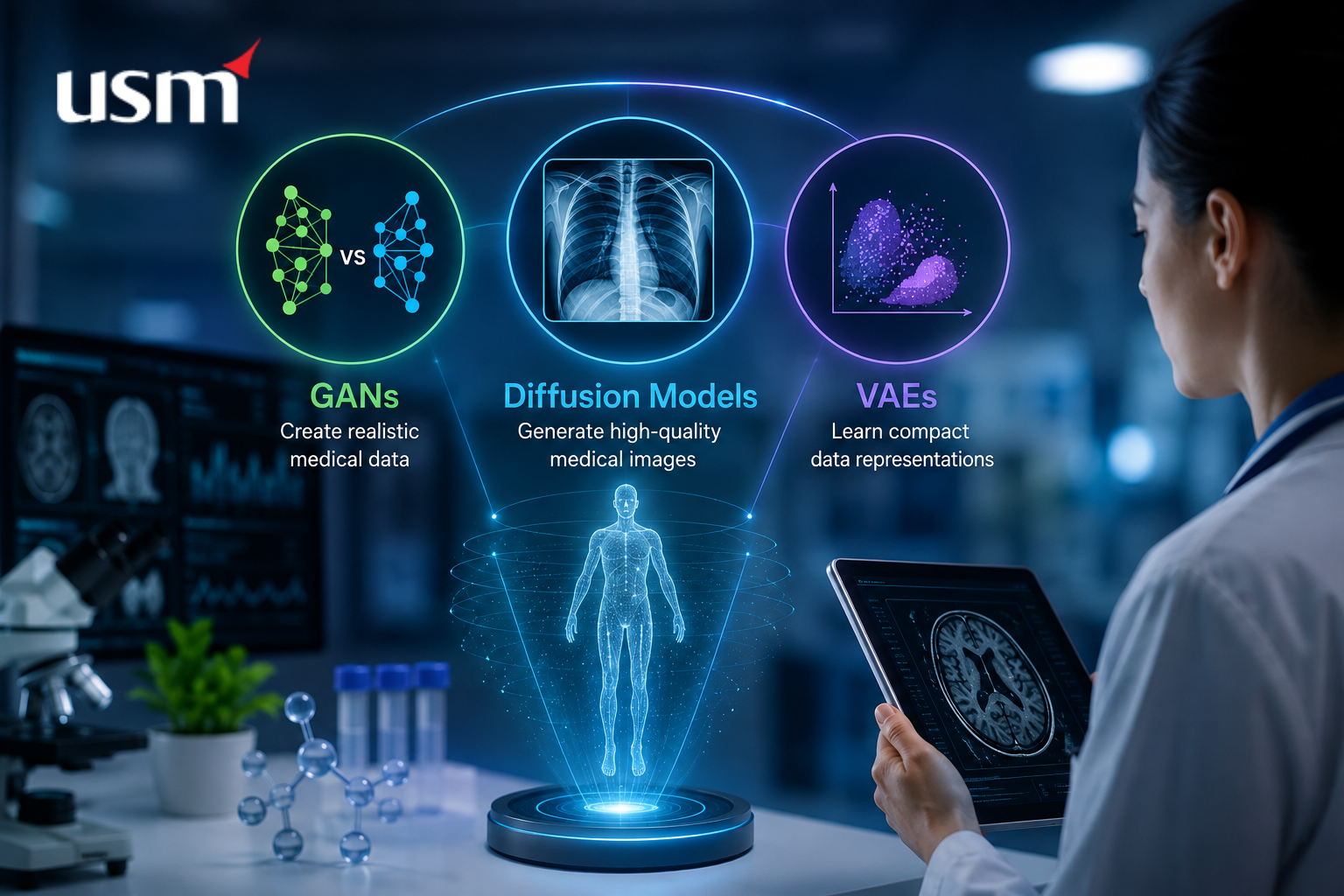
Healthcare generates enormous amounts of complex data, from medical images and genomic information to clinical records and physiological signals. Yet collecting enough high-quality, diverse data for artificial intelligence training remains a major challenge. Generative AI offers a different approach: instead of only analyzing existing information, it can learn patterns from medical datasets and create new, synthetic examples that resemble the original data.
Among the most important generative architectures used in medical AI are Generative Adversarial Networks (GANs), Variational Autoencoders (VAEs), and diffusion models. Each follows a different learning strategy, making them suitable for different healthcare and biomedical applications.
Understanding the differences between these models is important for organizations deciding which technology can support medical imaging, drug discovery, clinical research, synthetic data generation, or personalized healthcare applications.
What Is Generative AI in Medicine?
Generative AI in medicine refers to AI systems capable of producing new content or synthetic data based on patterns learned from medical information.
Depending on the model and training data, generative systems can produce:
-
Synthetic medical images
-
Patient-like datasets
-
Molecular structures
-
Drug candidates
-
Medical text and summaries
-
Imaging variations for model training
-
Simulated clinical scenarios
-
Reconstructed or enhanced medical images
The objective is not simply to create realistic-looking data. In medical environments, generated information must also preserve clinically meaningful characteristics while minimizing privacy risks, bias, and misleading outputs.
This makes model selection particularly important.
Why Generative Models Matter in Healthcare
One of the biggest limitations in medical AI is access to sufficiently large and diverse datasets. Rare diseases, uncommon abnormalities, limited patient populations, and privacy restrictions can make data collection difficult.
Generative models can help researchers create additional training examples or simulate specific conditions. Synthetic data may also support experimentation when direct access to patient information is restricted.
In AI in Healthcare, generative architectures can therefore complement traditional predictive models by helping organizations address data scarcity and improve experimentation.
However, synthetic data should not automatically be considered equivalent to real clinical data. Generated samples need to be evaluated for accuracy, diversity, clinical relevance, and potential bias before they are used in high-stakes applications.
Generative Adversarial Networks (GANs)
GANs use two neural networks that work against each other: a generator creates synthetic samples, while a discriminator attempts to distinguish generated samples from real ones.
The generator continually improves its output based on feedback from the discriminator. Over time, the system attempts to produce increasingly realistic data.
Medical Applications of GANs
GANs have been explored extensively for medical image generation and augmentation. They can generate variations of X-rays, MRI scans, CT images, retinal images, and other forms of medical imagery.
They can also support:
-
Image-to-image translation
-
Medical image enhancement
-
Synthetic abnormality generation
-
Dataset augmentation
-
Resolution improvement
-
Cross-modality image generation
GANs are particularly useful when realistic visual output is important. However, training can be unstable, and some GAN architectures may suffer from mode collapse, where the generator produces limited varieties of samples.
For medical applications, that limitation matters because a dataset that looks realistic but lacks sufficient diversity may not adequately represent real patient populations.
Variational Autoencoders (VAEs)
VAEs take a different approach. Instead of directly learning to generate samples through competition between two networks, they learn a structured representation of the input data in a latent space.
A VAE contains an encoder that compresses information into a probabilistic latent representation and a decoder that reconstructs or generates data from that representation.
This makes VAEs useful when researchers need to understand or manipulate the underlying structure of medical data.
Medical Applications of VAEs
VAEs can be applied to:
-
Medical image reconstruction
-
Representation learning
-
Patient data generation
-
Anomaly detection
-
Feature extraction
-
Drug and molecular research
-
Dimensionality reduction
One advantage is their relatively structured latent representation, which can make it easier to explore variations in generated data.
Their main limitation is that generated images can sometimes appear less sharp than those produced by newer generation techniques. For applications where fine visual detail is critical, other architectures may provide better results.
Diffusion Models
Diffusion models have become an important approach for high-quality content generation. Their basic mechanism involves gradually adding noise to training data and then learning how to reverse that process to generate new samples.
Rather than producing an output in a single step, the model progressively removes noise until a coherent sample emerges.
This iterative generation process allows diffusion systems to achieve high levels of detail and diversity.
Medical Applications of Diffusion Models
In medicine, diffusion models are being explored for:
-
Synthetic medical imaging
-
Image reconstruction
-
Image enhancement
-
Data augmentation
-
Cross-modality translation
-
3D medical image generation
-
Molecular and drug design
-
Multimodal medical generation
Recent research is also moving toward models capable of working across multiple medical modalities, including imaging, pathology, and clinical information.
A major advantage of diffusion models is their ability to generate detailed and diverse outputs. Their drawback is computational cost: the iterative sampling process can require considerably more resources and time than simpler generation approaches.
GANs vs VAEs vs Diffusion Models
The three architectures should not be viewed as competitors where one model is universally superior.
GANs are attractive when highly realistic visual outputs and fast generation are priorities, particularly in image-related applications.
VAEs are valuable when learning meaningful latent representations, reconstructing information, or exploring structured variations within medical datasets is important.
Diffusion models are increasingly attractive when image quality, diversity, controllability, and complex generation tasks are major requirements.
The appropriate architecture ultimately depends on the clinical problem, available data, computational resources, regulatory requirements, and desired output quality.
How These Models Support Drug Discovery
Generative AI is also creating opportunities beyond medical imaging.
In pharmaceutical research, models can learn patterns associated with molecular structures and generate potential compounds with desired properties. Researchers can use these systems to explore chemical possibilities more efficiently before laboratory validation.
This is one reason AI in Pharmaceutical Industry initiatives increasingly include generative modeling alongside predictive machine learning and other computational approaches.
Generative systems can potentially support early-stage compound design, molecular optimization, toxicity exploration, and candidate prioritization. However, generated molecules remain hypotheses until they are validated through appropriate scientific and experimental processes.
Generative AI and the Future of Medical Technology
Generative AI is moving from experimental research toward increasingly specialized medical applications. Its value is not limited to generating images or text. The technology can potentially help researchers simulate complex datasets, accelerate drug research, support medical software development, and improve AI training pipelines.
At the same time, successful implementation will depend on combining advanced models with high-quality data, clinical expertise, strong security, human review, and responsible governance.
For organizations developing healthcare applications, selecting the right architecture is only one part of the equation. The surrounding data pipeline, application design, cloud infrastructure, integration strategy, security controls, and validation framework are equally important.
Companies looking to turn these capabilities into production-ready products can work with an experienced AI app development company to design, integrate, test, and scale generative AI within their existing technology environment.
Conclusion
GANs, VAEs, and diffusion models each provide a different pathway for generating medical data. GANs remain valuable for realistic synthetic imagery, VAEs offer structured representation and reconstruction capabilities, while diffusion models have emerged as a powerful option for detailed and diverse generation.
The best choice depends on the intended application rather than simply selecting the newest architecture.
As healthcare organizations continue exploring AI solutions, the focus is shifting from experimentation toward measurable clinical, research, and operational value. The future of generative AI in medicine will likely depend on models that are not only capable of producing realistic outputs but are also reliable, explainable, secure, clinically validated, and responsibly deployed.
 Italiano
 English
 Arabic
 French
 Spanish
 Portuguese
 Deutsch
 Turkish
 Dutch
Dutch
 Russian
 Romaian
 Portuguese (Brazil)
 Greek
Greek
