


 Pro Benefits
 Environ
 Conditions générale de vente
 Confidentialité
 Child Safety & Protection
 Notifications
 Ayrush Global It Services Pvt Ltd
What is Quantization in LLM? A Complete Guide to Optimizing AI Models
Artificial intelligence has rapidly evolved from an academic pursuit to a core business tool. Companies now deeply want to integrate models like ChatGPT into their own secure systems. This desire stems from a non-negotiable need for data privacy, ensuring sensitive information remains entirely on internal networks. Yet the monumental size and computational demands of these models present a massive deployment hurdle. They demand resources often beyond what's readily available.
Then there’s quantization in LLM, a powerful technique that reduces the precision of model parameters. This decreases memory usage and improves inference speed. This article will explore the concept of what is quantization in LLMs in the context of LLMs, tracing its history, detailing various types, examining size benefits, understanding perplexity as a performance metric, discussing accuracy loss, and highlighting how AI model quantization makes private LLM hosting viable.
Historical Context of Quantization
Origins of Quantization
Quantization as a concept has deep roots in digital signal processing (DSP) and data compression techniques. Initially, it aimed to convert continuous signals into a format suitable for computer storage and processing. The earliest examples of quantization can be traced back to the development of pulse-code modulation (PCM) in the 1930s, in which analog signals were represented in digital form by sampling and quantizing their amplitudes. As noted in the literature, "Quantization forms the core of essentially all lossy compression algorithms."
Evolution in AI
Then deep learning arrived. The 2010s saw neural networks growing not just in complexity but in sheer size. Their computational and memory demands became increasingly profound. Researchers noticed those old DSP concepts. Pioneering work by people like Courbariaux and Rastegari around 2016 showed us something remarkable. We could actually use low-precision weights inside neural networks. They can be made smaller and faster without completely breaking their performance.
Adoption in LLMs
The transition from traditional models to LLMs, with their billions of parameters, highlighted the increasing need for Large Language Model quantization. When models like Llama exploded in size to billions of parameters, the theoretical became an urgent necessity. Quantization was no longer just an interesting optimization. It was the only way to deploy these behemoths on accessible hardware realistically, especially for teams planning a scalable MCP server deployment for enterprise AI systems.
Current Trends
The field is advancing at a very fast pace right now. We're seeing techniques like post-training quantization gain traction, promising not just smaller models, but smarter, more accurate quantized models. The focus has fully shifted to preserving quality, not just compressing size. It’s a fascinating evolution to watch.
Read our Spring Boot LLM integration guide to implement LLMs in production applications.

Types of Quantization
Quantization techniques can be broadly categorized into several types, each with its unique methodologies and applications in optimizing LLMs. This includes widely used LLM quantization techniques applied across modern architectures.
Post-Training Quantization (PTQ)
Post-training quantization is often the first method teams try. It happens after the model is fully trained. You simply convert those high-precision weights, like 32-bit floats, down to a more efficient 8-bit integer format. The great advantage here is speed. You can have a quantized model ready for deployment without the lengthy and expensive retraining process. The trade-off is usually a small accuracy dip, two to five percent. This is perfectly acceptable for a great many applications, says research. especially for teams using AI model quantization to optimize inference.
Quantization-Aware Training (QAT)
Quantization-Aware Training takes a more thorough approach. QAT bakes the quantization process directly into the training loop. The model learns to adapt to the lower precision from the very beginning. It's a bit like training an athlete with ankle weights, so they feel incredibly light once removed. This method generally protects accuracy much better than PTQ, making it worth the extra effort for performance-critical deployments where quantization in neural networks must preserve performance.
Dive into our guide on open-source LLMs to explore cost-effective AI model solutions.
Comprehensive Overview of Quantization Formats
The choice of quantization format significantly impacts model performance, memory usage, and computational efficiency. Here's an in-depth look at the most important formats used in quantization in machine learning workflows:
INT8 (8-bit Integer)
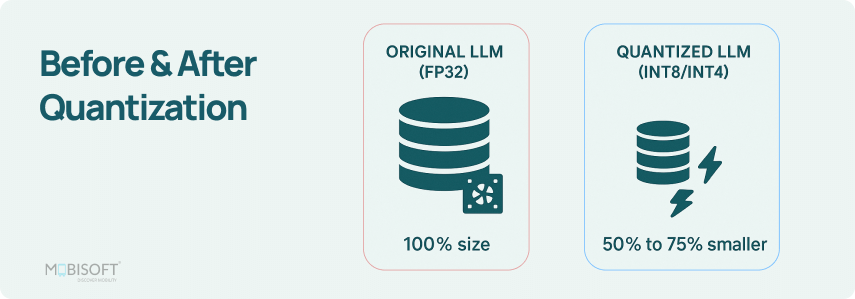
INT8 quantization is the trusted workhorse for production systems. It cuts the model size by seventy-five percent compared to FP32. You typically see less than a one percent accuracy drop, which is just remarkable. Through studies, scholars found out that a massive 70B parameter model that needed 280GB of memory suddenly becomes a much more manageable 70GB. The hardware support across different vendors is also excellent.
Key characteristics:
- Memory reduction: 4x compared to FP32, 2x compared to FP16
- Minimal accuracy loss (typically <1%)
- Excellent hardware support across NVIDIA, AMD, and Intel GPUs
- Industry standard for production deployments in Large Language Model quantization
FP16 (16-bit Floating Point)
FP16, or 16-bit floating point, offers a nice middle ground. It provides a two times reduction in memory and is a common baseline for inference. Modern GPUs handle these calculations natively with their Tensor Cores, which gives you a nice speed boost almost for free.
INT4 (4-bit Integer)
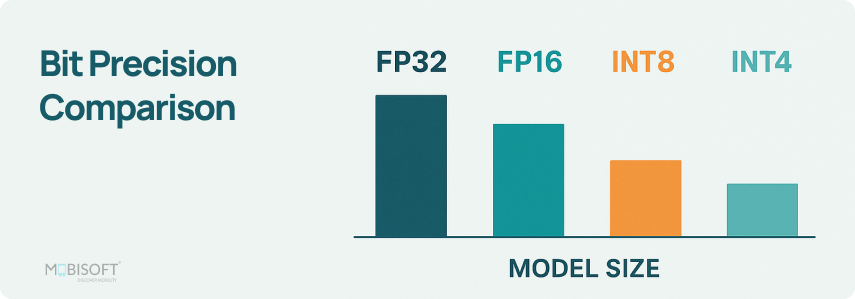
INT4 quantization provides aggressive 8x memory reduction compared to FP32, making large models accessible on consumer hardware. However, this comes with greater accuracy trade-offs. Several methods have emerged to optimize INT4 quantization, supporting the broader goals of AI model optimization techniques used in deployment.
GPTQ (General Pre-Trained Transformer Quantization)
Uses layer-wise quantization with approximate second-order information to minimize output error. GPTQ processes weights in batches, calculating mean squared error (MSE) and updating weights to minimize it. The method is optimized for GPU inference and can achieve 3.25-4.5x speed improvements on various NVIDIA GPUs.
AWQ (Activation-aware Weight Quantization)
Unlike GPTQ, AWQ assumes not all weights are equally important. AWQ identifies ~1% of salient weight channels using activation statistics, then scales these channels up before applying uniform low-bit quantization to all weights. Scaling up the salient channels can reduce the quantization error.
Performance comparison:
- AWQ typically maintains higher accuracy than GPTQ at the same bit width
- Memory usage for a 7B model: ~3.5GB (vs. 14GB in FP16)
- A 70B model requires only ~35-45GB with INT4 (vs. 140GB in FP16)
FP4 (4-bit Floating Point) and NF4 (4-bit NormalFloat)
FP4 represents a newer approach that uses floating-point representation at 4-bit precision. Compared to integer quantization, FP4 handles bell-shaped and long-tail distributions more flexibly. This is particularly advantageous for neural network weights used in quantization in neural networks.
NF4 (NormalFloat 4-bit)
NF4 uses information-theoretically optimal quantization, normalizing weights to fall within a specific range for more efficient representation. Key features include:
- Assuming weights follow a Gaussian distribution
- Using lookup tables for efficient dequantization
- Being integrated with bitsandbytes library for easy deployment
- Enabling fine-tuning of 65B+ models on single consumer GPUs
- Combining with Double Quantization (DQ) for additional 0.4 bits per parameter savings.
Read more: What is Quantization in LLM? A Complete Guide to Optimizing AI Models
 French
 English
 Arabic
 Spanish
 Portuguese
 Deutsch
 Turkish
 Dutch
Dutch
 Italiano
 Russian
 Romaian
 Portuguese (Brazil)
 Greek
Greek
