


 Pro Benefits
 About
About
 Voorwaarden
 Privacy
 Child Safety & Protection
 Meldingen
 Ayrush Global It Services Pvt Ltd
What Are Research Peptides? A Full Comprehensive Guide
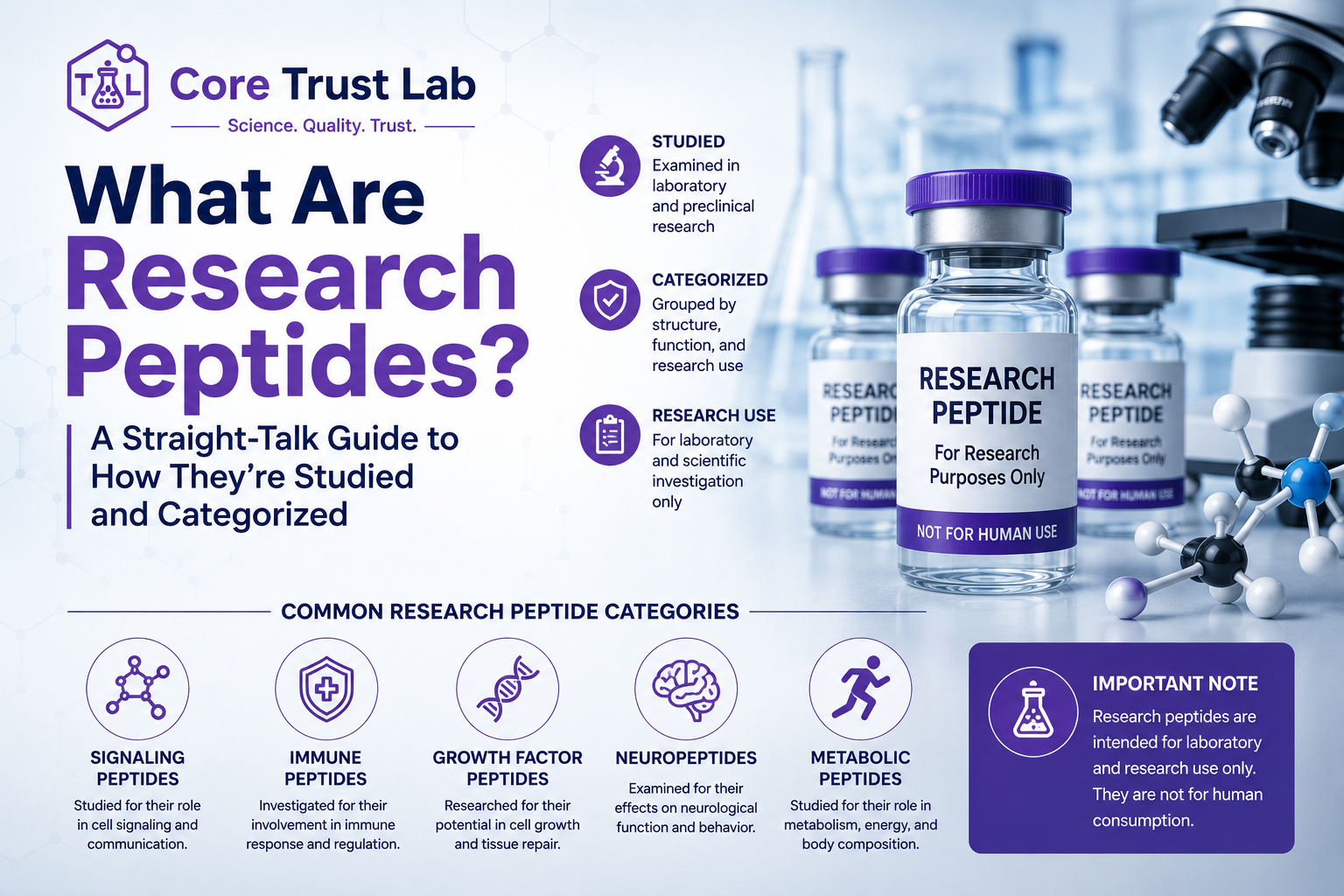
Research peptides are short chains of amino acids used in laboratory and preclinical research to study biological processes like tissue repair, growth hormone signaling, and metabolic function. They're manufactured to a specific purity standard and sold strictly for research use — not for human consumption — which is why you'll see that distinction on virtually every reputable peptide product page, including ours.
If you've spent any time researching this category, you've probably noticed the same handful of names come up again and again: BPC-157, TB-500, CJC-1295, Ipamorelin, GHRP-2, GHRP-6, PT-141, Melanotan 2, AOD-9604, NAD+. Each one belongs to a different research niche, and it's easy to lose track of which is which. Here's a clear breakdown.
What Exactly Is a Peptide?
A peptides is a short chain of amino acids linked together — shorter than a full protein, but built from the same basic building blocks. Because peptides are smaller and more targeted than proteins, researchers can study how specific sequences interact with specific receptors or pathways in the body, which is part of why this category has become such an active area of biomedical research over the past two decades.
How Are Research Peptides Categorized?
Most peptides sold for research purposes fall into a few broad categories based on what they're studied for:
| Peptide | Common Research Category |
|---|---|
| BPC-157 | Tissue repair and recovery research |
| TB-500 (Thymosin Beta-4) | Tissue repair and recovery research |
| CJC-1295 (DAC and No DAC) | Growth hormone signaling research |
| Ipamorelin | Selective growth hormone release research |
| GHRP-2 | Growth hormone secretagogue research |
| GHRP-6 | Growth hormone secretagogue research |
| PT-141 | Neurological and behavioral research |
| Melanotan 2 (MT2) | Melanin and pigmentation research |
| AOD-9604 | Metabolic and fat-oxidation research |
| NAD+ | Cellular energy and metabolism research |
This table is a starting point, not a complete picture — each of these peptides has its own body of published research worth reading directly if you want the full context.
Why Does Purity and Testing Matter So Much in This Category?
Purity matters because peptide research depends on knowing exactly what's in the vial. A sample contaminated with residual solvents, incorrect sequences, or inconsistent concentrations doesn't just produce bad data — it makes any research built on it unreliable from the start.
That's why third-party testing has become the baseline expectation for any peptide supplier worth using. A certificate of analysis should confirm identity and purity for every batch, not just a sample batch used for marketing. If a supplier can't produce that documentation on request, that's a signal worth paying attention to.
What Should You Look for in a Peptide Supplier?
A handful of things separate a supplier researchers actually trust from one that just looks the part:
- Independent, batch-level testing — not occasional spot checks, but verification for every batch that ships.
- Clear documentation — certificates of analysis, accurate labeling, and straightforward answers when you ask for specifications.
- Transparent sourcing — a willingness to explain where and how a product is made, rather than vague marketing language.
- Consistent formulation — the same specification, batch after batch, so research results aren't muddied by supply variability.
- Straightforward research-use labeling — no confusion about what the product is intended for.
Is BPC-157 the Same as TB-500?
No. Both are studied in the context of tissue repair and recovery, which is why people often group them together, but they're structurally different peptides with different research profiles. BPC-157 is derived from a protein found in gastric juice, while TB-500 is a synthetic fragment of Thymosin Beta-4, a naturally occurring protein involved in cell migration. They're frequently referenced together in research discussions, but they are not interchangeable compounds.
What's the Difference Between GHRP-2, GHRP-6, and Ipamorelin?
All three fall under the growth hormone secretagogue category, meaning they're studied for their effect on growth hormone release — but they aren't identical. Ipamorelin is generally studied for its selectivity, meaning it's associated with fewer effects on other hormones like cortisol. GHRP-2 and GHRP-6 are older-generation secretagogues, with GHRP-6 historically associated more strongly with appetite-related research. Researchers choosing between them are typically making a deliberate choice based on the specific pathway they want to study.
A Quick Note on Research-Use Labeling
Every peptide in this category — from BPC-157 to Melanotan 2 to NAD+ — is intended for laboratory and research use, not for human consumption. That's not a technicality; it reflects the actual regulatory status of these compounds and the stage of research they're currently at. Reputable suppliers label products this way because it's accurate, and any research or clinical application of peptide compounds should be guided by a qualified professional working within appropriate protocols.
A Few More Questions People Ask
Do research peptides expire or degrade over time? Yes. Peptides are sensitive to heat, light, and repeated freeze-thaw cycles, which is why proper storage (typically refrigerated or frozen, and shielded from light) is part of any serious research protocol — not an afterthought.
Why do peptide names include numbers like "157" or "500"? These numbers typically trace back to internal research codes or sequence identifiers assigned during early studies, and they've simply stuck as the common name — similar to how many pharmaceutical compounds keep their original research designation long after formal naming.
Are all peptides on the market equally studied? No. Some, like CJC-1295 and Ipamorelin, have a substantial published research base. Others are newer to the commercial market and have a thinner body of available literature. It's worth checking how much published research actually exists before assuming two peptides are equally understood.
The Bottom Line
Research peptides Core Trust Labs cover a wide range of biological questions — from tissue repair to growth hormone signaling to cellular metabolism — and the category has grown fast enough that it's easy to get lost in product names without understanding what actually separates them. The two things that matter most when evaluating any peptide product are category fit (does it actually align with what you're researching) and supplier transparency (can they prove what's in the vial). Get those two things right, and everything else about sourcing peptides responsibly tends to follow.
Browse Core Trust Labs' full peptide catalog, or contact our team for batch documentation and specifications on any product.
 Dutch
Dutch
 English
 Arabic
 French
 Spanish
 Portuguese
 Deutsch
 Turkish
 Italiano
 Russian
 Romaian
 Portuguese (Brazil)
 Greek
Greek
