


 Pro Benefits
 Über
Über
 Bedingungen
 Datenschutz
 Child Safety & Protection
 Benachrichtigungen
 Ayrush Global It Services Pvt Ltd
How Direct Air Capture Supports Climate Goals
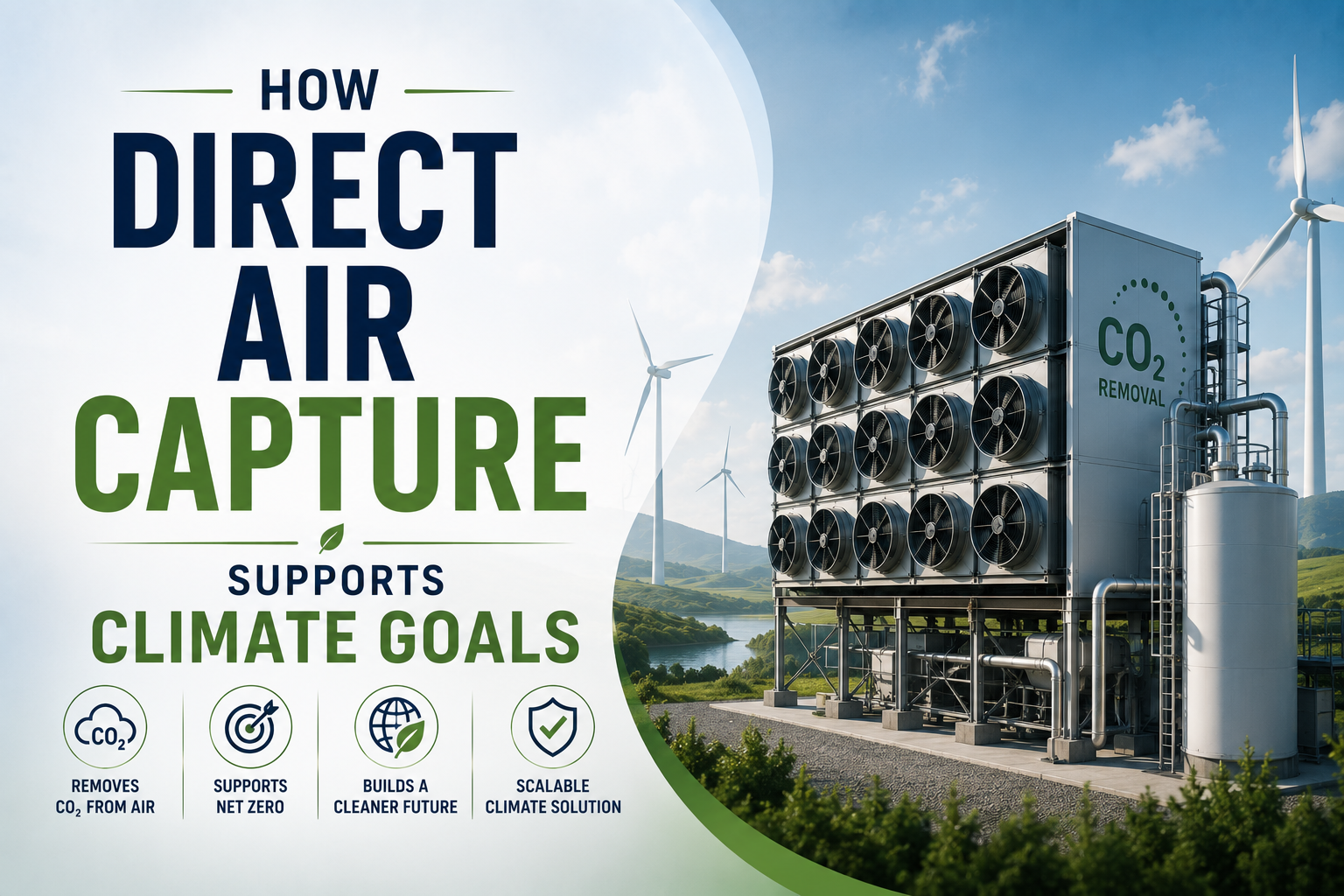
Direct air capture is gaining attention as governments, energy companies, industrial firms, and climate technology developers look for ways to remove carbon dioxide directly from the atmosphere. Unlike point-source carbon capture, which captures emissions from factories or power plants, direct air capture works with ambient air. The captured carbon dioxide can then be stored underground or used in selected industrial applications, depending on project design and policy requirements.
A published study by MarkNtel Advisors reports that the global direct air capture sector was valued at around USD 0.18 billion in 2025. It is projected to grow from USD 0.24 billion in 2026 to USD 2.98 billion by 2032, registering a CAGR of around 52.17% during 2026–32. This growth reflects rising interest in engineered carbon removal, climate policy support, project development, and technology innovation.
Carbon Removal Gains Importance
Direct air capture is part of the wider carbon dioxide removal landscape. It is not a substitute for reducing emissions, but it can support climate strategies where residual emissions are difficult to eliminate. Industries such as aviation, cement, chemicals, and heavy transport may continue to face hard-to-abate emissions, making removal technologies relevant.
The International Energy Agency explains that direct air capture can remove CO₂ from the atmosphere and that carbon removal is part of a broader net-zero strategy alongside deep emissions reductions through its Direct Air Capture analysis. This context supports the role of DAC in long-term climate planning.
Policy Support Encourages Projects
Government policy is one of the most important forces behind direct air capture growth. Projects require high capital investment, long-term storage planning, monitoring systems, permitting, and strong buyer confidence. Public funding, tax credits, procurement programs, and carbon removal standards can help early projects move from demonstration to commercial deployment.
Policy support also signals long-term demand to developers and investors. As countries design climate strategies, direct air capture is being included among carbon management tools. This helps companies plan facilities, improve technology, and build partnerships across energy, engineering, storage, and industrial sectors.
Storage Creates Long-Term Value
The value of direct air capture depends heavily on what happens after CO₂ is captured. When captured carbon dioxide is stored in durable geological formations, it can support long-term removal outcomes. Storage projects require site selection, injection infrastructure, monitoring, verification, and regulatory oversight.
Durable storage is important because buyers and policymakers need confidence that removed carbon will stay out of the atmosphere. This makes measurement, reporting, and verification central to direct air capture business models. Projects with strong storage partners and transparent monitoring can build stronger market trust.
Utilization Offers Additional Routes
Captured carbon dioxide can also be used in selected products and industrial processes. Potential uses include synthetic fuels, chemicals, construction materials, beverages, and other carbon-based applications. However, the climate value depends on how long the carbon remains stored and whether the use avoids additional emissions.
Utilization can help create early revenue pathways for direct air capture developers, especially where storage infrastructure is limited. Still, long-term growth will likely depend on projects that combine capture with durable storage or use applications that provide verifiable climate benefit.
Technology Innovation Reduces Barriers
Direct air capture technologies are still developing. Companies are improving sorbents, solvents, contactor designs, heat integration, modular systems, regeneration processes, and energy efficiency. These improvements are important because DAC must process large volumes of air to capture carbon dioxide.
The U.S. Department of Energy describes carbon dioxide removal as including direct air capture with storage and other removal approaches through its carbon dioxide removal guidance. Continued research, demonstration, and deployment can help reduce technology barriers and improve operating performance.
Energy Demand Remains a Challenge
Energy use is one of the biggest challenges for direct air capture. DAC systems need power and heat to move air, bind carbon dioxide, release it from capture materials, compress it, and prepare it for storage or utilization. If energy comes from high-emission sources, the overall climate benefit can be reduced.
This makes clean energy access important for DAC projects. Developers often evaluate renewable power, waste heat, geothermal energy, nuclear energy, and low-carbon industrial heat sources. The ability to secure reliable low-carbon energy can influence project location, operating cost, and environmental performance.
Corporate Buyers Support Demand
Corporate carbon removal purchasing is supporting early direct air capture deployment. Companies with climate targets may buy verified carbon removals to address residual emissions after reducing their own footprint. These purchases can help developers secure revenue and demonstrate demand for future projects.
However, buyers are becoming more selective. They look for durability, additionality, transparent measurement, third-party verification, and clear project documentation. This pushes direct air capture companies to build stronger reporting systems and credible removal certificates.
Industrial Partnerships Are Expanding
Direct air capture projects often require partnerships across multiple sectors. Technology developers need engineering firms, energy suppliers, landowners, storage operators, carbon transport networks, financiers, and buyers. These partnerships help reduce project complexity and support scale-up.
Industrial companies can also support DAC by providing infrastructure knowledge, subsurface storage experience, project management capability, and access to low-carbon energy. As the sector grows, partnerships between climate technology startups and established energy or industrial firms are likely to become more important.
Regulation Supports Credibility
Regulation and standards are important because direct air capture claims must be credible. Carbon removal projects require accurate measurement of captured CO₂, verification of storage or use, lifecycle emissions accounting, and clear ownership of credits. Without strong rules, buyers may struggle to judge project quality.
The IPCC discusses direct air carbon capture and storage within wider carbon dioxide removal methods in its cross-sectoral climate assessment. This supports the need to evaluate DAC alongside storage duration, energy use, governance, and residual-emission management.
Costs Need Further Reduction
Cost reduction remains central to direct air capture commercialization. Early systems face high equipment, energy, engineering, and storage costs. Scaling manufacturing, improving capture materials, standardizing modules, and building shared infrastructure can help reduce expenses over time.
Project developers are also working to improve plant design and operating reliability. As more facilities are built, the sector may benefit from learning effects, better supply chains, and more efficient project execution. Lower costs can help expand demand beyond early corporate buyers and public funding programs.
Outlook for Direct Air Capture
The global direct air capture sector is expected to grow rapidly through 2032, supported by climate policy, carbon removal purchasing, technology innovation, storage infrastructure, and industrial partnerships. The sector remains early-stage, but its role is expanding as countries and companies plan for residual emissions and long-term carbon management.
Future growth will depend on lower costs, clean energy access, durable storage, transparent verification, project financing, and stronger buyer confidence. Companies that combine efficient capture technology, reliable storage partnerships, strong measurement systems, and credible climate performance will remain important in the direct air capture sector.
 Deutsch
 English
 Arabic
 French
 Spanish
 Portuguese
 Turkish
 Dutch
Dutch
 Italiano
 Russian
 Romaian
 Portuguese (Brazil)
 Greek
Greek
