


 Pro Benefits
 Σχετικά
 Όρους
Όρους
 Ιδιωτικότητα
 Child Safety & Protection
 Ειδοποιήσεις
 Ayrush Global It Services Pvt Ltd
How AI Is Transforming Modern Marketing and Sales Strategies
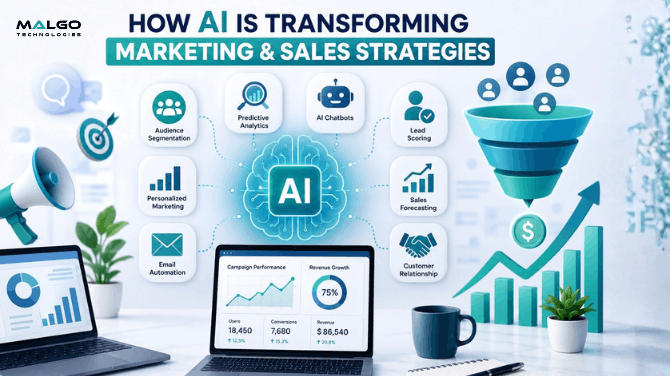
Marketing and sales have always depended on understanding customer behavior, building meaningful relationships, and delivering the right message at the right time. However, as customer expectations continue to grow and digital channels multiply, businesses face increasing pressure to respond quickly while maintaining personalized experiences. Artificial intelligence (AI) is helping organizations overcome these challenges by making marketing and sales processes more intelligent, efficient, and data-driven.
Instead of replacing marketing professionals, AI enhances their capabilities. It automates repetitive tasks, uncovers valuable customer insights, predicts purchasing behavior, and helps sales teams focus on high-value opportunities. Companies of all sizes are now using AI to improve decision-making, strengthen customer engagement, and achieve better business outcomes.
Why AI Is Becoming Essential for Modern Marketing Space
The modern customer journey is more complex than ever before. Consumers interact with businesses through websites, search engines, social media platforms, mobile applications, emails, and online advertisements before making a purchasing decision. Managing these interactions manually has become increasingly difficult.
AI enables marketers to process vast amounts of customer data in real time, identify meaningful patterns, and make faster decisions. Instead of relying solely on assumptions or historical reports, businesses can use AI-powered insights to understand customer preferences, predict future behavior, and optimize campaigns while they are still running.
This ability to analyze data continuously allows organizations to improve campaign performance, reduce wasted advertising spend, and deliver more relevant experiences to their audiences.
Smarter Customer Segmentation
One of AI's biggest advantages is its ability to create highly accurate customer segments. Traditional segmentation often groups customers based on age, location, or gender. While useful, these categories rarely capture the complexity of modern buying behavior.
AI analyzes browsing activity, purchase history, engagement patterns, search intent, and customer interactions to create dynamic audience segments. As customer behavior changes, AI automatically updates these groups, ensuring businesses always target the right audience with relevant messaging.
This level of personalization improves customer satisfaction while increasing conversion rates across marketing campaigns.
Personalized Marketing at Scale
Personalization has become one of the most important factors influencing purchasing decisions. Customers expect businesses to understand their interests and recommend products or services that match their needs.
AI makes large-scale personalization possible by analyzing customer behavior and delivering tailored experiences across multiple channels. Email campaigns can display personalized recommendations, websites can highlight relevant products, and digital advertisements can adapt based on previous customer interactions.
Instead of creating separate campaigns for every audience, marketers can rely on AI to deliver individualized experiences automatically, improving both engagement and customer loyalty.
AI-Powered Lead Generation
Generating qualified leads is often one of the most time-consuming aspects of marketing. AI simplifies this process by identifying potential customers who are most likely to convert.
Machine learning algorithms evaluate customer behavior, online interactions, demographic information, and engagement history to score leads based on their likelihood of making a purchase. Sales teams can then prioritize high-quality prospects instead of spending valuable time pursuing leads with little buying intent.
This approach improves sales efficiency while allowing marketing teams to allocate resources more effectively.
Improving Sales Forecasting
Accurate sales forecasting helps businesses make informed decisions about inventory, staffing, budgeting, and future growth. Traditional forecasting methods often rely heavily on historical sales data and manual analysis.
AI enhances forecasting by incorporating multiple data sources, including customer demand, seasonal trends, economic conditions, competitor activity, and real-time market changes. These predictive insights help organizations prepare for future opportunities while reducing uncertainty in business planning.
Sales leaders can also identify emerging trends earlier, allowing them to adjust strategies before market conditions change significantly.
AI Chatbots and Virtual Assistants
Customer support has become an important part of both marketing and sales. Many customers expect immediate responses regardless of the time of day.
AI-powered chatbots provide instant assistance by answering frequently asked questions, recommending products, scheduling appointments, and guiding users through purchasing decisions. More advanced virtual assistants can qualify leads, collect customer information, and transfer complex inquiries to human representatives when necessary.
This combination of automation and human support improves response times while ensuring customers receive timely assistance throughout their buying journey.
Creating Better Marketing Content
Content remains one of the most effective ways to attract and educate potential customers. AI assists content creators by identifying trending topics, analyzing audience interests, generating content ideas, and optimizing articles for search engines.
Rather than replacing human creativity, AI helps marketers produce more relevant content that aligns with customer intent and current market trends. Businesses can maintain consistent publishing schedules while improving the quality and effectiveness of their marketing materials.
Strengthening Customer Relationships
AI helps businesses strengthen long-term relationships by identifying customer satisfaction trends, predicting churn, and recommending proactive engagement strategies.
For example, AI can detect when customers become less active and automatically trigger personalized offers, educational content, or follow-up communications designed to rebuild engagement. These timely interactions improve customer retention while increasing lifetime value.
Measuring the ROI of AI in Marketing and Sales
Investing in AI is not just about adopting new technology—it is about achieving measurable business outcomes. To understand whether AI is delivering value, businesses should track key performance indicators (KPIs) before and after implementation. These metrics provide a clear picture of how AI is improving marketing efficiency and sales performance.
For marketing teams, AI can increase campaign effectiveness by improving click-through rates, conversion rates, customer engagement, and return on advertising spend. AI-powered analytics also help identify which campaigns generate the highest-quality leads, allowing marketers to allocate budgets more effectively and reduce unnecessary spending.
Sales teams can measure AI's impact through faster response times, improved lead qualification, shorter sales cycles, and higher conversion rates. By prioritizing prospects with the greatest likelihood of making a purchase, AI enables sales representatives to spend more time building relationships instead of manually sorting through leads.
Customer retention is another important indicator of AI success. Businesses can monitor repeat purchases, customer lifetime value, and satisfaction scores to determine whether AI-driven personalization and support are strengthening long-term customer relationships. When customers receive timely recommendations and personalized experiences, they are more likely to remain loyal to the brand.
Businesses working with an AI development company can also build customized dashboards that track these performance metrics in real time. Instead of relying on manual reports, decision-makers gain instant visibility into campaign performance, sales trends, and customer behavior, allowing them to make faster and more informed strategic decisions.
Ultimately, measuring AI's return on investment helps organizations refine their strategies, maximize the value of their technology investments, and identify new opportunities for continuous improvement. Companies that regularly evaluate AI performance are better equipped to scale successful initiatives and maintain a competitive advantage in an increasingly data-driven marketplace.
Conclusion
Artificial intelligence is reshaping the way businesses approach marketing and sales by enabling smarter decision-making, greater personalization, and improved operational efficiency. From customer segmentation and predictive analytics to lead generation and content optimization, AI helps organizations build stronger customer relationships while maximizing business performance.
As AI technologies continue to evolve, businesses that embrace intelligent marketing strategies today will be better positioned to compete in an increasingly digital marketplace. By combining human creativity with AI-powered insights, organizations can create more meaningful customer experiences, improve sales performance, and drive sustainable long-term growth.
 Greek
Greek
 English
 Arabic
 French
 Spanish
 Portuguese
 Deutsch
 Turkish
 Dutch
Dutch
 Italiano
 Russian
 Romaian
 Portuguese (Brazil)
