


 Pro Benefits
 Σχετικά
 Όρους
Όρους
 Ιδιωτικότητα
 Child Safety & Protection
 Ειδοποιήσεις
 Ayrush Global It Services Pvt Ltd
Ride Sharing Software for Corporate ESG Goals
How Ride Sharing Software Supports Corporate ESG and Net Zero Mobility Goals
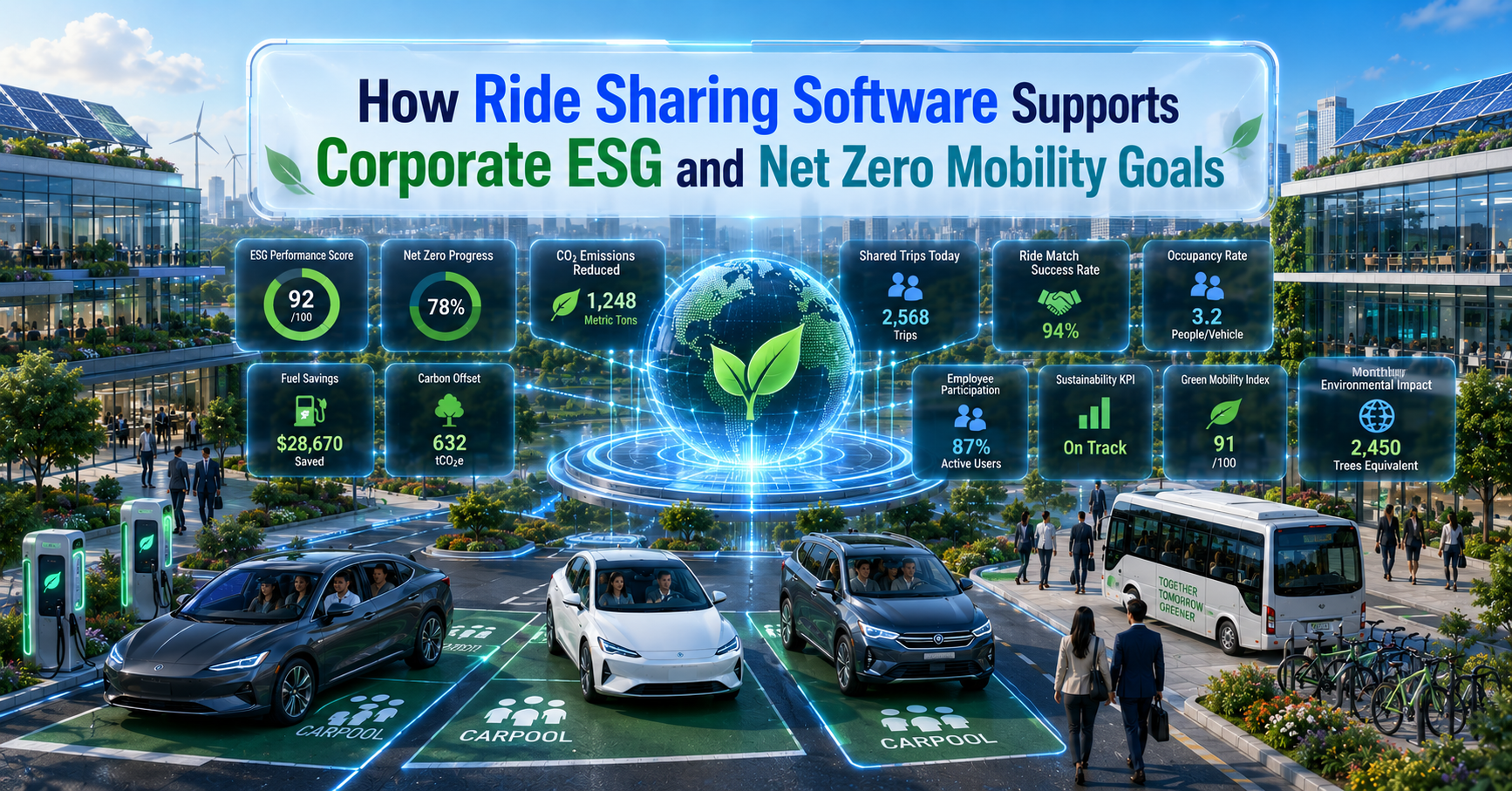
ESG targets used to live mostly in energy audits and supply chain reviews. That has changed, and commuting is now part of the conversation too. A ride sharing software platform gives companies a concrete way to act on this, rather than leaving mobility as a vague line item in a sustainability report. This article looks at how such tools connect daily commuting to real ESG and net zero progress.
Why Does Employee Commuting Matter for ESG Goals?
Commuting emissions sit under Scope 3, the bucket that covers indirect emissions across a company's wider footprint. Energy use gets audited down to the decimal. Supplier emissions get tracked, questioned, and re-tracked. Commuting, somehow, still gets a rough guess scribbled once a year and filed away. That gap is getting harder to defend. Regulators want sharper disclosure now, and investors have started asking the kind of pointed questions that used to get a shrug. Younger employees notice too, more than companies expect, and they tend to check whether a sustainability pledge actually shows up in how people get to work. Commuting sits right in the middle of all this, plain to see every morning in the parking lot, yet almost nobody measures it properly.
-
Investor scrutiny on Scope 3 disclosure is increasing year over year
-
Regulatory frameworks in several regions now expect commute related reporting
-
Employees increasingly expect employers to back sustainability claims with action
Ignoring this category does not make it disappear from an audit. It simply means the eventual number, when someone finally calculates it properly, tends to be larger and less flattering than expected.
How Does Ride Sharing Software Cut Commute Emissions?
The logic is fairly direct once you sit with it. Every solo drive replaced by a shared ride removes one vehicle's worth of daily emissions from the total. Do that consistently across hundreds of employees, and the numbers stop being trivial.
A thoroughly developed ride sharing software platform enables this behavior as well as measures it. Every pooled trip gets logged, which means a company can finally see actual figures instead of rough guesses pulled together once a year for a report.
Fewer Cars, Measurable Impact:
-
Number of rides pooled each month, tracked automatically
-
Total distance saved through shared trips instead of solo drives
-
Estimated emissions avoided, calculated from real trip data
Underneath this, a carpool management system handles the operational side, matching employees by route and schedule so the emissions reduction actually happens at scale, not just in theory.
Can Carpooling Data Feed Into ESG Reporting?
This is where the software earns its place beyond day-to-day convenience. Trip data collected through a corporate carpooling solution can be structured to align with common Scope 3 disclosure formats, which saves sustainability teams from rebuilding estimates from scratch every reporting cycle.
Commute reporting based on manual estimation is often inaccurate, as it is prone to errors. Someone surveys a sample of employees, takes an average, hoping it would suffice. Automated reporting removes most of that guesswork, since the platform already has the actual trip counts on file.
-
Total emissions avoided across a reporting period, broken down by month
-
Participation rate among eligible employees, tracked over time
-
Trend data showing whether adoption is growing or plateauing
We think this reporting layer is genuinely undervalued. Companies often buy carpooling software purely for the logistics benefit, then discover months later that the same data solves a reporting headache too, almost as a side effect.
How Does This Support Net Zero Commitments?
Net zero targets are built from many smaller reductions stacked together, and commuting is one piece that companies can influence relatively directly. Unlike supply chain emissions, which often depend on third-party cooperation, commute emissions sit largely within a company's own reach.
The contribution compounds, too. Even if a simple ride-sharing works and expands over time, the annual reduction over three to four years is significant for the business. That kind of steady, provable progress tends to matter more to auditors than a single dramatic announcement.
-
Annual emissions avoided, which can be tracked against net zero milestones
-
Reduced fuel consumption across the employee base, adding up over the years
-
Lower dependency on carbon offsets, since actual emissions are cut rather than compensated for
None of this replaces the harder structural work net zero targets demand elsewhere in the business. It does, however, give sustainability teams one category where progress is visible, provable, and reasonably fast to demonstrate.
What Business Value Comes With ESG Aligned Mobility?
The payoff here goes beyond ticking a compliance box. Companies that take visible action on commute emissions often find it helps with hiring too, since candidates who care about sustainability can tell the difference between a careers page slogan and an actual working program. There is an investor angle as well. ESG scores built on real numbers carry more weight than ones built on good intentions, and that difference shows up in due diligence conversations. Something else happens internally, and it is easy to miss. When employees see their own leadership carpooling instead of just endorsing it from a memo, the whole initiative starts to feel real rather than staged, and that shift in perception counts for more than most companies assume.
-
Stronger ESG scores supported by verifiable commute data
-
Positive press and recognition tied to measurable sustainability action
-
Smoother disclosure audits, since data is already structured and available
When evaluating a rideshare management software platform for this purpose, a few priorities matter more than others. Reporting depth should come first, followed by how easily the tool integrates with existing ESG software. Scalability matters too, since a car pooling system that works for two hundred employees needs to hold up just as well at two thousand. Ease of adoption rounds out the list, since a platform employees actually use is the only one that produces real data.
Turn Commute Data Into Real ESG Progress
Commuting is no longer a footnote in ESG strategy. A capable ride-sharing software platform turns daily rides into measurable progress toward net-zero goals, backed by real data rather than estimates. Perhaps it's time to ask how much of your own commute footprint is actually being tracked, and how much is still a guess.
 Greek
Greek
 English
 Arabic
 French
 Spanish
 Portuguese
 Deutsch
 Turkish
 Dutch
Dutch
 Italiano
 Russian
 Romaian
 Portuguese (Brazil)
