


 Pro Benefits
 Sobre
Sobre
 Termos
 Privacidade
 Child Safety & Protection
 Notificações
 Ayrush Global It Services Pvt Ltd
How Employee Transportation Management Systems Improve Workforce Safety and Visibility
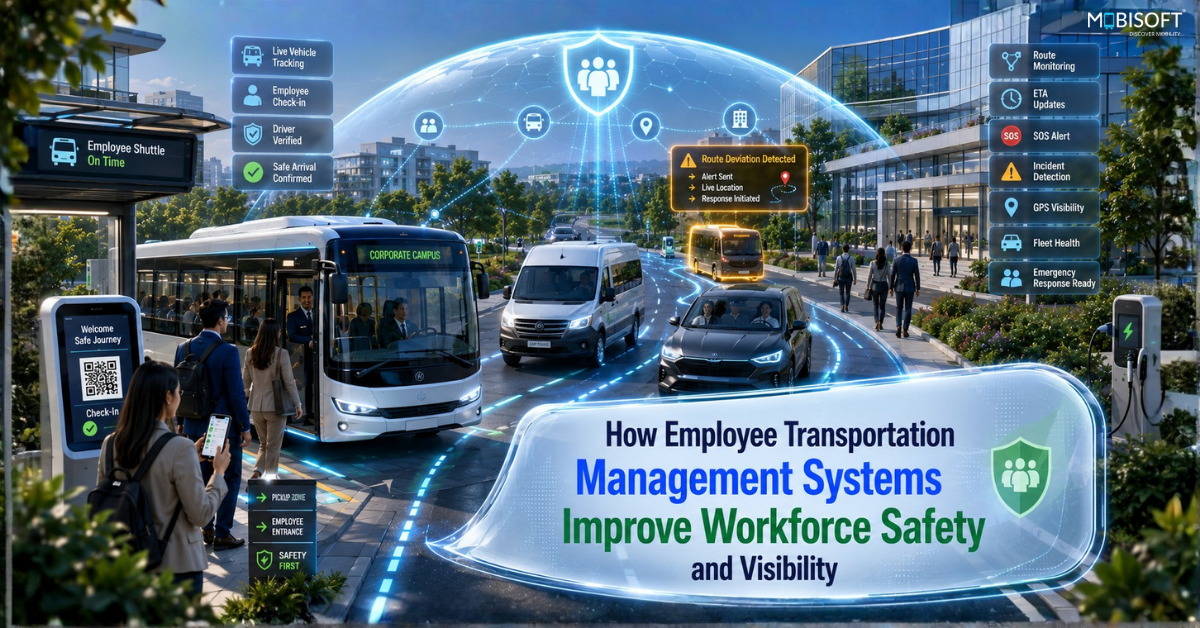
Most companies can tell you exactly where their inventory is at any given moment, down to the shelf. Very few can tell you, with the same confidence, where an employee actually is fifteen minutes after they left the office gate. That mismatch is high, and transport is often the part of the day where a company has the least visibility and the most liability at once. A proper employee transportation management system solves it by making sure the admin is notified of the issue, instead of an hour later when someone finally asks.
What Happens in the First Minutes of a Transit Incident
Say a rider misses a scheduled check-in, or an SOS gets triggered from inside the vehicle. What happens in the next few minutes decides a lot, arguably more than anything that happens after. On a system with live tracking, an alert lands on someone's screen almost immediately, showing the exact location, the vehicle's recent path, and who else is on board. That admin can act while the situation is still unfolding instead of piecing it together after the fact.
Compare that to the phone call version, which is still how a surprising number of companies handle this. Someone tries the driver, gets no answer, maybe tries again in five minutes, then starts calling around to see if anyone's heard anything. By the time there's an actual picture of what happened, ten or fifteen minutes have usually passed. In a genuine emergency, that gap matters more than most safety policies acknowledge.
An employee transport management system built around this problem treats those first minutes as the whole point, not an afterthought bolted onto a routing tool.
What Do Admins and Employees Need to See in Real Time
Visibility gets used as a catch-all word, but it means two different things depending on who's asking.
-
What Admins Need to See
A facilities or transport admin is watching a fleet, not a single trip. They need a live map showing every active vehicle, route changes, vehicles not communicating back, option to monitor a specific vehicle's status in case of a possible issue. Most of the time nothing's wrong, and the dashboard works fine without prompting anything.
-
What Employees Need to See
An employee riding solo at night doesn't care about fleet-wide anything. They want to know who's driving, what that person looks like, roughly when the vehicle will show up, and a way to flag a problem without needing to explain themselves to anyone first. A capable employee transport management software setup treats these as genuinely separate interfaces built for two different kinds of anxiety, not one dashboard awkwardly serving both.
How Incident Records Protect Companies and Employees
Most companies do not prepare for this possibility until it becomes a scenario. Whenever something does go wrong, such as a missed pickup, a route dispute, or an accusation against a driver, the company cannot rely solely on human memory for details. It needs timestamped location history, a record of who boarded and when, and driver credentials that were actually verified rather than assumed.
This matters for an HR investigation. It matters if a parent or family member is asking hard questions about a late-night worker's commute home. It matters, frankly, in front of a regulator or in a courtroom, where "we believe the driver followed the route" carries a lot less weight than a logged trip history that backs it up. An employee transportation solution without this kind of record-keeping is really just a booking tool wearing a safety label it hasn't earned.
Good documentation also protects employees, not just the company. A driver wrongly accused of something has a record clearing them. A rider whose complaint got dismissed has proof it happened. That cuts both ways, and it should.
Does Time of Day Change Employee Transport Safety
A shuttle running at 6 pm with fifteen people on it and a shuttle running at 11 pm with one solo rider are not the same risk, even if it's the same vehicle on the same road. Most transport policies treat every trip identically in terms of monitoring and response protocol, regardless of time or the people on board.
Late-night and early-morning pickups usually mean fewer riders, quieter roads, and less margin if something goes sideways, whether that's mechanical trouble or something involving personal safety. A handful of things change the calculation here.
-
Solo riders traveling late at night deserve tighter check-in intervals than a full daytime shuttle
-
Route familiarity matters more after dark, when detours or closures are harder to navigate blind
-
Response protocols should escalate faster for a single rider than for a packed vehicle, since there's no one else on board to notice or help
A well-built employee transportation solutions approach doesn't apply one blanket rule to every trip. It adjusts the level of attention to the actual risk in front of it, which sounds obvious written down and is rarely how it's actually done.
What Makes Real-Time Monitoring Different From Tracking
Plenty of platforms will show a dot moving on a map and call that safety. This way of tracking is useful, but only helps if someone happens to be watching at the right moment. Real monitoring refers to the system noticing something itself, like a vehicle that's been still for too long, a route deviation with no explanation, or a check-in that never came through.
The distinction sounds small until an incident actually happens at 2 am when nobody's staring at a screen. A tracking map assumes a human is paying attention at all times. Monitoring assumes they're not, and builds the alerting to compensate anyway.
Before choosing between vendors, it's worth asking a plain question. Does this platform tell you when something's wrong, or does it just let you go looking for the answer if you happen to think to check?
Build a Safer, More Visible Transport System Today
A delay causes most safety failures in employee transport. It is the time between something going wrong and someone finding out. An employee transport management solution shrinks that delay to nearly nothing, and that's the actual value: a company that handles an incident in minutes instead of hearing about it an hour later.
Go back to that missed pickup from the start of this piece. A system worth using would have flagged it before anyone had to ask.
 Portuguese (Brazil)
 English
 Arabic
 French
 Spanish
 Portuguese
 Deutsch
 Turkish
 Dutch
Dutch
 Italiano
 Russian
 Romaian
 Greek
Greek
