


 Pro Benefits
 Environ
 Conditions générale de vente
 Confidentialité
 Child Safety & Protection
 Notifications
 Ayrush Global It Services Pvt Ltd
Corporate Carpooling Solutions for Sustainable Mobility
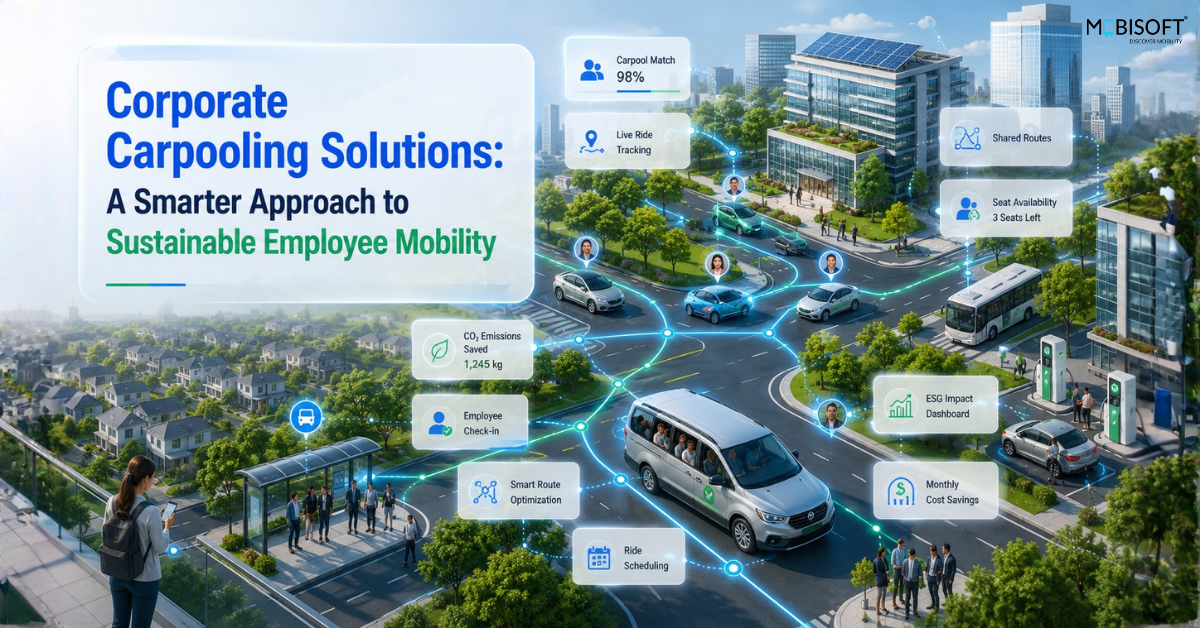
Getting employees to share a ride sounds simple on paper. It rarely works out that way because most carpool efforts fizzle out within a few months. Speaking from experience, the reason is rarely lack of interest, but that nobody solved the matching problem. Right people, right time, without someone having to babysit it every week. That's the gap a proper corporate carpooling solution closes, and it's a big part of why companies are looking at this space again now.
Why Do Most Carpool Programs Fail Early
Ask around, and you'll hear some version of the same story. Someone in HR builds a spreadsheet, gets a bunch of people to fill in their routes, and it looks fine for maybe three weeks. Then someone changes teams, someone else moves apartments, a couple of people quietly start driving alone again, and nobody updates the sheet. It just sits there getting more wrong by the week until whoever built it gives up on chasing people for updates.
-
No real matching logic. A shared spreadsheet can't account for work timing, route overlap, or who's actually reliable.
-
Zero accountability. If a rider bails at the last minute, there's no system to track it, so the driver just eats the inconvenience.
-
Manual coordination fatigue. Someone has to keep asking who's in, who's out, and that person usually gives up after a while.
A car pooling system built with actual software behind it solves this differently. It doesn't rely on goodwill or a volunteer coordinator; it handles matching and accountability in the background, which is honestly the only way these programs survive beyond the pilot phase.
What Makes a Carpool Match Actually Work
Matching people isn't just about who lives near who. A good carpool management system looks at a handful of things together, and gets the balance right more often than a human trying to eyeball it ever could.
-
Route and Timing Overlap
It looks at actual routes people drive, not just which neighborhood they live in. Two people ten minutes apart on a map can end up taking completely different roads, so going by area alone gets this wrong more often than you'd think.
-
Work Schedule Sync
Hybrid schedules make this trickier than it used to be. Someone's Monday match might make zero sense by Thursday if their office days moved, and a lot of tools just don't bother checking again once a match is made. That's really where things fall apart for most setups.
Beyond those two, most platforms also weigh things like vehicle capacity, gender preference for safety reasons, and how consistently someone's shown up in the past. None of this needs to be complicated for the rider; they just open an app, get matched, and go. The complexity sits behind the scenes where it belongs.
How Does Rideshare Software Handle Trust and Safety
This is probably the part people worry about most, and fairly so. Getting into a car with a coworker you barely know feels different from hailing a cab. A solid rideshare management software setup usually handles this through a few layers.
-
Verified employee profiles tied to company ID, so nobody's a stranger on paper at least
-
Ratings or feedback after each ride, similar to how consumer ride apps work
-
Trip visibility for both riders, so the route and timing are never a mystery
-
An opt-out option that doesn't require an explanation, because sometimes people just aren't comfortable and that's fine
We think the safety piece is often underestimated by companies rolling this out for the first time. It's tempting to focus purely on logistics and forget that asking employees to share a car is asking them to trust a system, not just an app. Good ride sharing software treats that trust as the actual product, not an afterthought bolted on after the routing engine was built.
Can Carpooling Actually Cut Costs and Emissions
Here's where it gets interesting for finance and sustainability teams alike, though for slightly different reasons. Fewer cars on the road for the same headcount means less spent on fuel reimbursements, less parking pressure at the office, and a smaller emissions footprint tied to daily commuting.
It's not a dramatic overnight change either. The savings build slowly as adoption grows, and that's honestly a more believable story than the huge percentage claims some vendors like to throw around. A company that gets even a third of its eligible employees carpooling regularly will notice a real dent in both parking demand and commute-related costs within a couple of quarters, without much drama involved.
Employees benefit too, and not just financially. Splitting a ride cuts individual fuel spend, sure, but it also means less time stuck alone in traffic, and for a lot of people, that's a quieter kind of relief nobody really talks about enough.
Setting Up a Carpool Program That People Actually Use
Rolling this out well takes more than just buying software and hoping people sign up. A few things tend to separate programs that stick around from ones that fade out within a year.
-
Make joining effortless: If registration takes more than a few minutes, a chunk of people simply won't bother.
-
Incentivize early adoption: Reserved parking spots or small perks for regular carpoolers go a long way in the first few months.
-
Keep leadership visibly involved: When managers carpool too, it signals this isn't just a cost-cutting exercise dumped on staff.
-
Review and adjust quarterly: Office days move around, teams reorganize, and the matching logic needs fresh data to stay useful.
Perhaps the simplest way to judge if a corporate carpooling solution is actually working is this. Are people still using it three months in without being reminded? If yes, the program earned its place. If everyone's back to driving solo, something in the setup needs a second look.
Conclusion
Corporate carpooling isn't a new idea, but doing it well finally feels achievable now that software can handle the coordination humans kept dropping. A well-built carpool management system solves the matching, the trust, and the accountability all at once, which is exactly where most manual attempts used to fall apart.
Maybe it's worth asking whether your own commute setup still makes sense, or whether it's just running on habit at this point.
Take a look at how your employees actually get to work this month. There might be more room for sharing rides than anyone's assumed.
 French
 English
 Arabic
 Spanish
 Portuguese
 Deutsch
 Turkish
 Dutch
Dutch
 Italiano
 Russian
 Romaian
 Portuguese (Brazil)
 Greek
Greek
