


 Pro Benefits
 About
About
 Voorwaarden
 Privacy
 Child Safety & Protection
 Meldingen
 Ayrush Global It Services Pvt Ltd
The Enterprise Guide to AWS Cloud Migration

Enterprise cloud migrations fail in predictable ways. The migration project team undervalues the complexity of its application's dependency requirements. Instead of modernizing its workload's architecture, which would enable leveraging of cloud services, the migration team migrates it as is to pay for cloud-based applications using an on-premise pricing model. The security and compliance measures put in place for the on-premise environment are not set up to protect the cloud before migrating the workload to it. The post-migration cost optimization activities required to validate the migration business case are never carried out, as the migration team is already working on its next big priority project.
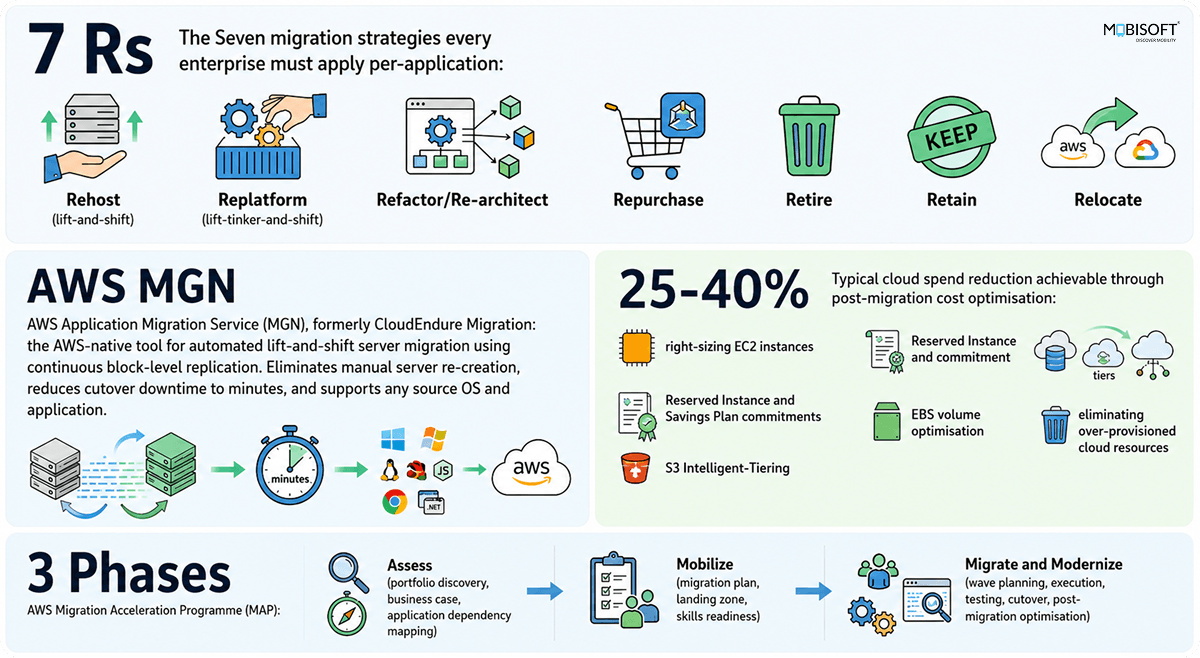
Mobisoft's enterprise cloud migration practice is built on a structured framework: the AWS MAP Migration Acceleration Programme phases, the AWS migration strategy 7 Rs, AWS MGN application migration for automated server replication, AWS DMS database migration for database migration, and the AWS Well-Architected Framework review for post-migration architecture review. This framework prevents each of these failure modes systematically.
Why Enterprise Cloud Migrations Fail: The Five Structural Failure Modes and How a Structured Framework Prevents Them
Enterprise cloud migration projects have a higher failure rate than most enterprise technology initiatives. This is not because the technology is unreliable. AWS infrastructure is significantly more reliable than the on-premises infrastructure most enterprises are migrating from. The problem is that the migration approach consistently underestimates the complexity of the enterprise's application portfolio and consistently overestimates the readiness of the organisation's people and processes for the post-migration operating model.
The Five Structural Migration Failure Modes
The table below maps each failure mode to its financial consequence and shows how the MAP framework prevents it systematically.
|
Failure Mode |
How It Manifests |
Financial Consequence |
How MAP Prevents It |
|
Portfolio underestimation |
|
|
|
|
Architecture replication |
|
|
|
|
Security and compliance gaps |
|
|
|
|
Database migration underestimation |
|
|
|
|
Post-migration stagnation |
|
|
|

The AWS MAP Migration Acceleration Programme: Three Phases That Prevent Migration Failure
The AWS MAP Migration Acceleration Programme is the structured framework that Mobisoft applies to every enterprise cloud migration engagement. MAP is not a consulting methodology. It is a framework with specific deliverables, specific tools, and specific checkpoints that must be completed at each phase before the programme progresses to the next. The discipline of the MAP framework is what prevents the five failure modes described above.
Read More: The Enterprise Guide to AWS Cloud Migration
 Dutch
Dutch
 English
 Arabic
 French
 Spanish
 Portuguese
 Deutsch
 Turkish
 Italiano
 Russian
 Romaian
 Portuguese (Brazil)
 Greek
Greek
