


 Pro Benefits
 About
About
 Terms
Terms
 Privacy
 Child Safety & Protection
 Notifications
 Ayrush Global It Services Pvt Ltd
RCS vs SMS: Which One Should Your Business Use
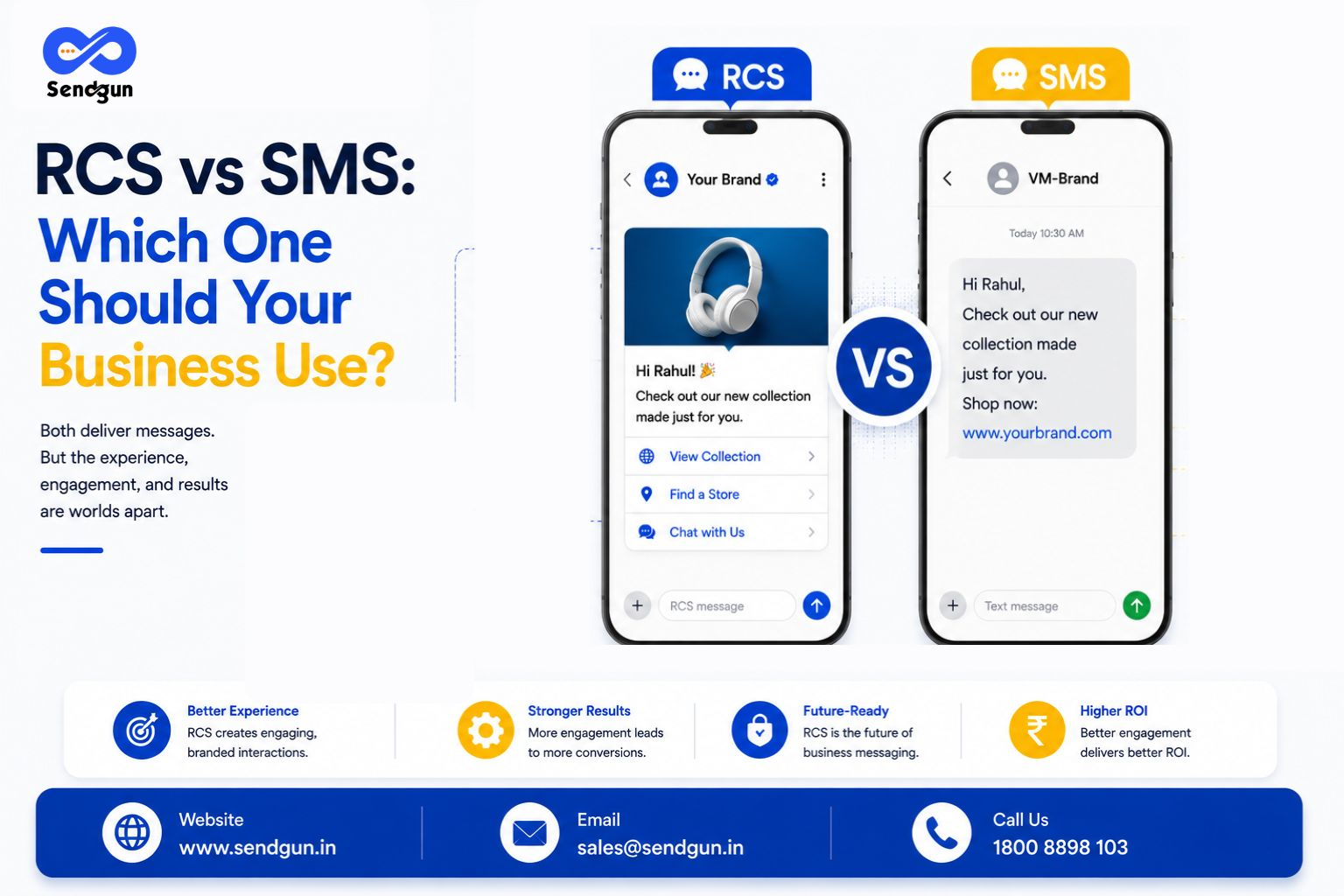
Two businesses can both claim they're "messaging their customers" and mean completely different things by it. One is sending plain grey-bubble texts with no branding and a link the customer has to tap and load separately. The other is sending a verified, branded message with images, buttons, and actions the customer can complete without ever leaving the conversation. Both count as messaging. Only one of them is built for how people actually respond in 2026.
What a plain text setup actually looks like today
A basic SMS setup gets a message out, and for simple alerts, that's often enough. But the moment a business wants a customer to act, click, browse, confirm, buy, plain text starts showing its limits. There's no way to verify the sender visually, no way to show a product image inline, and no way to embed a real action beyond a link that opens a separate page.
Customers have also gotten warier of unbranded texts generally, given how much of that channel gets used for spam and scams. A message with no logo, no verification, and no context asking someone to click a link is a harder sell than it used to be, regardless of how good the offer actually is.
What rich messaging changes structurally
Working with a proper RCS service provider in India changes what's technically possible inside the message itself. Product carousels, verified branding, quick-reply buttons, and even map integrations for store locations or delivery tracking, all of it lives inside the conversation instead of requiring a separate app or webpage.
This isn't just a visual upgrade. It changes the number of steps between a customer seeing a message and completing whatever action the business wants, confirming an appointment, browsing a product, tracking an order. Fewer steps generally means more people actually finish the action instead of dropping off somewhere along the way.
Where the gap actually shows up in results
A business running plain text campaigns alongside a competitor using verified rich messaging is often losing conversions it never sees a clear reason for. The customer got the message, technically. They just didn't trust it enough to act, or the extra step of opening a separate link cost enough friction that they didn't bother.
This is the quiet cost of sticking with a basic setup. The acquisition spend to get that customer's attention in the first place stays the same either way. What changes is whether the final message actually converts that attention into action, and that gap tends to compound across every campaign sent afterward.
Fallback handling is where a lot of setups quietly fail
Not every device supports rich messaging, and that's fine, as long as the fallback is handled properly. A business working with a genuine RCS message service provider gets a setup where unsupported devices automatically receive a clean SMS version of the same message instead of nothing at all. Businesses that skip this step, or work with providers who don't handle it well, end up with silent delivery failures they often don't notice until someone checks the numbers months later.
What to compare before choosing a provider
A few questions tend to separate providers doing this properly from ones offering a surface-level version of the same feature:
-
Is sender verification actually completed, or left in a pending state indefinitely?
-
Does the fallback to SMS work reliably, or does it silently drop messages?
-
Is delivery and engagement reporting detailed enough to actually optimize campaigns?
-
Can the platform support interactive elements without heavy custom development?
Businesses that take the time to compare properly tend to find the difference between an average setup and a best RCS service provider in India shows up clearly within the first few campaigns, in open rates, click-throughs, and how many customers actually complete the intended action.
What Sendgun does differently here
Sendgun's platform is built specifically to close this gap, verified business messaging with proper fallback handling, interactive elements that work without custom builds, and reporting detailed enough to show exactly where a campaign is converting and where it isn't.
Conclusion
The difference between plain texts and rich messaging isn't cosmetic. It's the difference between a customer trusting a message enough to act on it and a customer scrolling past it as just another unbranded text. Businesses still running basic setups aren't failing at messaging; they're just leaving a meaningful chunk of their potential conversions unclaimed.
 English
 Arabic
 French
 Spanish
 Portuguese
 Deutsch
 Turkish
 Dutch
Dutch
 Italiano
 Russian
 Romaian
 Portuguese (Brazil)
 Greek
Greek
