


 Pro Benefits
 Sobre
Sobre
 Termos
 Privacidade
 Child Safety & Protection
 Notificações
 Ayrush Global It Services Pvt Ltd
Why is CO2 Scrubber Not Working?
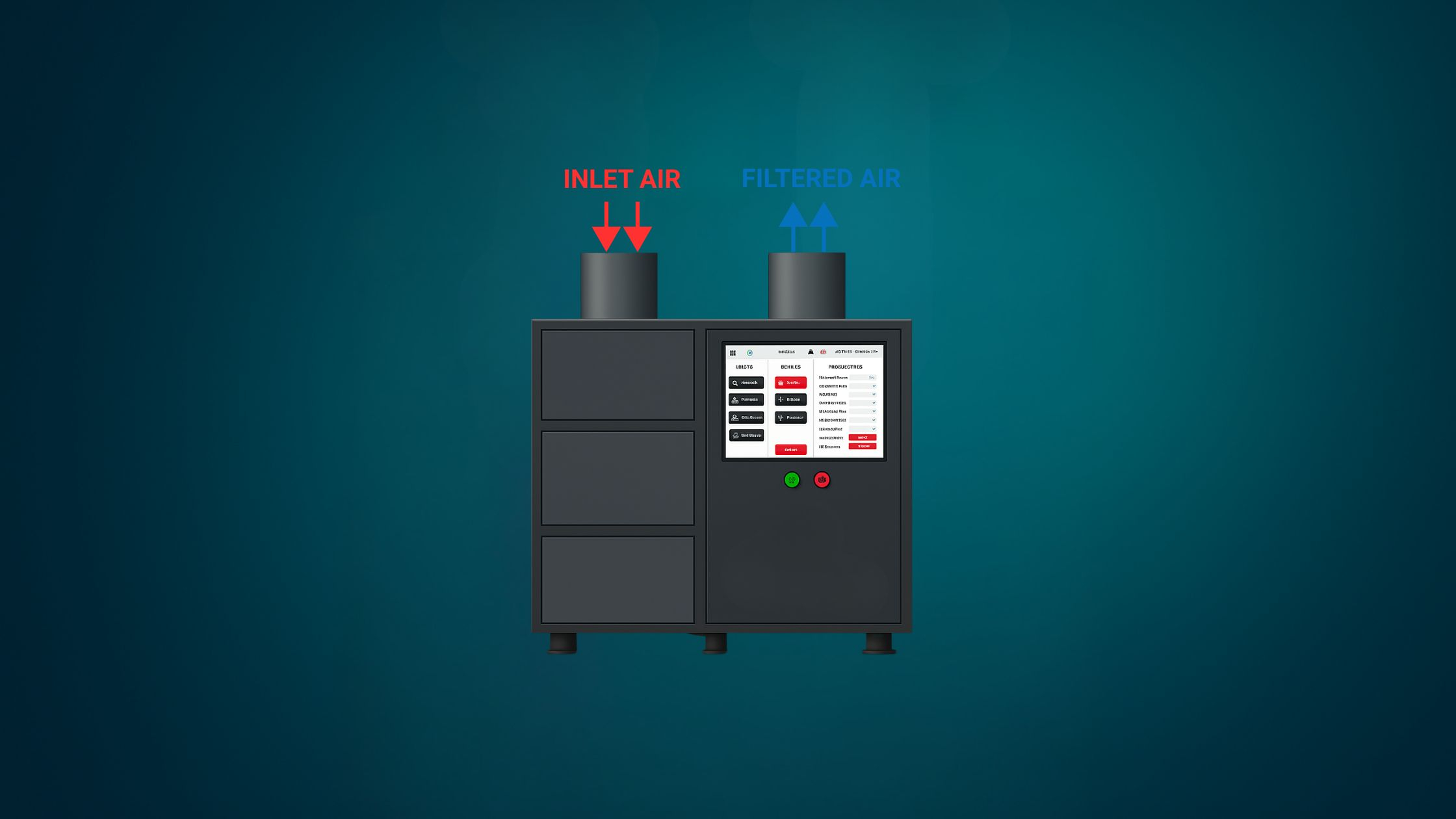
A duty officer in an underground command shelter checks the CO2 readout during hour thirty of a sealed lockdown. The number is climbing instead of holding steady. The scrubber is running, indicator lights green, fans audible — yet the atmosphere is degrading anyway.
This is one of the more disorienting failure modes in sealed-shelter operations. The equipment appears functional while quietly failing at its core job.
A malfunctioning CO2 removal system rarely announces itself with an obvious mechanical failure. More often, it's a slow drift — rising readings, sluggish response, or media that's simply spent — and by the time it's noticed, occupants are already feeling the effects. Knowing what actually causes these failures is the difference between catching the problem in minutes versus hours.
Problem 1: Saturated or Exhausted Absorption Media
The most common failure in any CO2 scrubber isn't electronic — it's chemical. Lithium hydroxide and soda lime media have a finite absorption capacity, and once saturated, CO2 passes straight through unaffected.
The fix: Track media life against actual occupancy load, not a generic calendar schedule. A shelter running at higher-than-planned headcount exhausts media far faster than the rated duration suggests.
Why Occupancy-Based Calculation Matters Here
This is where many shelter operators get caught out. Media replacement intervals are calculated against expected occupancy — not maximum capacity.
If a twelve-person shelter is sheltering eighteen people during an actual event, the scrubbing media will saturate well ahead of schedule, even though the unit appears to be operating normally.
Problem 2: Inadequate Airflow and Recirculation
A scrubber can have perfectly functional absorption media and still fail if air isn't being pulled through it efficiently. Dead zones in shelter layout — corners, alcoves, equipment-crowded areas — allow localized CO2 pockets to build even while the central monitor reads acceptable levels.
The fix: Recirculation fans need to be positioned and sized against actual shelter geometry, not just total volume. Air that isn't moving past the scrubbing media isn't being treated.
Problem 3: Sensor Drift and Inaccurate Monitoring
CO2 sensors degrade over time, particularly in humid or temperature-fluctuating sealed environments. A drifting sensor can report safe levels while actual concentrations climb past dangerous thresholds.
The fix: Calibrate sensors on a fixed schedule, not reactively. Cross-check primary sensors against a secondary reference unit during routine maintenance.
Problem 4: Power Supply Interruptions
Continuous-duty scrubbing systems depend on uninterrupted power. A brief outage during a grid failure — even one resolved by backup power within seconds — can let CO2 concentrations spike if the system isn't designed for instant failover.
The fix: Backup power planning needs to account for the scrubber's full power draw, not just lighting and communications loads. This is a frequent oversight in retrofit installations.
Problem 5: Poor Integration With NBC Filtration and Pressurization
Positive-pressure NBC filtration and CO2 scrubbing are separate systems solving separate problems, but they share the same sealed airspace. Poorly integrated systems can work against each other — pressurization cycles disrupting scrubber airflow, or scrubber exhaust interfering with filtration intake.
The fix: Integration should be engineered at the design stage, not patched together after installation. This is one of the most overlooked aspects of CO2 scrubber for bunker applications specifically.
Problem 6: Wrong System for the Application
A CO2 scrubber for home use and a CO2 scrubber industrial installation have fundamentally different duty cycles, occupancy assumptions, and media capacities. Installing undersized equipment because of upfront CO2 scrubber price rather than actual load requirements is a common and costly mistake.
The fix: Size the system to occupancy-based CO2 generation and shelter volume — not square footage or budget alone.
Problem 7: Inadequate Alarm Thresholds
Some systems are configured with alarm thresholds set too close to physiologically dangerous CO2 levels, leaving little response time once an alert triggers.
The fix: Set alarm thresholds with enough margin to allow corrective action — ventilation adjustment, occupancy reduction, or media replacement — before concentrations approach unsafe territory.
Key Features That Prevent These Failures
A well-engineered CO2 removal system is built to avoid these problems from the outset, with:
- Real-time monitoring with cross-checked sensor redundancy
- Regenerative or high-capacity absorption media matched to occupancy
- Reliable backup power integration
- Corrosion-resistant, low-maintenance construction
- Modular design that scales with shelter occupancy changes
Where Reliability Matters Most
These failure points carry the highest stakes in military bunkers, NBC-protected command centres, civil defence shelters, government continuity facilities, and sealed data centre enclosures — anywhere extended sealed occupancy is a real operational scenario, not a theoretical one.
What to Look for When Sourcing a Replacement or New System
If recurring failures point to a system that's simply inadequate for its application, evaluate suppliers on demonstrated engineering experience in sealed-environment air management, documented testing procedures, and genuine post-installation technical support.
Teams researching a CO2 Removal System after experiencing reliability issues should also confirm whether manufacturers offer customization for specific occupancy profiles and integration with existing pressurization infrastructure — generic specifications rarely fit real-world sealed shelters.
Common Mistakes That Lead to Repeat Failures
- Treating media replacement as calendar-based rather than occupancy-based
- Ignoring airflow dead zones during shelter design
- Skipping routine sensor calibration
- Underestimating backup power requirements for continuous operation
- Failing to integrate scrubbing systems with existing NBC filtration during installation
- Choosing equipment based on price rather than lifecycle reliability
- Setting alarm thresholds without adequate response margin
Final Word
Most CO2 scrubber failures aren't sudden — they're gradual, and they're preventable with the right monitoring, maintenance discipline, and system sizing from day one. A properly specified CO2 removal system doesn't just remove carbon dioxide; it does so reliably, predictably, and with enough margin to handle real-world occupancy and duration variance.
Catching these seven failure points before they compromise a sealed shelter is what separates a system that protects occupants from one that quietly puts them at risk. In sealed-environment engineering, reliability isn't a feature — it's the entire point.
 Portuguese (Brazil)
 English
 Arabic
 French
 Spanish
 Portuguese
 Deutsch
 Turkish
 Dutch
Dutch
 Italiano
 Russian
 Romaian
 Greek
Greek
