


 Pro Benefits
 Σχετικά
 Όρους
Όρους
 Ιδιωτικότητα
 Child Safety & Protection
 Ειδοποιήσεις
 Ayrush Global It Services Pvt Ltd
Manual vs Automated Event Transportation: Decision Framework + Migration Checklist
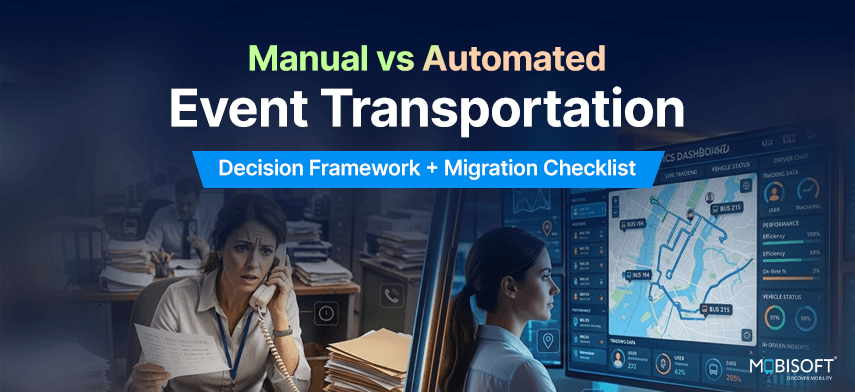
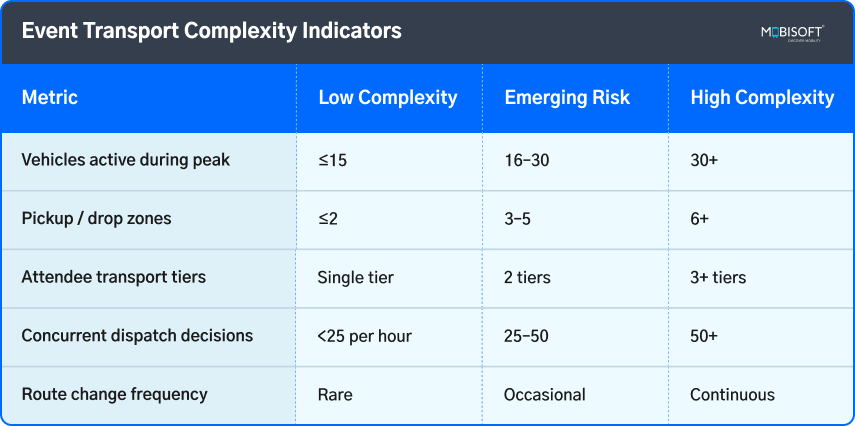
During peak egress at a large-scale event, a manual dispatcher manages approximately 30-50 active decisions per hour. Vehicle positions, driver confirmations, zone congestion, route changes, attendee surges, etc., are handled by one person, one radio under Manual transportation management. This mental map loses accuracy over time under increasing pressure.
Most ops teams have built reliable systems around experienced dispatchers. For years, that's been enough. But fleet size grows, events get more complex, and the tolerance for transport failure at the VIP and sponsor tier gets thinner. At some point, the system that worked stops working, and the gap rarely announces itself clearly.
That's the operational reality this blog addresses. It answers whether your specific setup, fleet size, event frequency, and risk exposure have moved past what manual coordination can reliably handle, or require Event transportation software.
The two tools here are:
- A decision framework built on three operational axes
- And a migration checklist structured around four deployment phases.
Both are designed for dispatch coordinators and ops leads who need to make this call with clear criteria, not instinct alone. If you're already assessing whether manual coordination is reaching its limits, exploring a purpose-built event transportation software can clarify what operational control actually looks like at scale.
Why Manual Dispatch Still Exists at Scale?
Calling the manual dispatch outdated would be inaccurate. For a large portion of event ops teams, it has delivered consistent results across hundreds of events. But the reasons manual dispatch persists at scale are operational.
Experienced dispatchers carry a specific kind of knowledge that's difficult to document. They know which zones back up first at a particular venue. They know which drivers handle high-pressure surges well and which ones need clearer instructions. They've built working relationships with venue security, parking coordinators, and ground crews over multiple event cycles. That accumulated knowledge has real operational value, and no platform replaces it on day one.
Beyond individual expertise, the tools of manual dispatch, radio, walkie-talkie, and direct phone coordination became deeply embedded in event ops culture for a practical reason. They work in low-connectivity environments without the need to onboard. And when something goes wrong, the dispatcher can escalate immediately without navigating through transportation management systems.
There are also legitimate financial considerations that keep teams on manual systems:
- Mid-tier event operations often run on tight margins, and the upfront cost of Event transportation software is hard to justify without a clear ROI timeline
- Procurement cycles at larger organisations can delay platform decisions by 12 to 18 months, even when the operational case is clear
- The fear of a system failure on a live event day carries real weight, particularly for teams without an internal tech function to manage troubleshooting
Perhaps the most persistent reason is the "if it isn't broken" logic. For operations running fewer than 20 vehicles across two or three events a year, that logic often holds. Manual dispatch at that scale is genuinely manageable, especially in smaller setups where employee transport software is not yet required.
The problem is that event operations rarely stay that size because fleets grow, and attendee numbers increase. Stakeholder expectations at the VIP and sponsor tiers become more demanding. So the manual system that worked reliably at one scale starts accumulating small failures at the next, missed pickups absorbed into general confusion, scheduling conflicts traced back to a miscommunication nobody logged, delays that get blamed on traffic rather than dispatch sequencing.
That's where the audit needs to start, often leading teams toward Event transport solutions.
Where Manual Dispatch Breaks Under Event Conditions
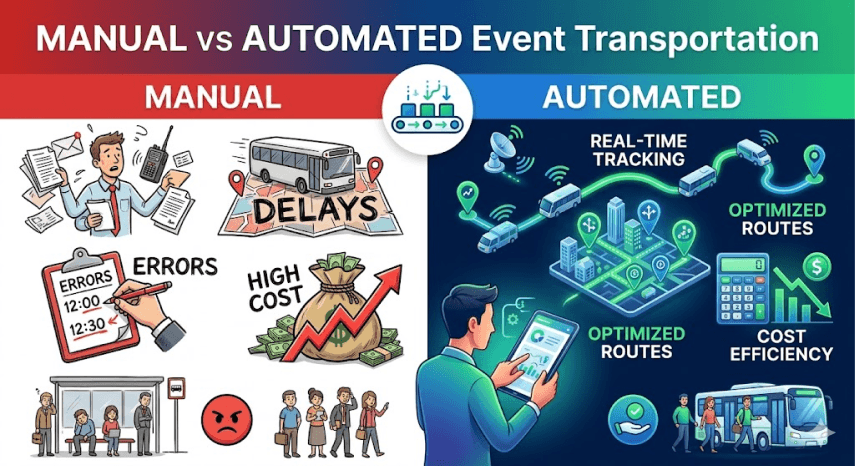
Manual dispatch was designed for manageable complexity, reasonable time windows, and a communication chain that could absorb a few delays without spiraling. Large-scale events offer none of those conditions. The failure modes below aren't edge cases. Dispatch coordinators who've run high-attendance events will recognise most of them.
The Departure Surge Problem
When a session ends early or runs 20 minutes over schedule, the attendee flow to pickup zones changes immediately. Manual dispatch cannot resequence 40-plus vehicles in real time based on that change. The dispatcher is working from a pre-set staging plan, and adjusting it mid-event means pulling drivers off the radio, recalculating zone priorities mentally, and hoping the updated instructions land before the queue builds.
In practice, they rarely do. The surge hits before the resequencing completes, and the queue dwell time climbs while the dispatcher works through the backlog of calls. It exposes the limits of Manual transportation management compared to Automated transportation management.
Communication Lag at Critical Moments
Road closures, filled lots, and blocked entry points don't wait for a convenient moment. When conditions change on the ground, the information has to travel from the driver to the dispatcher by radio or phone, get processed, and then travel back out to other drivers as updated instructions. That chain takes time, and in a compressed egress window, even a two-minute lag has downstream consequences across multiple zones simultaneously, especially without Transportation planning software.
Read more : Manual vs Automated Event Transportation: Decision Framework + Migration Checklist

 Greek
Greek
 English
 Arabic
 French
 Spanish
 Portuguese
 Deutsch
 Turkish
 Dutch
Dutch
 Italiano
 Russian
 Romaian
 Portuguese (Brazil)
