


 Pro Benefits
 About
About
 Terms
Terms
 Privacy
 Child Safety & Protection
 Notifications
 Ayrush Global It Services Pvt Ltd
Why Enterprises Are Choosing Specialized Blockchain & AI Development Companies Over Generalist Agencies in 2026
Two years ago, a company could hire a generalist software agency to explore blockchain and call it an innovation initiative. The deliverable was a proof-of-concept. The expectation was a demo.
That era is over.
In 2026, enterprises in financial services, real estate, healthcare, and supply chain are deploying production blockchain infrastructure that moves regulated capital, manages patient data, and automates cross-border settlement. These systems do not run on experiment mode. They run under SLAs, audit requirements, and regulatory scrutiny.
The technology partner you choose for this work determines whether you ship something that works — or spend 18 months explaining to your board why the project stalled.
This article explains why the enterprise market is shifting decisively toward specialized blockchain and AI development firms, what that specialization actually looks like in practice, and how to evaluate a partner before you commit your next major technology investment.
Why Generalist Agencies Fail at Enterprise Blockchain and AI
Generalist software development agencies build excellent web applications, mobile products, and internal tools. That skill set does not transfer cleanly to enterprise blockchain and AI infrastructure.
Here is where the gap shows up most painfully:
Security Architecture Is Fundamentally Different
Web application security focuses on authentication, authorization, and input validation. Smart contract security adds an entirely different attack surface: reentrancy vulnerabilities, oracle manipulation, flash loan exploits, and governance attacks. A team that has not shipped and defended production contracts under adversarial conditions does not know what they do not know — and the consequences of that gap are irreversible once funds are deployed on-chain.
Compliance Is Embedded, Not Bolted On
Enterprise blockchain systems operate inside regulatory frameworks — MiCA in Europe, SEC guidelines in the US, VARA in the UAE, MAS in Singapore. Compliance is not a post-development checkbox. It shapes token architecture, permissioning logic, data residency, and audit trail design from day one. Generalist teams engage compliance counsel at the end. Specialized firms integrate regulatory requirements into the architecture from the first sprint.
Operational Continuity Requires Domain Experience
A production blockchain system does not go offline at 5 PM. It processes transactions, enforces smart contract logic, and generates audit events continuously. Hypercare periods, incident response protocols, and upgrade management for live on-chain systems require a support model that generalist agencies have never built and cannot staff on demand.
AI Integration Adds Compounding Complexity
Enterprise AI is not a chatbot added to a dashboard. Reliable AI automation — agents connected to operational systems, RAG pipelines with enterprise data, fine-tuned models with safety guardrails — requires evaluation frameworks, streaming architectures, and content safety layers that take years of production experience to build correctly. Generalist teams routinely underestimate the gap between a demo and a deployable system.
What Specialization Actually Looks Like in a Blockchain and AI Firm
Specialization is a claim many firms make. Here is how you verify it.
Production Case Studies with Real Metrics
A specialized firm can show you systems that shipped — not wireframes, not sandboxes, not client testimonials that say "great to work with." They show you an NFT marketplace that processed real transactions, a prediction market platform with on-chain oracle settlement, a DEX with audited AMM contracts deployed on mainnet. Metrics include settlement time reductions, assets tokenized, gas optimization benchmarks, and uptime records.
Audit-Ready Delivery as Standard Practice
Every engagement at a specialized firm includes threat modeling, automated vulnerability scanning, and manual code review as part of the definition of done — not as an upsell. The audit report is a deliverable, not an afterthought. Security is embedded in the sprint cycle, not scheduled after launch.
Deep Blockchain Network Expertise
Specialized firms work across Ethereum, Hyperledger Fabric, Solana, Polygon, Cosmos SDK, Avalanche, and emerging L2 stacks. More importantly, they recommend the right network for each use case based on your compliance requirements, throughput needs, and interoperability constraints — not based on which chain they know best or which is trending on social media.
Regulatory and Compliance Architecture Knowledge
The best blockchain development firms employ or partner closely with legal and compliance expertise. They understand how token structures map to securities classifications. They know how to build permissioned ledgers that satisfy GDPR data residency requirements. They architect systems that generate the audit artifacts regulators require, built in from the start rather than reconstructed later.
AI Systems That Connect to Real Operations
Genuine AI specialization means shipping agents and pipelines connected to live operational data — not building demo products that work in isolation. It means implementing RAG systems that retrieve from enterprise knowledge bases with acceptable latency, fine-tuning models on proprietary data with appropriate safety evaluation, and building streaming UX that delivers AI output reliably at scale.
The Services That Define an Enterprise Blockchain & AI Development Firm
The strongest enterprise technology partners cover the full stack of blockchain and AI capability under one delivery model. Here is what that looks like:
Enterprise Blockchain Development — Permissioned ledgers built for regulated environments, with interoperability bridges, governance models, and compliance-ready data architecture. Not a public chain deployment with a white-label frontend, but infrastructure designed around your access controls, audit requirements, and operational continuity needs.
Smart Contract Development and Audits — Secure contract systems covering token standards, DeFi protocols, governance mechanisms, and settlement logic, with formal review paths including threat modeling, automated scanning, and manual line-by-line audit. The audit report ships with the code.
DeFi Development and Engineering — Production-grade protocol engineering covering AMM design, oracle resistance, solvency modeling, and adversarial testing. This is not template deployment. It is economic mechanism design paired with formal security validation.
AI Automation Systems — Reliable agents and data pipelines that connect AI models to operational systems. This includes workflow automation, document processing, decision support, and real-time monitoring — all built with operational guardrails and evaluation frameworks that catch model failures before they affect production.
Generative AI Solutions — Production-grade AI-native products covering RAG architectures, fine-tuning pipelines, streaming UX, evaluation harnesses, and content safety. The difference between a demo and a deployable product is the evaluation framework and the safety layer. Specialized firms ship both.
RWA Tokenization and Issuance — Compliant on-chain asset representation covering transfer restrictions, NAV attestation, custody-grade operations, and investor reporting. Legal-architecture alignment is part of the engagement, not something the client arranges separately.
dApp Development — High-trust interfaces built for Web3 products, covering wallet integration, transaction flow design, gas optimization, and observability. Every user action that touches the chain is designed for clarity, reversibility awareness, and failure handling.
Industries That Need This Specialization Most
Enterprise blockchain and AI infrastructure has the highest impact — and the highest execution risk — in regulated, high-stakes industries. These are the sectors where specialized partners matter most:
Financial Services and Capital Markets — Settlement infrastructure, custody systems, and asset tokenization platforms operate under securities regulations, banking oversight, and audit requirements that demand correctness above all else. A bug in a settlement contract does not produce a support ticket. It produces a financial loss and a regulatory inquiry.
Healthcare — Patient data consent layers, HIPAA-compliant audit chains, and clinical trial record systems must satisfy both data privacy regulations and interoperability standards. Healthcare blockchain infrastructure requires a partner who understands how medical data governance maps onto permissioned ledger design.
Supply Chain and Logistics — End-to-end traceability, document automation, and carrier coordination on-chain eliminates reconciliation disputes and enables real-time visibility across multi-party networks. The value is in cross-organizational data sharing — which requires careful permissioning architecture and legal framework alignment.
Real Estate and Asset Management — Tokenization, investor reporting, and lifecycle management for real property or fund assets requires coordination between legal structuring, smart contract engineering, and secondary market infrastructure. All three must work together from day one.
Energy and Utilities — Renewable energy attestations, settlement workflows, and grid automation require systems that bridge operational technology (OT) environments with blockchain infrastructure — a technical challenge that requires specific domain experience.
Gaming and Metaverse — In-game asset ownership, NFT marketplaces, and blockchain-native game economies require high-throughput, low-latency infrastructure with user experience design that makes Web3 mechanics invisible to players.
How to Evaluate a Blockchain and AI Development Partner: A Practical Checklist
Before you sign an engagement, run your shortlisted firms through these questions:
1. Can you show me production systems that shipped in my industry?
Ask for case studies with real metrics, deployed on mainnet or a live permissioned network. Sandbox demos do not count.
2. What is your formal audit methodology for smart contracts?
Expect a clear answer covering threat modeling, automated tools, and manual review. Ambiguous answers about "security best practices" indicate no formal process.
3. How do you handle regulatory requirements during architecture?
Compliance-fluent firms answer this in the first conversation. Firms that defer to client counsel for all regulatory guidance will build systems that need expensive rework.
4. What does your post-launch support model look like?
Expect a defined hypercare period with direct access to the build team, followed by a structured SLA covering incident response, protocol upgrades, and monitoring.
5. How do you recommend between blockchain networks?
The answer should reference your compliance requirements, throughput needs, and interoperability constraints — not which chain is currently popular.
6. Will you sign an NDA before technical discussions?
Serious enterprise partners sign mutual NDAs without friction. It signals they operate at the level of enterprise procurement.
The Bottom Line: Specialization Is Not a Premium. It Is a Risk Reduction.
Hiring a specialized blockchain and AI development firm costs more per sprint than hiring a generalist agency. It saves significantly more on rework, compliance remediation, security incidents, and missed launch windows.
The question is not whether your blockchain or AI project needs specialized expertise. Every enterprise-grade deployment does. The question is whether you discover that requirement before or after your first production failure.
Organizations that move decisively — choosing partners with production track records, formal audit discipline, and regulatory fluency — are the ones shipping working systems in 2026 while their competitors are still running steering committee reviews of pilot project postmortems.
The infrastructure advantage compounds over time. Every month of delay is a month your competitors spend building production experience you will eventually have to catch up to.
Work with a Firm That Has Already Built What You Are Planning
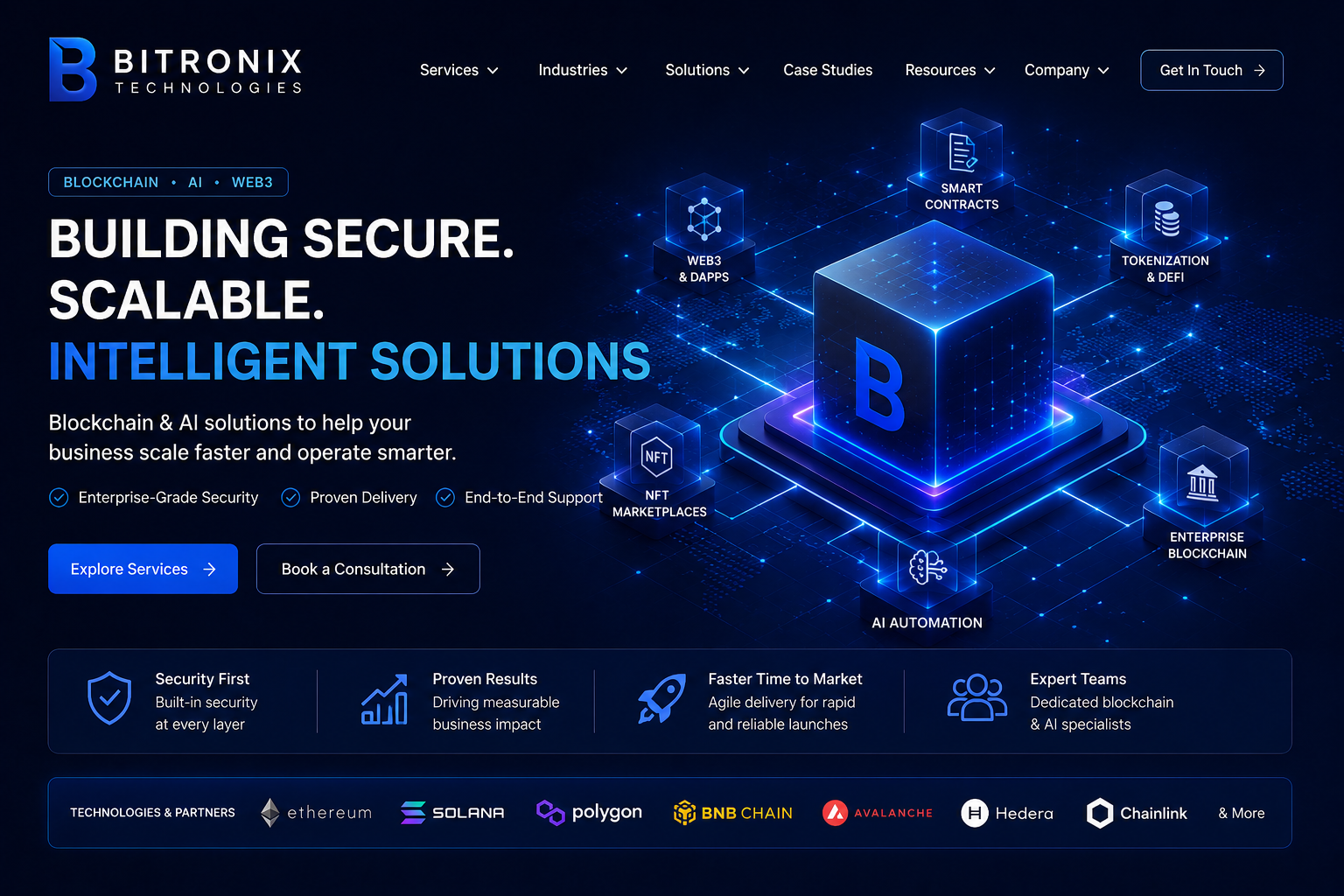
Bitronix Technologies is an enterprise blockchain and AI development company operating across the USA and Dubai. The firm specializes in smart contract development, DeFi engineering, RWA tokenization, AI automation, and enterprise blockchain infrastructure for regulated industries.
Every engagement includes audit-ready delivery, compliance-aligned architecture, and structured post-launch support — built into the scope from day one, not added as afterthoughts.
Explore the full capability set: Enterprise Blockchain & AI Development — Bitronix Technologies
 English
 Arabic
 French
 Spanish
 Portuguese
 Deutsch
 Turkish
 Dutch
Dutch
 Italiano
 Russian
 Romaian
 Portuguese (Brazil)
 Greek
Greek
