


 Pro Benefits
 About
About
 Termini e Condizioni
 Privacy
 Child Safety & Protection
 Notifiche
 Ayrush Global It Services Pvt Ltd
How Does International Bulk SMS Help Businesses Communicate Reliably Across Borders?
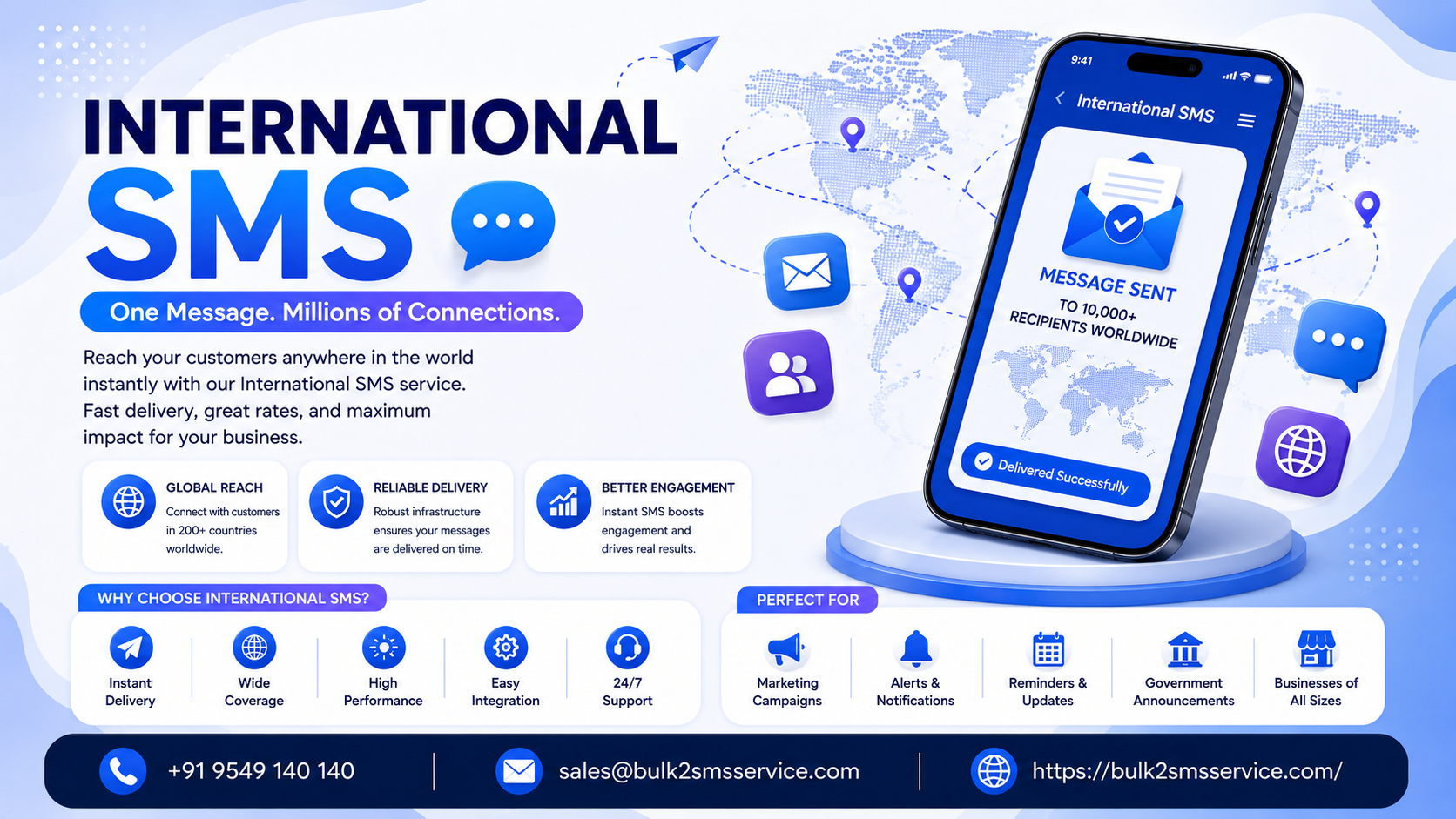
There's a specific moment every growing business hits when a customer signs up from another country, and suddenly the SMS infrastructure that worked flawlessly at home stops being reliable. The OTP that arrives in two seconds for a customer in Mumbai takes twelve seconds for a customer in Jakarta, or sometimes doesn't arrive at all. That's not a minor technical hiccup buried in a server log somewhere. That's a checkout that feels broken to a real person, a login that simply doesn't work, and a customer who quietly decides to try a competitor instead of troubleshooting your app.
The moment a business starts serving customers outside its home country, its messaging infrastructure needs to cross that border too properly, not just technically. And this is exactly where most businesses discover that what worked domestically doesn't automatically translate into reliable global communication.
Why Domestic Infrastructure Doesn't Simply Scale Into Global Reach
When businesses start exploring an international bulk sms provider, the first real surprise is how many things change the moment a message has to cross a border. A domestic SMS setup typically relies on a handful of routes connecting to telecom operators within a single country. International messaging requires direct relationships with operators across dozens, sometimes hundreds, of countries each with different network behaviours, different regulatory frameworks, and very different expectations around delivery speed.
Delivery timing varies enormously by geography, often for reasons that have nothing to do with the message itself. A message to a customer in the United Kingdom might land within two seconds because the routing infrastructure there is mature and well-connected. The exact same message sent to a customer in parts of Southeast Asia or Africa might take considerably longer, purely because of how telecom routing works differently in those regions. Businesses that don't account for this end up with wildly inconsistent customer experiences depending entirely on geography, without ever realising that's the actual cause.
What Genuinely Changes When You Compare Local SMS to International Messaging
It helps to understand exactly what separates a domestic SMS setup from genuine international infrastructure, because the differences aren't always obvious until something has already gone wrong in production.
A domestic provider typically optimises for a single regulatory environment, a single set of telecom partnerships, and a fairly predictable delivery pattern because they're only dealing with one country's infrastructure. This works perfectly well as long as every customer you're messaging lives within that same country.
The moment customers start coming from multiple countries, that single-country optimisation becomes a liability rather than a strength. A provider built for international reach has to maintain operator relationships across many markets simultaneously, monitor delivery performance separately for each region, and stay current with regulatory changes that can shift independently in any one of those markets at any time. This is a fundamentally more complex operational challenge, and it's exactly why some providers that perform brilliantly for domestic SMS simply aren't equipped to extend that same reliability internationally, even if their marketing suggests otherwise.
Where International Messaging Reliability Actually Changes Real Business Outcomes
A mid-sized fintech platform expanding into Southeast Asia relied on an international sms service provider that lacked proper regional routing infrastructure, and OTP delivery for new signups in certain markets stretched well past fifteen seconds during peak hours. New users attempting to verify their accounts simply abandoned the process before completing it, and for months, the company couldn't understand why conversion in that specific region lagged so far behind every other market they operated in. The eventual root cause traced directly back to delivery delays that had never been properly monitored or flagged.
A travel booking platform sending confirmations across multiple countries ran into a different but equally damaging issue. Character encoding problems meant that booking confirmations reaching customers in certain Middle Eastern markets displayed as broken, unreadable text instead of clear booking details and customer names. Support tickets from confused customers spiked specifically in that region, and the entire issue traced back to a provider that had never properly tested encoding compatibility across the languages and scripts it claimed to support in its marketing materials.
Both cases share a common thread the businesses involved didn't choose a deliberately bad provider. They chose one that looked sufficient on paper, performed adequately in their home market, and only revealed its actual limitations once real international traffic exposed gaps that weren't visible during initial evaluation.
What Actually Matters When Evaluating a Global Messaging Partner
Coverage claims listed on a provider's website mean very little without verified delivery performance to back them up. It's worth asking directly which countries have genuine direct telecom operator connections versus which rely on third-party intermediaries, because that single distinction often explains why delivery feels strong in some regions and inconsistent in others, even when a provider claims uniform global coverage.
Why Bulk2SMSService Handles Global Reach With Genuine Consistency
Bulk2SMSService connects directly with telecom operators across more than 180 countries, which means messages take the fastest available path to their destination rather than bouncing through multiple intermediaries hoping to eventually find a working route. Delivery consistency stays strong whether a business is reaching customers in India, the United States, or the Philippines, with the same dependable standard applied across every region rather than concentrated only in the easiest, most well-connected markets.
Character encoding is handled automatically across the platform, so messages display correctly regardless of the language or script involved, removing one of the most common and quietly damaging international messaging failures. Campaigns spanning multiple countries can be managed from a single unified dashboard, eliminating the need to juggle separate provider accounts and separate reporting systems for each individual region.
Conclusion
The moment a business becomes international, its messaging infrastructure needs to genuinely follow that growth, not just technically stretch to cover it. International bulk sms service provider done properly means customers everywhere experience the same speed, the same clarity, and the same reliability, regardless of which country they happen to be in when they receive a message. Choosing a provider that treats every market with the same seriousness as the home market is ultimately what determines whether global expansion feels smooth and trustworthy to customers, or quietly costs a business goodwill and conversions in markets nobody was watching closely enough.
 Italiano
 English
 Arabic
 French
 Spanish
 Portuguese
 Deutsch
 Turkish
 Dutch
Dutch
 Russian
 Romaian
 Portuguese (Brazil)
 Greek
Greek
