


 Pro Benefits
 About
About
 Koşullar
 Gizlilik
 Child Safety & Protection
 Bildirimler
 Ayrush Global It Services Pvt Ltd
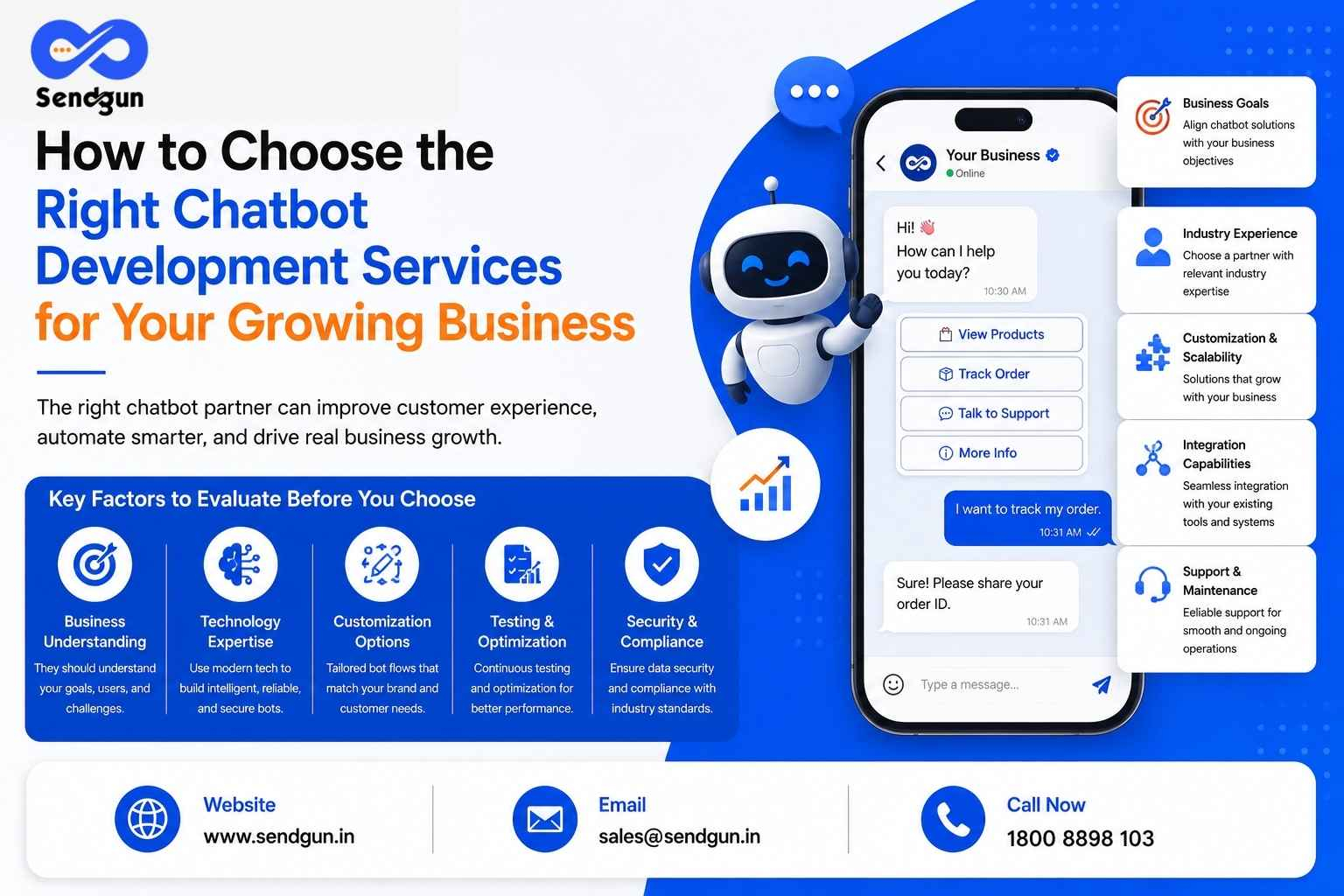
How to Choose the Right Chatbot Development Services for Your Growing Business
Most startups don't lose customers because their product is bad. They lose them in the gaps - the 11 PM query that nobody answered, the lead that filled a contact form and heard nothing for two days, the repeat customer who asked a simple question and was told to "wait for the next available agent."
These aren't resource problems. They're communication infrastructure problems. And for a startup or SME operating with a lean team, an AI chatbot isn't a luxury feature. It's the system that fills those gaps without requiring three additional hires.
The challenge is that chatbot development services vary wildly in depth, quality, and fit. A chatbot that answers five FAQs is technically a chatbot. So is one that qualifies leads, books appointments, processes returns, and escalates complex issues to the right human agent with full conversation context. The word covers an enormous range - and the distinction matters enormously to a business making a real investment.
This article breaks down what genuinely useful AI chatbot solutions look like, what startups and SMEs should demand of a development partner, and why the setup decisions made upfront determine whether the chatbot becomes a business asset or a source of frustrated customer experiences.
What a Chatbot Actually Does in a Business Context
Strip away the technology jargon, and a chatbot does one thing: it handles conversations automatically, without a human needing to be present for each one.
What those conversations look like depends entirely on how the chatbot is built. The spectrum runs from simple rule-based bots - decision trees where specific inputs trigger specific outputs - to AI-powered conversational systems that understand natural language, learn from interactions, and handle queries that weren't explicitly anticipated during setup.
For startups and SMEs, the most immediately valuable applications tend to cluster around four areas:
Customer support automation
Answering repetitive queries - pricing, availability, order status, return policies, business hours - without those queries ever reaching a human inbox. For a team of five managing customer communication, eliminating 60% of repetitive inbound queries is a measurable operational change.
Lead qualification and capture
A visitor lands on your website at midnight. Instead of a static contact form they fill out and forget, a chatbot engages them - asks what they're looking for, qualifies their requirement, captures their contact details, and categorises the lead before your sales team arrives the next morning. The lead is warm, contextual, and ready to convert.
Appointment and booking management
Service businesses - healthcare providers, consultants, salons, coaching providers - use chatbots to let customers book, reschedule, and confirm appointments without phone calls. The chatbot checks availability, confirms the slot, sends reminders, and handles rescheduling requests automatically.
Post-sale support
Order tracking, return initiation, warranty queries, and product guidance. These are high-volume, low-complexity interactions that consume disproportionate support team time. A well-built chatbot handles them without agent involvement.
Why the "AI" Part Matters More Than It Used to
Early chatbots were essentially elaborate menu systems. They worked for highly predictable queries and broke down the moment a user phrased something unexpectedly.
Modern AI chatbot development is fundamentally different. Natural language processing allows the chatbot to understand what someone means, not just what they typed. A user who types "I haven't got my order yet" and a user who types "where is my delivery?" are asking the same thing - a properly built AI chatbot recognises both.
This matters practically for startups and SMEs for one specific reason: your customers don't read your FAQ page before messaging you. They type, however,r they naturally communicate. An AI-powered system handles that range. A rule-based bot fails on anything outside its defined triggers.
The gap between these two experiences - a bot that understands vs. a bot that doesn't - is the difference between a customer who gets their answer and stays, and a customer who gives up and leaves.
What to Demand From a Chatbot Development Company in India
The Indian market has no shortage of chatbot development providers. Separating competent partners from those who deliver a basic template and call it custom requires asking specific questions.
Multi-channel deployment
Your chatbot should work where your customers already are - your website, WhatsApp, your mobile app, potentially Facebook Messenger. A chatbot that only lives on your website misses every customer who reaches out through other channels. Sendgun AI chatbot solutions are built for multi-channel deployment, including deep WhatsApp integration - particularly relevant given how Indian SME customers communicate.
CRM and platform integration
A chatbot that can't connect to your existing systems is a disconnected tool. The real value comes when the chatbot reads from and writes to your CRM - logging conversations, updating lead status, pulling order data, and creating support tickets. This integration requires development expertise, not just a chatbot template.
Human handoff design
Every chatbot needs a graceful exit point for queries it can't handle. The handoff - bot to human agent - should pass the full conversation context so the agent doesn't start from scratch. A poorly designed handoff forces the customer to repeat themselves, which eliminates much of the trust the chatbot built.
Conversation flow design
The technical build matters. The conversation design matters equally. How the bot greets users, how it handles unexpected input, how it re-engages a user who goes silent mid-conversation - these are design decisions that determine whether interactions feel helpful or robotic.
Analytics and iteration capability
A deployed chatbot is a starting point, not a finished product. You need visibility into which queries the bot handles successfully, where conversations drop off, which questions it can't answer, and what users are actually asking. A chatbot development company that delivers a build without analytics infrastructure is delivering an unoptimisable tool.
The Cost of Getting It Wrong
A poorly built chatbot doesn't just underperform - it actively damages customer experience. A bot that misunderstands queries, loops users in circles, or fails to escalate appropriately signals to customers that the business doesn't value their time.
The investment in proper chatbot development solutions - built thoughtfully, integrated correctly, deployed on the right channels - pays back through reduced support costs, higher lead conversion, and customer interactions that happen reliably even when your team isn't available.
For a startup building brand trust, that signal is expensive. For an SME competing against larger companies with more resources, a frustrating chatbot experience leads customers to competitors who handle communication better.
Where Sendgun Fits
Sendgun operates as a full-stack AI chatbot development company in India, building chatbot systems designed for the operational reality of Indian startups and SMEs. Their approach combines AI-powered conversation design with multi-channel deployment - including WhatsApp, which remains the dominant customer communication channel across Indian markets - and integrates with the CRM and communication tools businesses already use.
The platform also connects chatbot automation with Sendgun broader communication infrastructure: SMS, voice, and email - meaning a chatbot interaction can trigger an SMS follow-up, a WhatsApp notification, or a support ticket without requiring a separate integration layer.
For startups and SMEs evaluating chatbot development services for the first time, or looking to replace a basic bot with something that actually delivers business outcomes, that integrated approach significantly reduces both setup complexity and ongoing operational friction.
Conclusion
Every unanswered question on your website is a small, quiet loss that never shows up clearly in any report - but it adds up steadily over time. A properly built chatbot closes that gap, capturing the visitors who would otherwise have left silently and giving your team the breathing room to focus on conversations that actually need a human touch.
 Turkish
 English
 Arabic
 French
 Spanish
 Portuguese
 Deutsch
 Dutch
Dutch
 Italiano
 Russian
 Romaian
 Portuguese (Brazil)
 Greek
Greek
