


 Pro Benefits
 Environ
 Conditions générale de vente
 Confidentialité
 Child Safety & Protection
 Notifications
 Ayrush Global It Services Pvt Ltd
What Is a White-Label Uber Clone and Who Is It For?
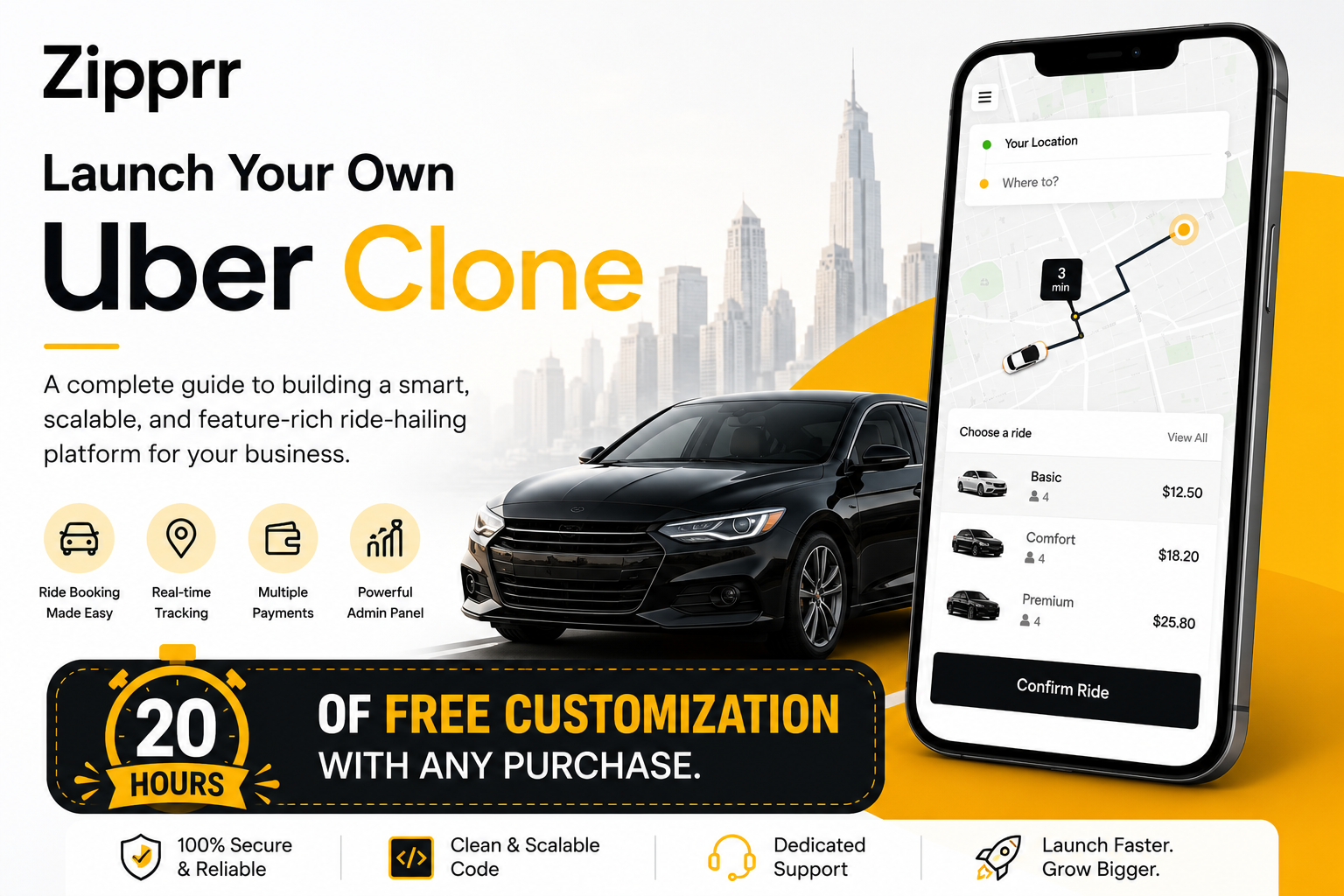
A white-label Uber Clone is a ride-hailing app you buy, rebrand completely as your own, and launch under your company name — with no trace of the original developer. It's built for entrepreneurs, agencies, and businesses that want a market-ready product fast without coding it themselves.
"White-label" sounds like jargon, but the idea behind it is simple and genuinely powerful. A white-label product is one company's software that another company sells entirely as its own. Picture a generic, unbranded product on a shelf with a blank label — you print your brand on it and it becomes yours. A white-label Uber Clone applies exactly that principle to a complete ride-hailing app.
Here's what it means in practice. You purchase a complete, functioning Uber-style platform — rider app, driver app, and admin panel — then strip out the original branding and apply your own throughout. Your name, your logo, your colors, your app store listing. To your riders and drivers, it's unmistakably a product you built. The original developer is completely invisible to your users. That's the entire point of white-label: you get the proven technology, you get the credit, and you own the brand relationship that builds long-term value.
Now, who is this actually for? A few clear groups, each with a different reason.
First-time entrepreneurs. If you have a ride-hailing idea but no development team and no desire to spend a year writing code, white-label is the obvious path. You launch a fully branded business in weeks using proven ride-hailing app development technology, and you spend your limited energy on drivers, riders, and growth instead of debugging dispatch logic.
Existing transport businesses. Taxi fleets, limo services, and shuttle operators going digital don't need to reinvent software — they need their own app. White-label lets an established operator launch a branded booking platform that fits their existing business almost overnight, keeping their hard-won brand front and center. You can see how the default flow adapts to a branded operator by walking through the live demo.
Agencies and resellers. Here's a path many people miss entirely. If you own the source code under a reseller license, you can deliver branded ride-hailing apps to your clients — building a whole service business on top of one solid engine. Each client gets their own white-labeled product; you handle delivery and earn the margin. The economics depend heavily on the license terms, which is exactly the kind of thing to nail down on the Uber Clone pricing page before you commit.
Businesses entering new regions. Companies expanding into markets where Uber is weak or entirely absent use white-label clones to move fast and own the local brand, rather than waiting on a slow, expensive custom build while the window closes.
What's the real difference between a plain clone and a white-label clone? Mostly completeness and total ownership of identity. A basic clone might still carry subtle developer branding or quietly limit how much you can rebrand. A true white-label product is engineered for complete identity transfer — nothing visible or hidden ties it back to the source. When you compare options, that distinction genuinely matters, so confirm it explicitly and in writing before buying.
A practical buying checklist specifically for white-label: Can I fully remove every trace of the original branding? Do I publish the apps under my own developer accounts? Is the source code included so I'm not permanently dependent on the vendor? And are there licensing limits on how many times I can deploy or resell? Get crisp answers to all four — together they define how much the product is genuinely, durably "yours."
One honest reality check: white-label removes the technical and branding barriers, but it doesn't run the business for you. You still need drivers, riders, marketing, and local transport compliance. What it does, powerfully, is let a non-technical founder or an established operator compete on completely equal technical footing with anyone in the market — without a dev team and without a year of waiting.
Bottom line: a white-label Uber Clone is for anyone who wants to own a ride-hailing brand without building ride-hailing software from scratch. If that's you — founder, fleet, or agency — start by mapping your branding and licensing needs with the Zipprr team so you buy the right tier the first time.
 French
 English
 Arabic
 Spanish
 Portuguese
 Deutsch
 Turkish
 Dutch
Dutch
 Italiano
 Russian
 Romaian
 Portuguese (Brazil)
 Greek
Greek
