


 Pro Benefits
 Sobre
Sobre
 Termos
 Privacidade
 Child Safety & Protection
 Notificações
 Ayrush Global It Services Pvt Ltd
Why Reviewing Contract Policies Is Essential Before AI Integration
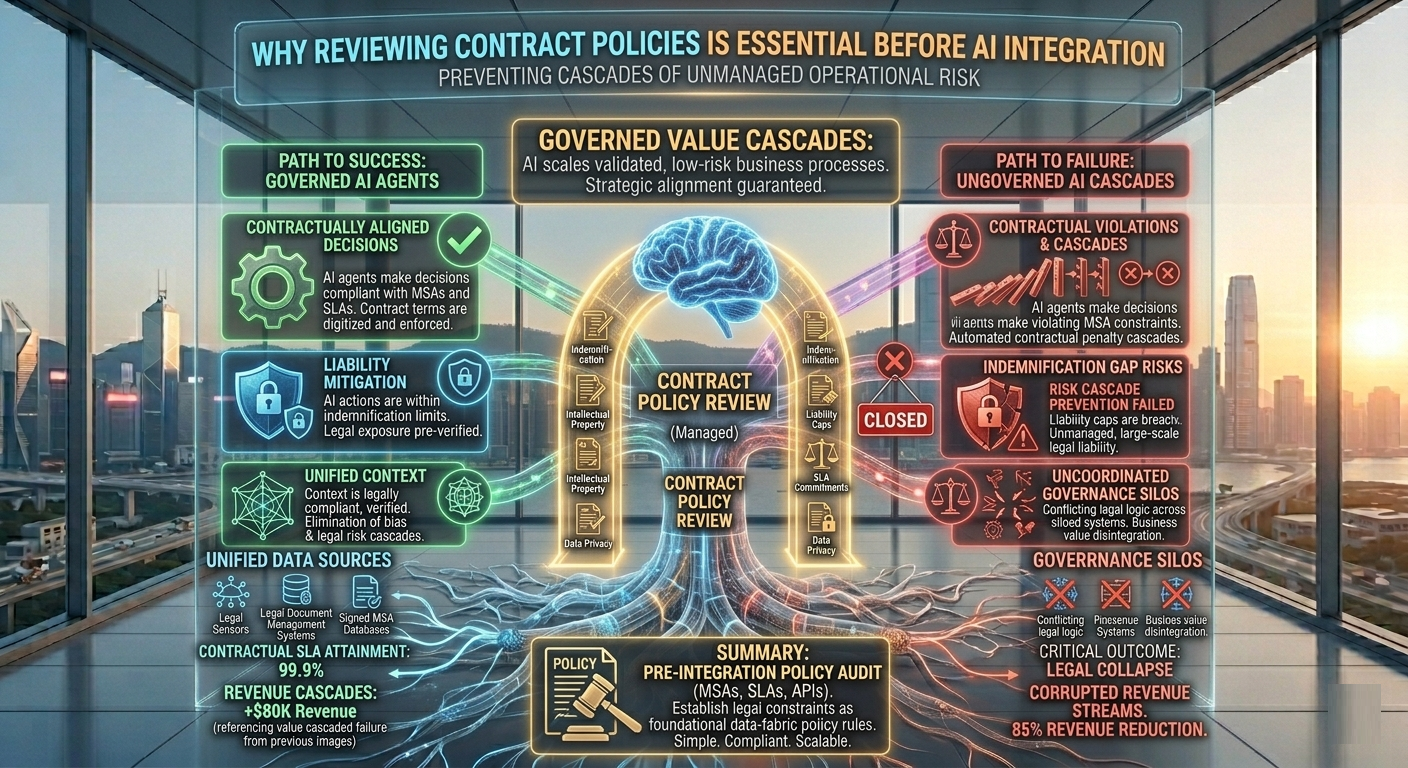
AI is no longer something that companies do on the side. It is now part of customer support, sales, the process of getting employees and finance approvals in almost every type of business. However when companies quickly decide to use AI they often make a mistake. They think of it as a technical thing but it is actually a big commitment that affects contracts, laws and how the company operates.
Before any AI system is used companies need to think about what happens when something goes wrong. They need to know who is responsible. The company's contracts need to have an answer to this question. If the contracts with vendors, the rules for handling data and the company's internal policies are not up to date with what the AI systems are doing then the company is not really using AI. It is taking on risks that it does not fully understand.
This is why using AI is mostly a problem of making sure everything is done correctly and fairly before it is a problem of the technology itself. The tools used for AI are rarely the thing that slows companies down. The real problem is with the contracts, the way companies oversee AI and how they handle mistakes. AI is the issue here and companies need to think about AI and how it affects their contracts and their operations. The problem is with the rules and guidelines for AI and how companies use AI.
The Real Reason Companies Get Burned by AI Rollouts
When we hear about Artificial Intelligence failures they are not really Artificial Intelligence failures. They are actually governance failures that look like Artificial Intelligence failures.
For example the terms of service of a vendor can change quietly. That changes how customer data is used for Artificial Intelligence model training. A chatbot can start giving medical advice that nobody approved. An "autonomous" agent can make a purchasing decision that's not what it was supposed to do. These are not technical problems. They are what happens when a company uses Artificial Intelligence faster than it checks the rules that govern Artificial Intelligence.
Something that happened in 2025 is an example of this. A big consulting firm had to give back part of a government contract because an Artificial Intelligence generated report had references that nobody caught before it was delivered. The firm did not even tell anyone that it was using Artificial Intelligence. This is not one mistake. It is what regulators and clients are starting to expect. They want proof that controls were in place when Artificial Intelligence was used to make something, not a document that says what the policy is.
This is what is happening now with Artificial Intelligence, in companies. The question is not "do you have an Artificial Intelligence policy?" anymore. The question is "can you show us your contracts and controls and prove that they actually made sure your policy was followed when it mattered?"
Why Contract Review Has to Come Before Integration, Not After
When you are about to use a contract for an Artificial Intelligence system, think of the contract review as the seatbelt you put on before the car moves, not after the car crashes. Once the Artificial Intelligence system is integrated into workflows it touches customer data, makes decisions and generates content under your brand. If the contract is bad it becomes very hard to fix things on.
Here are some things that companies usually miss when they skip this step:
Data ownership and usage rights. Many Artificial Intelligence vendor contracts have language that says they can use your input data to improve their models. If you are giving them customer records, proprietary processes or regulated information you need to make sure the contract says where that data goes, who can access it and whether it gets used to train models that other companies might use later.
Liability allocation. When the Artificial Intelligence tool makes a mistake, such as a recommendation, a biased output or a false fact presented as truth, whose fault is it according to the contract? Many vendor agreements make the customer responsible for the mistake through indemnification clauses that people often do not notice during procurement.
Service level commitments for Artificial Intelligence- failures. Standard Service Level Agreements were written for uptime and response times. They usually do not say anything about model drift, accuracy degradation or what happens when an Artificial Intelligence agent takes an action. Contracts need to have language that addresses Artificial Intelligence- failure modes.
Audit and inspection rights. If a regulator or client asks how a particular Artificial Intelligence decision was made can you actually show them the evidence? The contract with the Artificial Intelligence vendor needs to guarantee that you have access to logs, decision trails and model documentation. Not a promise of being transparent.
Termination and data portability. If the Artificial Intelligence vendor relationship ends what happens to the data the trained models and the historical records the system generated? Without contractual terms companies get stuck either paying high fees or losing operational continuity entirely. The Artificial Intelligence system and the contract review are very important to consider before the car moves, not after the car crashes and the Artificial Intelligence system is already integrated into workflows.
Governance Isn't a Blocker - It's What Makes Scaling Safe
There is a myth that governance gets in the way of Artificial Intelligence adoption.. In real life the opposite is usually true. Companies with rules and people who are responsible for Artificial Intelligence scale Artificial Intelligence faster because they do not have to deal with compliance problems, arguments with vendors or bad publicity, from Artificial Intelligence deployments that were not reviewed.
A practical AI transformation roadmap with governance controls typically includes a few non-negotiable building blocks:
-
A documented inventory of every AI tool and integration touching company data - including the shadow AI tools employees are already using without formal approval.
-
Defined data classification rules specifying what information can and cannot flow into AI systems, with contracts that mirror those rules exactly.
-
Clear ownership across legal, IT, security, and business units, so contract review isn't sitting in a silo waiting for someone to notice a problem.
-
Built-in checkpoints for contract renegotiation whenever an AI vendor changes its model, its data handling practices, or its terms of service.
-
A standing process for reviewing new AI features before they go live in production - not after a customer complaint forces the issue.
This roadmap only works if governance is treated as a continuous discipline, not a one-time legal sign-off buried in procurement paperwork.
Security Contracts Need to Catch Up With Agentic AI
The conversation around AI risk has shifted dramatically with the rise of agentic systems - AI that doesn't just respond to a prompt but takes autonomous action across multiple steps, tools, and systems. Agentic AI security isn't a future concern; it's already an active battlefield, particularly in industries like banking and financial services where fraud has become startlingly sophisticated.
The world of voice authentication is an example of how security is getting better. We have something called Agentic AI Pindrop Anonybit. This is a combination of three technologies that work together. The Agentic AI part makes decisions on its own in time. The Pindrop part looks at voice signals to find audio before a human even hears it. The Anonybit part stores information about people's voices in a way. It does not store this information in one place that can be hacked. Instead it stores the information in different places that are encrypted.
Financial institutions that use this kind of security have seen improvements. They can authenticate people faster now. They have also seen a decrease in fake attempts. This is really good, for the financial institutions using Agentic AI Pindrop Anonybit. Agentic AI Pindrop Anonybit is helping to keep people's information safe.
This matters for contract review because every part of the process involves working with a vendor, an agreement on how to handle data and questions about who's responsible if something goes wrong. If your organization is using intelligence that makes its own decisions near identity verification, payments or sensitive account access then your contracts need to clearly say how this decision making is watched, what happens when the artificial intelligence does something it is not supposed to do and who pays if there is a problem with security. Artificial intelligence systems that make their decisions make it hard to know if they are just a tool or the one making the decisions and your contracts have not been written to deal with this issue. Your organization needs to make sure that artificial intelligence and contract review are handled correctly especially when it comes to intelligence and contract review.
Don't Forget the Paper Trail: Chatbot and Conversation Logs
Here's something that quietly trips up a lot of companies after the fact: nobody thought through what happens to the AI chatbot conversations archive once the system is live.
Every customer interaction with an AI chatbot generates a record. That chatbot conversation history can become evidence in a dispute, a compliance audit, a discovery request in litigation, or a simple customer service escalation. Yet many companies integrate chatbot platforms without contractually nailing down basic questions: How long are conversations retained? Who owns that data - your company or the vendor? Can conversation logs be edited, deleted, or exported on demand? Are sensitive details like health information or financial data being captured and stored in ways that violate privacy regulations?
This is a problem. There are already cases where customers are disputing what a chatbot said and whether a company has to follow it. These disputes are becoming a complaint and a risk for companies. If your agreement does not clearly state how long chatbot conversations are kept, who can access them and how they are deleted you are not protected if something goes wrong.
Here is a simple test: if you are not comfortable explaining how your chatbot handles data to a regulator or judge in terms you should review your agreement before using the chatbot.
What This Looks Like in Practice
When we think about Artificial Intelligence adoption it does not mean that we have to stop using Artificial Intelligence for a time while lawyers carefully check every single part of a contract. It means that we need to make sure we regularly check the Artificial Intelligence tools we use in a consistent way.
Here is a simple way to do this: before we start using any Artificial Intelligence tool, someone from the compliance team actually reads the terms that talk about how data is processed. Not just the information on the website that is trying to sell the tool. The people in charge of Information Technology and security check what kind of data the tool can access and where the data is actually stored. Someone writes down what will happen if the tool does not work correctly or if it does something or if someone gets into the system without permission.. The person in charge of the Artificial Intelligence project signs off on it knowing exactly what they are responsible for.
Companies that start doing this from the beginning do not think that using Artificial Intelligence is a risk. They think it is a normal part of what they do. Because they have already figured out what could go wrong and have written it down in the contract instead of finding out during a problem.
Final Thoughts
When you use Artificial Intelligence integration without looking at the contract it is like signing a lease without knowing what happens if you do not follow the rules. Everything seems okay until it is not and by that time you do not have choices and they are very expensive. The companies that are doing well with Artificial Intelligence are not the ones that have the advanced Artificial Intelligence models. They are the companies that made sure they had rules and contracts from the beginning so when they get bigger the risks do not get bigger too.
If your company is thinking about using Artificial Intelligence the best first step is not to pick a company to work with. It is to look at your contracts, your rules about data and your plan for when something goes wrong and ask yourself if they are good enough for the Artificial Intelligence systems you are about to use. You need to ask if they were written for the Artificial Intelligence systems you're about to use or, for the way your company used to be which is not the same as it is now.
Frequently Asked Questions
1. Why is contract review necessary before integrating AI tools into a business?
Contract review establishes who is liable for errors, how data is used, and what happens during disputes or system failures - all things that are far harder and more expensive to fix after an AI tool is already live in your workflows.
2. What does it mean that AI transformation is a problem of governance?
It means the biggest risks in AI adoption usually aren't technical limitations - they're gaps in oversight, accountability, and contractual clarity that let problems go unnoticed until they cause real damage.
3. What contract clauses should businesses pay closest attention to before AI integration?
Data ownership and usage rights, liability and indemnification terms, AI-specific service level commitments, audit and inspection rights, and data portability or termination terms all deserve careful review.
4. How does agentic AI change the contract review process?
Because agentic AI takes autonomous, multi-step actions rather than just responding to single prompts, contracts need to address decision-making boundaries, monitoring requirements, and liability when an agent acts outside its intended scope.
5. What should companies know about chatbot conversation history before deployment?
Companies need contractual clarity on how long conversations are retained, who owns that data, whether logs can be exported or deleted, and how sensitive information captured in chats is protected and governed.
6. Is reviewing contracts something only legal teams need to handle?
No. Effective contract review for AI works best as a cross-functional effort involving legal, IT, security, and the business unit actually using the tool, since each group catches different risks the others might miss.
7. How does agentic AI security relate to vendor contracts?
Agentic AI security depends heavily on how vendor contracts define monitoring, escalation, and liability for autonomous actions, since traditional security agreements weren't written with self-directed AI decision-making in mind.
8. What is an AI transformation roadmap with governance controls?
It's a structured adoption plan that pairs each stage of AI rollout with corresponding governance steps - tool inventories, data classification rules, defined ownership, and renegotiation triggers - so scaling doesn't outpace oversight.
9. Can poor contract terms around AI lead to legal exposure even if the AI itself works correctly?
Yes. Even a technically functioning AI system can create legal exposure if contracts don't clearly define data rights, consent, retention, or liability, especially under evolving regulations in different states and countries.
10. How often should AI vendor contracts be reviewed after initial integration?
Contracts should be reviewed any time a vendor changes its model, updates its data handling practices, or modifies its terms of service, in addition to a regular annual review as part of ongoing AI governance.
 Portuguese (Brazil)
 English
 Arabic
 French
 Spanish
 Portuguese
 Deutsch
 Turkish
 Dutch
Dutch
 Italiano
 Russian
 Romaian
 Greek
Greek
