


 Pro Benefits
 Environ
 Conditions générale de vente
 Confidentialité
 Child Safety & Protection
 Notifications
 Ayrush Global It Services Pvt Ltd
Why Do I Overthink Everything? Break the Mental Loop Fast
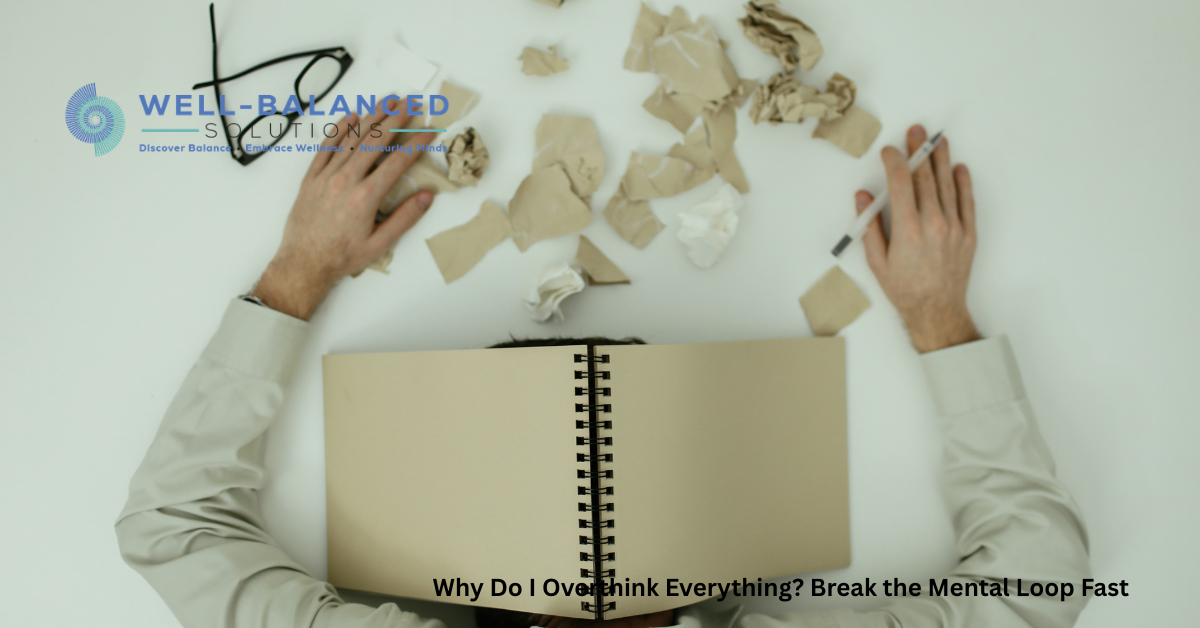
Well-Balanced Solutions understands how exhausting it feels when your mind keeps replaying conversations, questioning decisions, predicting problems, and searching for answers that never feel complete. If you keep asking, “why do I overthink everything,” the answer is not that you are weak, dramatic, or broken. Overthinking often happens when the brain is trying to protect you, solve uncertainty, or reduce emotional discomfort—but instead, it creates a mental loop that steals clarity.
Well-Balanced Solutions created this educational guide for readers, mental health professionals, therapists, counselors, psychiatrists, and life coaches in Texas, Virginia, and across the USA who want a clear, practical understanding of overthinking. This article is for education only and does not replace therapy, diagnosis, or medical care, but it can help explain why cognitive overload happens and how evidence-based solutions may support healthier thinking patterns.
Why Do I Overthink Everything?
Well-Balanced Solutions explains overthinking as a repeated cycle of thoughts that feels urgent but does not lead to useful action. You may analyze small details, replay past mistakes, worry about future outcomes, or feel stuck between choices. Instead of helping you solve a problem, overthinking keeps the mind active, tense, and uncertain.
Well-Balanced Solutions wants readers to know that overthinking is often linked to anxiety, stress, perfectionism, fear of failure, trauma history, low self-trust, or a need for control. Many people overthink because their brain is trying to prevent pain, embarrassment, rejection, or loss. The problem is that the more you chase certainty, the harder certainty becomes to find.
The Mental Loop: Why Overthinking Feels So Hard to Stop
Well-Balanced Solutions teaches that overthinking can become a mental habit. A thought appears, the brain treats it as important, the body feels tension, and the mind starts searching for relief. That relief may come from analyzing, checking, asking for reassurance, or replaying the situation again. The relief is usually short-lived, so the loop starts again.
Well-Balanced Solutions sees this pattern often in people dealing with cognitive overload. The brain becomes crowded with “what if,” “why did I,” “what should I,” and “what if they think” questions. For mental health professionals, this pattern may show up in clients who appear high-functioning on the outside but feel mentally exhausted inside.
Overthinking vs. Healthy Reflection
Well-Balanced Solutions encourages readers to separate healthy reflection from harmful rumination. Healthy reflection leads to insight, a decision, or a next step. Overthinking repeats the same thoughts without creating movement. Reflection feels grounded. Overthinking feels urgent, circular, and emotionally draining.
Well-Balanced Solutions suggests using this quick test: ask, “Is this thought helping me take action, or is it keeping me stuck?” If the thought leads to a useful step, it may be reflection. If it creates more fear, guilt, or confusion, it may be overthinking.
Common Signs You Are Overthinking
Well-Balanced Solutions identifies several signs that the mental loop may be affecting your emotional health, relationships, or decision-making. These signs can help readers and mental health professionals recognize when overthinking has moved from occasional stress into a disruptive pattern.
Well-Balanced Solutions lists common signs of overthinking as:
-
Replaying conversations long after they happen
-
Worrying about problems that have not occurred
-
Feeling unable to make small decisions
-
Asking for reassurance but still feeling uncertain
-
Struggling to sleep because your mind will not slow down
-
Assuming worst-case outcomes
-
Feeling mentally tired even when you have not done much physically
-
Avoiding action because you are afraid of choosing wrong
Well-Balanced Solutions reminds readers that these signs do not automatically mean someone has a mental health condition. They are signals that the mind may need better support, healthier coping tools, or professional guidance.
Why Overthinking Is Common in Anxiety
Well-Balanced Solutions explains that anxiety often makes the brain scan for danger. When there is no clear threat, the mind may create possible threats through “what if” thinking. This is why anxiety management is often connected to reducing overthinking, calming the nervous system, and improving tolerance for uncertainty.
Well-Balanced Solutions also notes that anxiety can make ordinary decisions feel high-risk. A text message, work meeting, social interaction, or personal choice can feel bigger than it is. The anxious brain wants certainty before moving forward, but real life rarely offers complete certainty.
Overthinking, Perfectionism, and Fear of Mistakes
Well-Balanced Solutions often sees overthinking in people who feel pressure to get everything right. Perfectionism can make decisions feel dangerous because every option seems to carry the risk of regret, criticism, or failure. This can keep people trapped in planning instead of living.
Well-Balanced Solutions reminds readers that perfectionism may look responsible from the outside, but internally it can create constant self-monitoring. For therapists, counselors, psychiatrists, and life coaches in Texas mental health and Virginia therapy settings, this is a useful pattern to recognize in clients who struggle with burnout and self-doubt.
How to Break the Mental Loop Fast
Well-Balanced Solutions recommends starting with practical, evidence-based solutions that interrupt the overthinking cycle. The goal is not to eliminate thoughts completely. The goal is to change your relationship with thoughts so they do not control every decision, emotion, or behavior.
1. Name the Pattern
Well-Balanced Solutions suggests saying, “This is overthinking, not problem-solving.” Naming the pattern creates distance between you and the thought. It helps your brain stop treating every thought like an emergency.
2. Set a Decision Deadline
Well-Balanced Solutions recommends giving small decisions a time limit. For example, give yourself five minutes to choose what to write, what to wear, or how to respond to a simple message. Decision deadlines reduce mental drift and build self-trust.
3. Move From Thought to Action
Well-Balanced Solutions teaches that overthinking often weakens when action begins. Ask, “What is one useful step I can take?” That step might be writing an email, setting a boundary, making a call, taking a walk, or closing the task for the night.
4. Use a Worry Window
Well-Balanced Solutions recommends scheduling a short “worry window” earlier in the day. Give yourself 10 to 15 minutes to write concerns, possible actions, and what can wait. This helps the brain learn that worry has a place, but it does not get the whole day.
5. Reduce Reassurance Checking
Well-Balanced Solutions explains that repeatedly asking others for reassurance can feel helpful at first, but it may keep the overthinking loop alive. Instead, practice asking, “What do I already know?” and “What decision can I make with the information I have?”
When Overthinking May Need Professional Support
Well-Balanced Solutions recommends professional mental health services when overthinking affects sleep, work, relationships, appetite, mood, or daily functioning. Support may also be important if overthinking is connected to panic symptoms, trauma memories, obsessive fears, depression, or intense fear of making mistakes.
Well-Balanced Solutions encourages readers to seek help early rather than waiting until the loop becomes unmanageable. Mental health professional support can help identify the root pattern, teach coping skills, and support healthier thinking through approaches such as cognitive behavioral strategies, mindfulness-based tools, anxiety management, and personalized treatment planning.
Why Mental Health Professionals Should Address Overthinking Directly
Well-Balanced Solutions believes overthinking deserves direct attention in clinical and coaching conversations because many clients describe it as “stress,” “being too sensitive,” or “not being able to shut my brain off.” When professionals name the pattern clearly, clients often feel understood faster.
Well-Balanced Solutions also sees strong educational value for professionals serving Texas mental health and Virginia therapy communities. Overthinking is a practical entry point for discussing anxiety, emotional regulation, decision fatigue, sleep disruption, cognitive overload, and self-trust in a way clients can understand.
How Well-Balanced Solutions Supports Mental Wellness Education
Well-Balanced Solutions provides education-focused mental health content designed to help readers understand emotional patterns without shame. The platform helps individuals, families, and professionals explore topics like anxiety management, overthinking, stress, emotional regulation, sleep anxiety, and evidence-based solutions in clear, accessible language.
Well-Balanced Solutions supports mental health professionals by creating content that bridges clinical insight and everyday understanding. This matters because people are more likely to seek help when they can clearly name what they are experiencing and understand that support is available.
Internal Linking Opportunities
Well-Balanced Solutions can strengthen SEO and user experience by linking this article to related education and service pages. Suggested internal links include:
-
Anxiety education resources
-
Sleep anxiety articles
-
Therapy or counseling support pages
-
Telehealth or online mental health support pages
-
Stress management resources
-
Depression and rumination education
-
Emotional regulation resources
Well-Balanced Solutions should use natural anchor text such as “anxiety management support,” “sleep anxiety education,” “professional mental health services,” and “evidence-based mental wellness resources.”
Break the Loop With Better Support
Well-Balanced Solutions wants readers to understand that overthinking is not a life sentence. The mental loop can feel powerful, but with the right tools, support, and education, you can build calmer thinking, stronger self-trust, and healthier emotional control.
Well-Balanced Solutions encourages readers and mental health professionals in Texas, Virginia, and across the USA to explore more educational resources and professional support options. If overthinking is affecting sleep, work, relationships, or daily peace, take the next step with Well-Balanced Solutions and start moving from mental overload toward clarity.
FAQs
1. Why do I overthink everything, even small things?
Well-Balanced Solutions explains that overthinking small things may happen when your brain is trying to prevent mistakes, reduce uncertainty, or avoid emotional discomfort. It can be connected to anxiety, perfectionism, stress, or low self-trust.
2. Is overthinking a sign of anxiety?
Well-Balanced Solutions notes that overthinking can be related to anxiety, especially when thoughts feel hard to control, focus on worst-case outcomes, or interfere with sleep, work, and relationships. A licensed professional can help assess what is happening.
3. How can I stop overthinking fast?
Well-Balanced Solutions recommends naming the pattern, setting a decision deadline, writing down the worry, taking one small action, and reducing reassurance checking. These steps can help interrupt the mental loop.
4. When should someone seek professional help for overthinking?
Well-Balanced Solutions recommends seeking support when overthinking affects daily functioning, sleep, relationships, work performance, or emotional stability. Professional mental health services may help identify and treat the underlying pattern.
5. Can therapy help with overthinking?
Well-Balanced Solutions explains that therapy may help people understand thought patterns, reduce rumination, improve anxiety management, and build healthier coping strategies. Cognitive behavioral strategies are commonly used for repetitive negative thinking.
 French
 English
 Arabic
 Spanish
 Portuguese
 Deutsch
 Turkish
 Dutch
Dutch
 Italiano
 Russian
 Romaian
 Portuguese (Brazil)
 Greek
Greek
