


 Pro Benefits
 Sobre
Sobre
 Termos
 Privacidade
 Child Safety & Protection
 Notificações
 Ayrush Global It Services Pvt Ltd
The Ultimate Guide to Yard Management Systems (YMS)
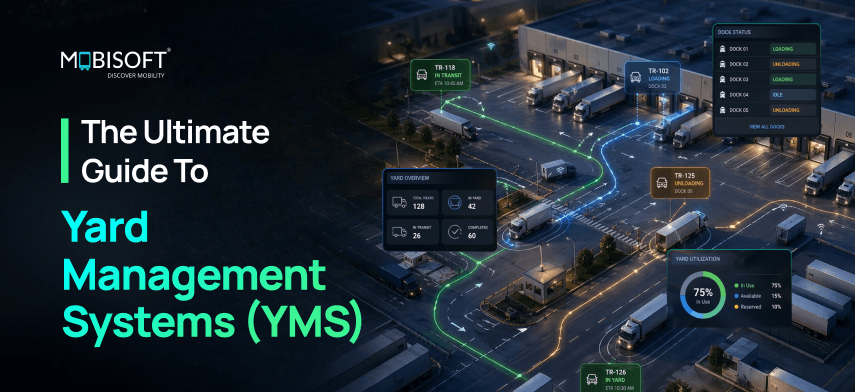
What This Guide Covers
1. What is a Yard Management System (YMS)?
2. The Cost of an Unmanaged Yard: the business case for YMS
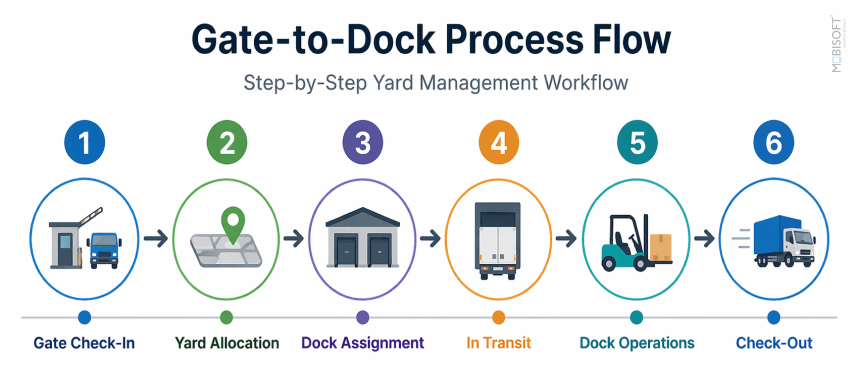
3. How a YMS Works: The Gate-to-Dock Flow
4. Core YMS Features: Complete breakdown
5. YMS vs. WMS vs. TMS: What each system owns
6. Key Benefits and ROI: Data-backed results
7. Industry Use Cases: Retail, Manufacturing, 3PL, Food & Beverage, Automotive, Pharma
8. AI and the Next Generation of Yard Management
9. How to Choose the Right YMS: 8-factor evaluation framework
10. Implementation: What to Expect
11. Frequently Asked Questions
12. Book a Demo with Mobisoft
What Is a Yard Management System (YMS)?
A Yard Management System, or YMS, is specialised logistics software. It monitors, coordinates, and optimises the movement of logistics inside a facility. This includes trucks, trailers, containers, and other yard equipment. Its responsibilities start when a vehicle arrives at the gate and stay active until that vehicle leaves after loading or unloading.
This system manages everything between your facility's outer boundary and the dock doors. In a busy distribution centre or manufacturing plant, the yard stays in constant motion. Dozens of vehicles move at once. Dock doors get allocated in real time. One bottleneck can quickly lead to missed shipments, detention charges, and throughput failures.
That is exactly where yard management software earns its place, offering order and visibility. Manual yard checks, phone-based coordination, and whiteboard scheduling are replaced by automated workflows, real-time tracking, and data-driven decisions. The yard stops being a guessing game and starts running like a system.
A Yard Management System is software that manages operations between the gate and the dock, enabling freight to flow without bottlenecks. It keeps track of every trailer, schedules every door, and coordinates every yard move in real time.
If you are evaluating platforms, see how YardOS approaches yard management system software for facilities of every size.
What a YMS Does: The Core Functions
Gate management
Automates vehicle check-in and check-out at the facility gate, such as driver ID, load confirmation, dock assignment, and access authorization
Dock scheduling
Assigns inbound and outbound shipments to specific dock doors based on load priority, equipment type, warehouse readiness, and carrier appointment
Trailer tracking
Provides real-time visibility of location, contents, dwell time, and status (empty, loaded, staged, in-use) of every trailer in the yard.
Yard move management
Assigns and tracks the work of yard drivers (spotters) moving trailers between parking slots and dock doors
Appointment management
Allows carriers to self-schedule delivery and collection appointments, reducing unplanned arrivals and gate congestion.
Integration hub
Connects with WMS, TMS, and ERP systems to share real-time data across the supply chain execution stack
Why It Matters More Than Most Operations Leaders Realise?
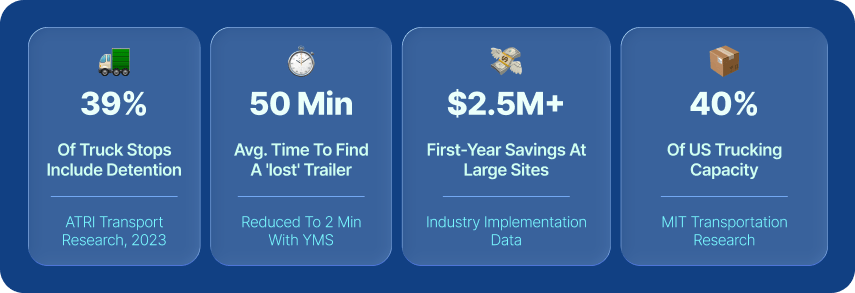
The yard is often described as the 'black hole' of the supply chain. This is because in the zone, visibility disappears, trailers sit idle, and decisions get made on guesswork. Research consistently shows that manual yard management in logistics is one of the most significant sources of operational waste:
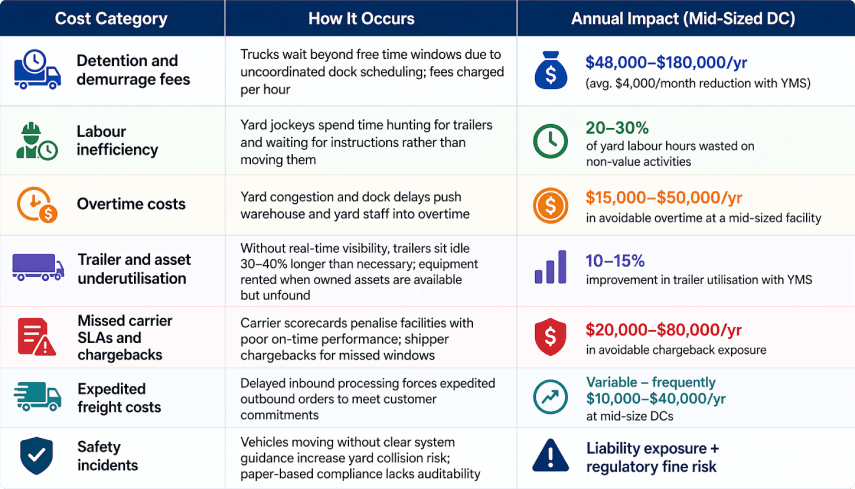
The Cost of an Unmanaged Yard
Before evaluating any YMS, it is worth quantifying what poor yard management is actually costing your operation today. Most facilities dramatically underestimate this figure because the costs are distributed across multiple budget lines rather than appearing as a single line item. This includes detention invoices, overtime labour, missed SLA penalties, carrier dissatisfaction, and reduced warehouse throughput.
The ROI Question to Ask First
Before evaluating YMS software platforms, complete this calculation for your facility:
Annual detention fees + Estimated overtime from yard delays + Annual trailer rental (for assets you probably own but can't find) + 10% of inbound processing hours (representing coordination waste)
For most mid-sized distribution centres, the yard management system ROI target figure lands between $150,000 and $500,000 per year. Most implementations recover that figure within 6 to 18 months.
Read More: The Ultimate Guide to Yard Management Systems (YMS)
 Portuguese (Brazil)
 English
 Arabic
 French
 Spanish
 Portuguese
 Deutsch
 Turkish
 Dutch
Dutch
 Italiano
 Russian
 Romaian
 Greek
Greek
