


 Pro Benefits
 About
About
 Termeni
 Confidențialitate
 Child Safety & Protection
 Notificări
 Ayrush Global It Services Pvt Ltd
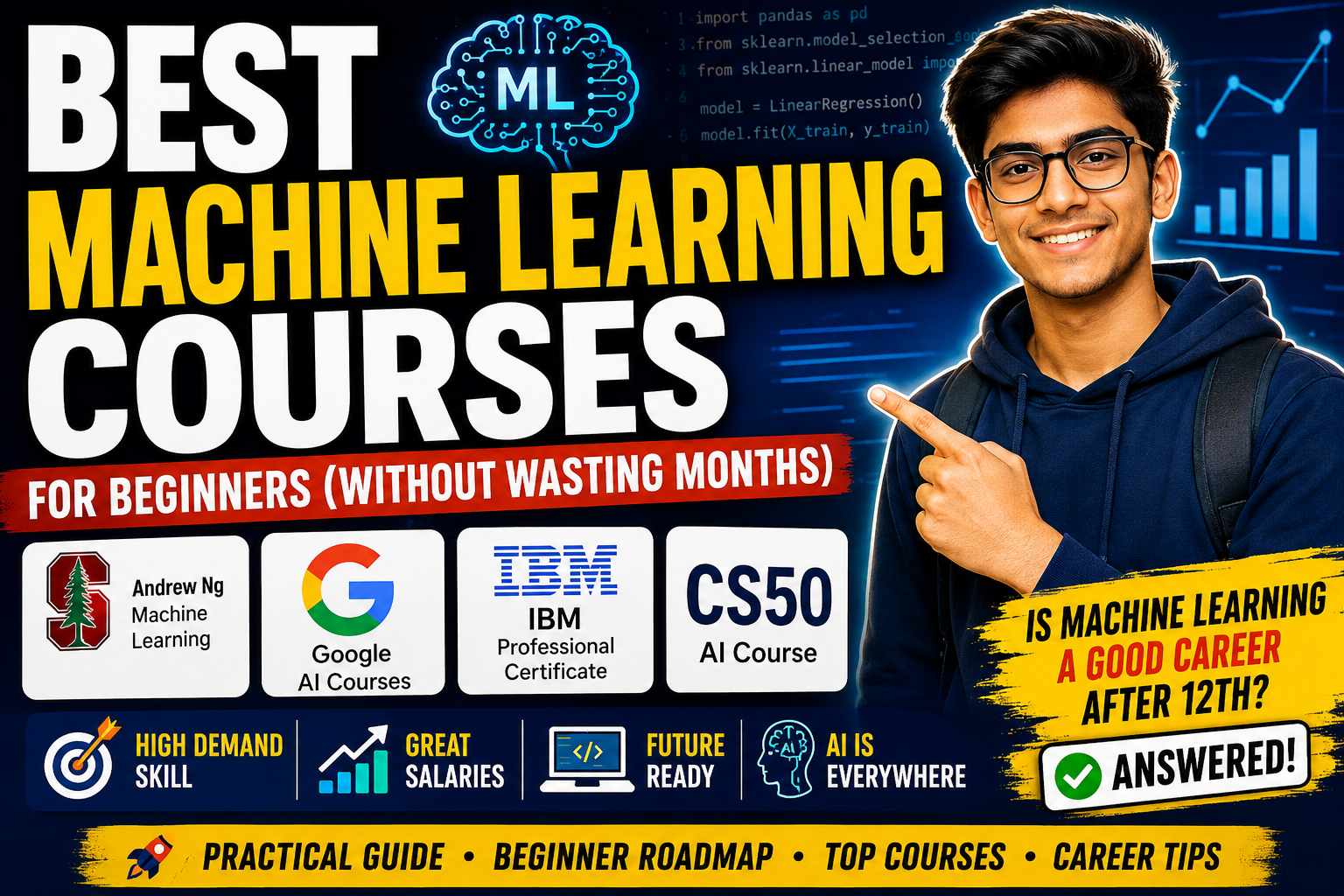
Is Machine Learning a Good Career? The Answer Nobody Gives You
Is Machine Learning a Good Career? The Answer Nobody Gives You
Is Machine Learning a Good Career After 12th? Here's What I'd Tell a Friend
Okay so you've probably already Googled this three times. And every article sounds the same — "ML is booming!" "AI is the future!" "Enroll now!" — and somewhere between the second and third tab, you started wondering if any of these people actually work in the field or if they're just copying each other. Fair.
So let me try a different approach. Let's talk about whether machine learning is a good career, the way I'd explain it to someone who just finished 12th and has no idea what they're walking into. No jargon dumping. No fake enthusiasm.
Just the real picture.
First — What Even Is Machine Learning?
Forget the Wikipedia definition. Here's how I think about it.
You know how Spotify somehow always knows what song you're in the mood for? Or how Gmail catches spam before you even see it? None of that is someone sitting there manually making decisions. The system learned from patterns — millions of them — and figured it out on its own.
That's machine learning. Teaching computers to learn from data instead of following fixed rules someone typed in.
And the reason companies can't get enough of it right now is simple. Every business runs on data. But data alone doesn't do anything. You need systems that can look at that data and make decisions — fast, at scale, without a human reviewing every single case. That's exactly what ML does.
So Is Machine Learning a Good Career in India? Honest Answer.
Yes. But the "yes" needs some context.
The demand is real. I'm not saying that because it sounds good — it's just what's happening. Bangalore, Hyderabad, Pune, even some companies in Delhi NCR are hiring ML engineers and AI folks at a rate that the talent pool hasn't caught up with yet. That gap between demand and supply? That's why the salaries are what they are.
Entry-level ML roles in India — we're talking ₹5 to ₹8 LPA to start. Mid-level, 2-3 years in, can go ₹12 to ₹25 LPA without much drama. Senior engineers at product companies? Some of them are pulling ₹40-60 LPA. These aren't made-up numbers.
Now here's the thing though. Most people who say "I want to do ML" have no idea what the day-to-day actually looks like. It's not all building cool robots and writing fancy algorithms. A lot of it is cleaning messy data. Debugging models that refuse to work. Staring at error messages that make no sense. Running the same experiment twelve times with slightly different parameters.
If that sounds exhausting to you — genuinely think twice. If that sounds weirdly interesting — you might be built for this.
What Does the Learning Path Actually Look Like?
This is where most "career in ML" articles either scare you away with a wall of tools or make it sound like a 30-day course will do the job. Neither is true.
Start with maths. Don't skip it.
I know. Not what you wanted to hear. But linear algebra, basic calculus, and statistics — these aren't optional. You don't need to go deep into research-level maths. But you do need to understand why an algorithm is doing what it's doing, not just that it works. If you had Maths in 12th PCM stream, you're already in a decent spot.
Then Python.
Not JavaScript. Not C++. Python. It's the language ML runs on, full stop. And you don't need to become a full software developer — you just need to get comfortable with it. Especially libraries like Pandas, NumPy, and Scikit-learn. Give it 6-8 weeks of actual practice, not just watching tutorials.
Then data. Before models.
That's where most beginners go wrong — jumping straight to building neural networks before understanding how to handle data properly. Bad data = bad model. Always. Learn to explore, clean, and prepare data first. It's unglamorous. It's also 60% of the actual job.
Then simple ML algorithms.
Linear regression. Decision trees. Logistic regression. Before you even touch deep learning. Most real-world ML problems don't need a massive neural network — they need a clean, well-tuned simple model. Learn this layer properly.
Then build something. Anything.
Two or three projects on GitHub. Doesn't matter if they're perfect. What matters is that you can explain what you did, why you did it, and what you learned. That's what hiring managers actually want to see.
ML vs Other High-Paying Careers After 12th — Straight Comparison
| Career | Starting Salary India | Time to Get Job-Ready | Difficulty | Demand Right Now |
|---|---|---|---|---|
| Machine Learning Engineer | ₹5–8 LPA | 2.5–3 years | High | Very High |
| Data Analyst | ₹2.5–4.5 LPA | 6–12 months | Medium | High |
| Software Developer | ₹3.5–6 LPA | 1–2 years | Medium | High |
| Digital Marketer | ₹2–4 LPA | 3–6 months | Low-Medium | High |
| UI/UX Designer | ₹3–5 LPA | 6–12 months | Medium | Growing |
ML has the highest ceiling. It also has the longest runway before you start earning. That's the trade-off. Nobody's going to tell you that clearly in a course brochure, but it's true.
If you need income sooner rather than later, data analytics or digital marketing might be smarter short-term moves. ML is a long game.
Can You Do It Without Engineering? (Real Talk)
The "standard" path is B.Tech in CS or IT, then specialization. And honestly, it's still the easiest path because the curriculum covers a lot of the maths and programming foundation automatically.
But it's not the only path.
BCA followed by a dedicated ML certification works. BSc in Data Science or AI — a lot of universities like NMIMS, Christ, Symbiosis have launched proper programs now. Even an online degree combined with serious self-study and a strong portfolio has gotten people hired, especially at startups that care more about what you can do than where you studied.
The degree matters less and less at the hiring stage if your skills are solid and you have projects to show. But for research roles or big MNCs, academic background still matters. Know which type of role you're aiming for.
The Bit That Nobody Warned Me About
Machine learning will humble you. Regularly.
Your model won't work. You'll tweak it and it still won't work. You'll look at someone else's code that's almost identical to yours and theirs works fine. You'll feel genuinely stupid sometimes. That's not a bug in the process — it's just how the field is.
The people who do well in ML are people who find that process interesting rather than demoralizing. They're the type who get slightly obsessed with why something isn't working. Who stay up too late because they're convinced the next change will fix it.
If you're that kind of person, honestly — this is your field.
Before You Commit, Try This First
Spend two weeks messing around with Python. Free tutorials, YouTube, whatever. Then find a beginner ML project — predicting house prices, classifying emails — and try to follow along with it.
See how it feels. Does it feel like pulling teeth? Or does it make you want to keep going?
That two-week experiment will tell you more about whether machine learning is a good career for you than any article, including this one.
FAQs
Q1. Is machine learning a good career after 12th in India? Yes, machine learning is one of the highest-paying and fastest-growing career paths in India right now, but it requires a strong foundation in maths, programming, and data handling before you can land a job.
Q2. What salary can I expect in a machine learning career in India? Entry-level ML professionals in India earn around ₹5–8 LPA, mid-level engineers with 2–3 years of experience can earn ₹12–25 LPA, and senior roles at product companies often go beyond ₹40 LPA.
Q3. Can I get into machine learning after 12th without a B.Tech? Yes — paths like BCA, BSc in Data Science, or structured online programs combined with a strong project portfolio can get you into ML roles, though B.Tech in CS still gives you the smoothest foundation.
Q4. How long will it take to get a job in machine learning after 12th? Realistically 3 to 4 years — you need time to build maths and programming foundations, learn ML properly, and develop a portfolio; anyone promising a job in 6 months is probably selling you something.
Q5. Is machine learning harder than data analytics? Yes, machine learning has a significantly steeper learning curve than data analytics — it requires deeper maths, more programming, and a longer learning timeline before you become job-ready.
Q6. What skills do I need to start learning machine learning after 12th? Start with Python basics, then statistics and linear algebra fundamentals, then move into data handling with Pandas, and only then into actual ML algorithms — in that order, not all at once.
Q7. Is the scope of machine learning good in India for the next 5 years? The scope is strong — AI adoption across Indian industries like fintech, healthtech, edtech, and e-commerce is accelerating, and skilled ML professionals are likely to remain in high demand through at least 2030.
Okay, Let's Land This
Look — is machine learning a good career? Yes, genuinely. Not because some YouTube ad says so, but because the demand is real, the salaries are real, and the work is actually interesting if you're wired for it.
But it's not a shortcut. It takes a couple of years of serious learning before you're job-ready. It'll frustrate you more than once. And it works best for people who are curious about why things work, not just people who want a high salary at the end.
If that's you — start this week. One Python tutorial. One dataset. Just start.
The gap between people who "want to do ML" and people who actually do it is just one decision made early enough.
 Romaian
 English
 Arabic
 French
 Spanish
 Portuguese
 Deutsch
 Turkish
 Dutch
Dutch
 Italiano
 Russian
 Portuguese (Brazil)
 Greek
Greek
