


 Pro Benefits
 About
About
 Terms
Terms
 Privacy
 Child Safety & Protection
 Notifications
 Ayrush Global It Services Pvt Ltd
Clean Ammonia Is Emerging as a Key Fuel for Low-Carbon Industry and Shipping
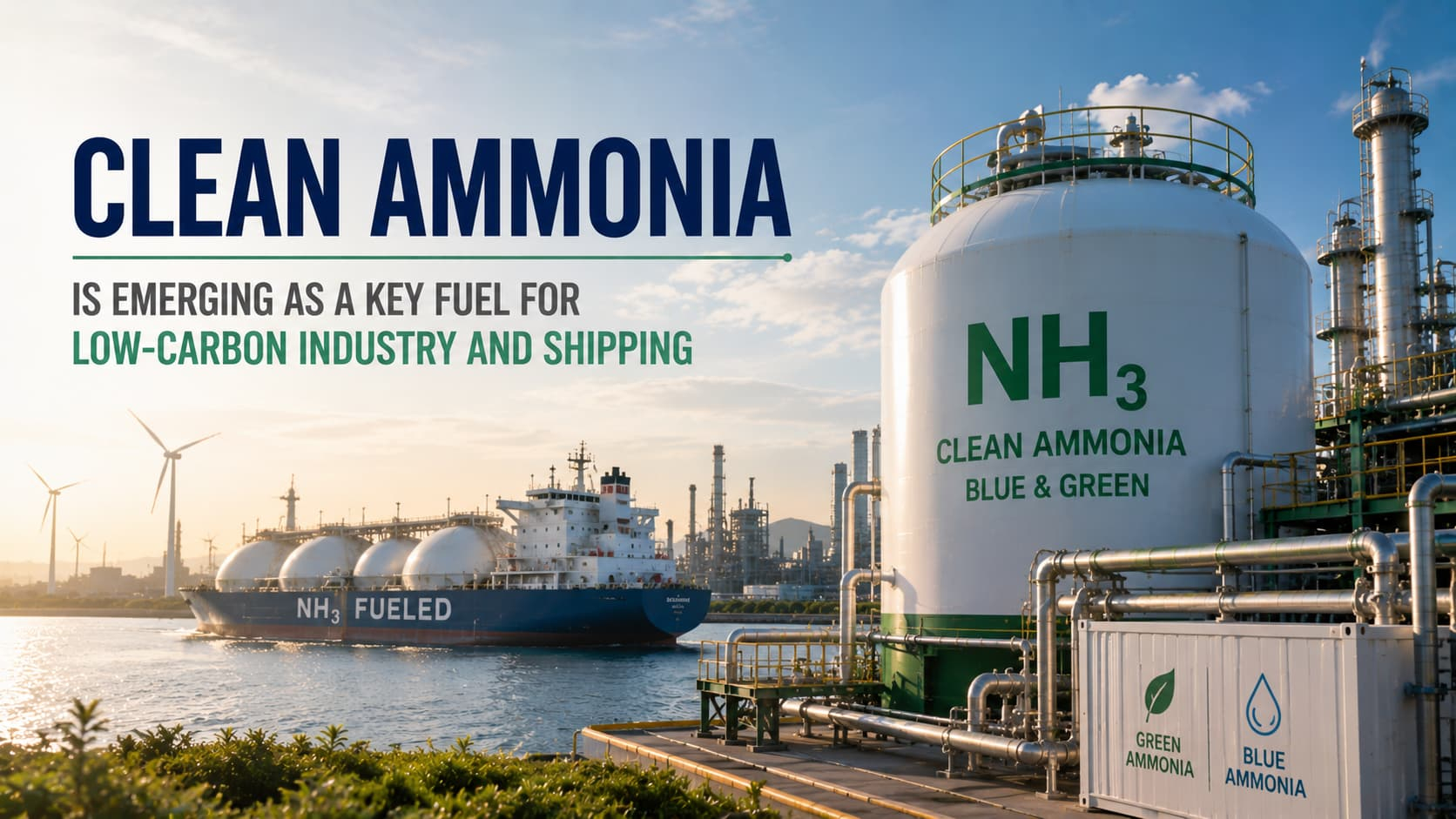
Clean ammonia is gaining global attention as countries and industries search for scalable solutions to reduce emissions in fertilizer production, shipping, power generation, and industrial fuel use. Ammonia is already widely used in agriculture as a fertilizer input, but conventional production is highly carbon-intensive because it relies mainly on fossil fuel-based hydrogen. Clean ammonia, produced either as blue ammonia with carbon capture or green ammonia using renewable hydrogen, offers a pathway to reduce emissions while using existing ammonia storage, handling, and transport experience.
According to MarkNtel Advisors, the global clean ammonia sector was valued at around USD 2.5 billion in 2025 and is projected to reach USD 24 billion by 2032. The USD 24 billion opportunity reflects an estimated CAGR of around 45.78% during 2026–2032, supported by emissions pressure across fertilizer, shipping, and power sectors, Asia-Pacific’s leading regional position, green ammonia adoption, and agriculture and fertilizers as a major end-use area.
Fertilizer Decarbonization Is a Core Growth Driver
Agriculture and fertilizers hold the largest share of clean ammonia demand because ammonia is a foundation material for nitrogen fertilizers. Conventional ammonia production is essential to food systems, but it also produces significant emissions. Clean ammonia offers a route to lower the carbon intensity of fertilizer supply chains without changing the basic role of ammonia in crop nutrition.
The Food and Agriculture Organization highlights the importance of sustainable agriculture and food security, making lower-emission fertilizer production relevant for long-term agricultural resilience. As food demand rises and pressure increases to reduce agricultural emissions, clean ammonia could become more important for fertilizer producers, distributors, and large agricultural economies.
Green Ammonia Is Gaining Stronger Momentum
Green ammonia is emerging as the leading type because it is produced from green hydrogen, which is made using renewable electricity and water electrolysis. This route can reduce dependence on natural gas and coal-based hydrogen when sufficient renewable power is available. Countries with strong solar, wind, and hydropower resources are exploring green ammonia as both a domestic industrial feedstock and an export product.
The International Renewable Energy Agency identifies green hydrogen as an important enabler for decarbonizing sectors that are difficult to electrify directly. Since ammonia can act as a hydrogen carrier and industrial chemical, green ammonia is increasingly being assessed for power generation, marine fuel, and cross-border clean energy trade.
Blue Ammonia Supports Transitional Supply
Blue ammonia is produced using fossil fuel-based hydrogen combined with carbon capture and storage. It is not emission-free, but it can reduce lifecycle emissions compared with conventional ammonia when carbon capture rates are high and upstream methane emissions are managed effectively. For countries with existing natural gas resources and ammonia infrastructure, blue ammonia can support early clean ammonia supply while green hydrogen capacity scales.
The International Energy Agency notes that low-emission hydrogen and hydrogen-based fuels can support decarbonization in hard-to-abate sectors. Blue ammonia fits within this broader transition by helping build demand, trade routes, certification systems, and end-use applications before green ammonia becomes more cost-competitive at scale.
Shipping Could Become a Major Future Application
Clean ammonia is also being evaluated as a potential marine fuel because it contains no carbon at the point of combustion. This makes it relevant for shipping companies seeking alternatives to heavy fuel oil and marine diesel. However, ammonia fuel adoption requires major progress in engine technology, safety systems, bunkering infrastructure, toxicity management, fuel standards, and lifecycle emissions certification.
The International Maritime Organization is pushing the shipping industry toward lower greenhouse gas emissions. As shipping decarbonization accelerates, clean ammonia could become one of the fuel options for long-distance vessels where battery-electric solutions are less practical. Its global trade experience as a chemical also gives it an advantage over some emerging fuels, although safety and handling remain critical concerns.
Asia-Pacific Leads Regional Prospects
Asia-Pacific is expected to present strong growth opportunities, supported by ammonia demand in agriculture, industrial decarbonization policies, energy import needs, and clean fuel strategies in countries such as Japan, South Korea, China, India, and Australia. Japan and South Korea are particularly active in evaluating ammonia for power generation and hydrogen transport, while Australia is positioning itself as a potential exporter of renewable hydrogen-based products.
The region’s leadership is also linked with existing fertilizer consumption and expanding renewable energy capacity. Clean ammonia projects can connect renewable power producers, electrolyzer manufacturers, fertilizer companies, ports, shipping firms, and industrial end users into a broader low-carbon value chain.
Power Generation Is Creating New Demand Pathways
Ammonia is being tested for co-firing in thermal power plants, especially in countries that are looking to reduce emissions while maintaining power system reliability. Co-firing ammonia with coal or using ammonia in dedicated turbines could create new demand if technology, economics, and emissions controls prove viable. However, nitrogen oxide emissions, fuel cost, combustion efficiency, and supply availability need careful management.
The Japan Ministry of Economy, Trade and Industry has supported hydrogen and ammonia as part of Japan’s clean energy strategy. These policies are helping create early demand signals for clean ammonia imports, power applications, and international supply-chain partnerships.
Certification and Cost Will Shape Adoption
Clean ammonia growth will depend heavily on credible certification systems that measure lifecycle emissions. Buyers will need clarity on whether ammonia is truly low-carbon, how it was produced, what energy sources were used, and how emissions were captured or avoided. Without transparent standards, global trade could face uncertainty.
Cost is another major challenge. Green ammonia production requires renewable power, electrolyzers, nitrogen separation, ammonia synthesis, storage, and export infrastructure. Blue ammonia depends on carbon capture, storage availability, and gas supply. Both routes require large capital investment, long-term offtake agreements, port facilities, and policy support.
Looking Ahead
Clean ammonia is expected to become increasingly important as fertilizer producers, shipping companies, utilities, and industrial users pursue lower-emission alternatives. With the sector projected to rise from USD 2.5 billion in 2025 to USD 24 billion by 2032 at a CAGR of around 45.78%, growth is likely to remain strongest in green ammonia, agriculture and fertilizers, Asia-Pacific, shipping fuel pilots, and power-sector applications. Its long-term direction will depend on production cost reduction, certification systems, renewable hydrogen availability, carbon capture performance, port infrastructure, safety standards, and the ability of clean ammonia to scale as both a low-carbon chemical and an energy carrier.
 English
 Arabic
 French
 Spanish
 Portuguese
 Deutsch
 Turkish
 Dutch
Dutch
 Italiano
 Russian
 Romaian
 Portuguese (Brazil)
 Greek
Greek
