


 Pro Benefits
 Sobre
Sobre
 Termos
 Privacidade
 Child Safety & Protection
 Notificações
 Ayrush Global It Services Pvt Ltd
Benefits of Using Learning Management System in Your Organization
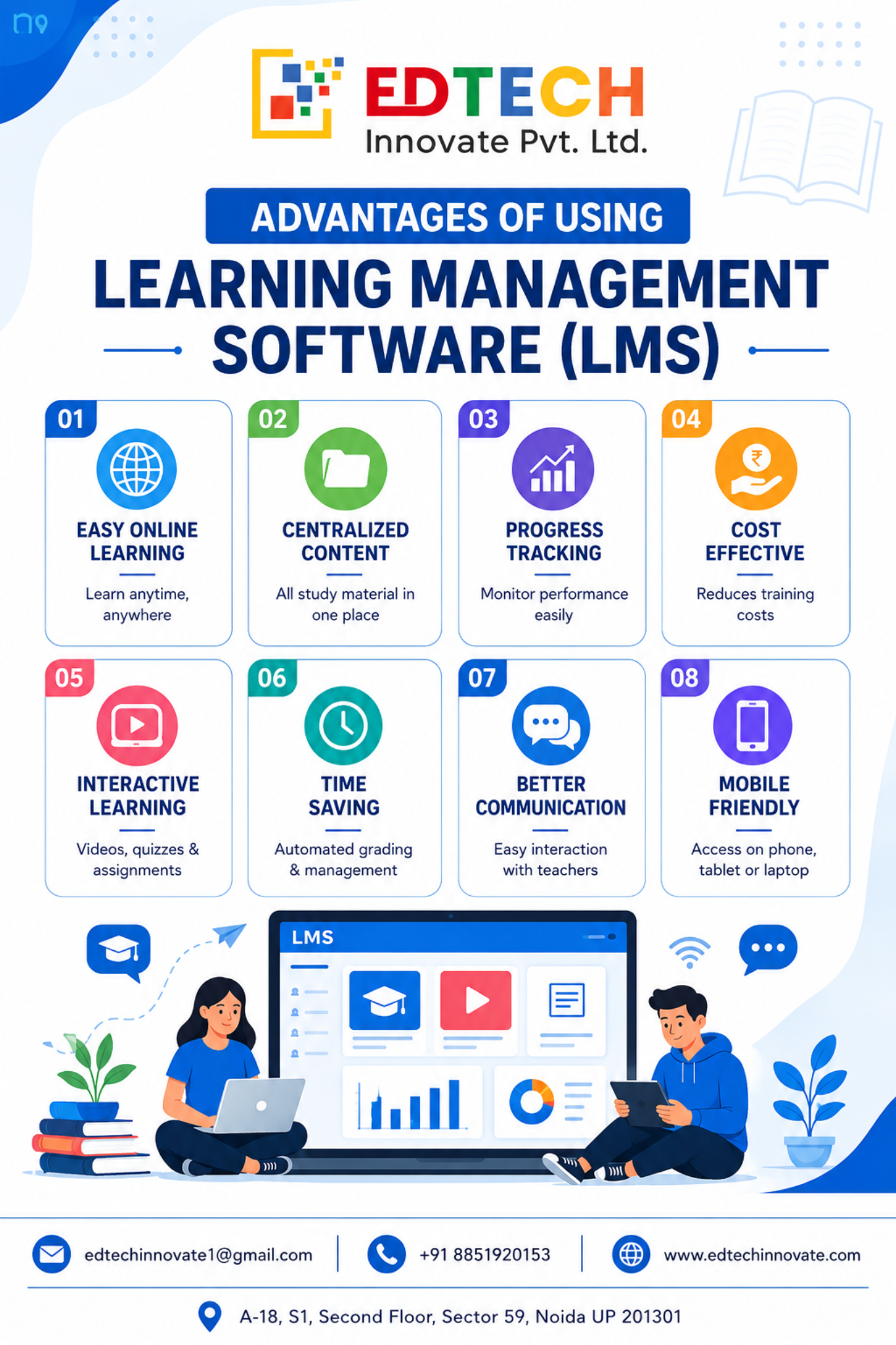
The way organizations deliver training and education has changed dramatically over the last decade. Whether you run a university, a corporate firm, or a coaching institute, the advantages of using learning management software are too significant to ignore. A Learning Management System (LMS) is no longer a luxury — it is a strategic necessity for institutions that want to stay competitive, efficient, and learner-centric in today's digital-first world.
If your organization is still relying on printed materials, physical classrooms, and manual tracking, this guide will show you exactly why it's time to make the switch.
What Is a Learning Management System?
A Learning Management System is a software platform that enables organizations to create, deliver, manage, and track educational content and training programs — all from one centralized location.
Unlike traditional learning setups, learning management software removes geographical and logistical barriers. Whether you're onboarding new employees, running academic courses, or conducting compliance training, an LMS handles it all seamlessly.
There are several types of LMS available today, each suited to different organizational needs:
-
Cloud-Based LMS — Hosted on remote servers; accessible from any device, anytime
-
Self-Hosted LMS — Installed on the organization's own servers for full data control
-
Open-Source LMS — Customizable platforms with community-driven development (e.g., Moodle)
-
Enterprise LMS — Built for large-scale corporate training with advanced integrations and analytics
Understanding these types of LMS helps organizations choose the right solution based on their size, budget, and goals.
Key Advantages of Using Learning Management Software
Here is a detailed look at the core benefits that make an LMS a game-changer for modern organizations:
1. Centralized Content Management
With a Learning Management System, all your course materials, assignments, videos, and assessments live in one place. Administrators can update content instantly, ensuring every learner always has access to the most current information — without printing a single page.
2. Flexible, Anytime Learning
One of the most compelling advantages of using learning management software is the freedom it gives learners. Students and employees can access modules at their own pace, from any device, at any time. This flexibility is especially valuable for:
-
Remote or hybrid workforces
-
Students in different time zones
-
Working professionals pursuing upskilling programs
3. Significant Cost Savings
Top learning management systems dramatically reduce operational costs by eliminating the need for physical classrooms, printed materials, travel allowances, and instructor overtime. Organizations report substantial reductions in per-learner training costs after implementing an LMS — often within the first year of deployment.
4. Real-Time Progress Tracking and Analytics
A robust Learning Management System gives administrators and instructors detailed dashboards showing:
-
Course completion rates
-
Assessment scores and performance trends
-
Time spent on individual modules
-
Learner engagement levels
These insights allow instructors to identify struggling learners early and adjust content delivery accordingly — something manual systems simply cannot do at scale.
5. Consistent Training Quality
Human-delivered training can vary in quality depending on the trainer, the day, or the audience. Learning management systems for businesses eliminate this inconsistency by standardizing content delivery across all departments, locations, and batches. Every learner receives the same high-quality experience.
6. Scalability Without Proportional Cost Increase
Whether you are training 50 employees or 5,000 students, an LMS scales effortlessly. Unlike traditional training models that require proportionally more resources as you grow, learning management software allows you to add users, courses, and programs without a significant jump in costs or effort.
7. Enhanced Learner Engagement
Modern top learning management systems come equipped with interactive features that boost engagement and retention:
-
Gamification elements (badges, leaderboards, points)
-
Discussion forums and peer collaboration tools
-
Multimedia content (videos, infographics, simulations)
-
Quizzes and instant feedback mechanisms
These tools transform passive learning into an active, motivating experience.
Why LMS Is Essential for Educational Institutions
LMS for educational institutions goes beyond just content delivery. It transforms the entire academic lifecycle — from student enrollment and course scheduling to assignment submission, exam management, and result publishing.
Institutions using a Learning Management System benefit from:
-
Role-based access for students, faculty, and administrators
-
Automated timetable and exam management
-
Integrated online assessment tools with AI-powered proctoring
-
Personalized learning paths tailored to individual student progress
-
Social learning features that encourage peer interaction and collaborative study
For universities and coaching institutes that manage thousands of students simultaneously, an LMS is not just helpful — it is indispensable.
Read More - The Growing Role of Learning Management Systems (LMS) and EdTech Software in Modern Education
Learning Management Systems for Businesses: A Competitive Advantage
Corporate organizations increasingly rely on learning management systems for businesses to manage employee onboarding, compliance training, leadership development, and skills upgradation.
The business benefits are clear:
-
Faster onboarding cycles for new hires
-
Streamlined compliance and certification tracking
-
Reduced dependency on external training vendors
-
Improved employee retention through continuous learning opportunities
-
Better alignment between learning outcomes and business KPIs
As talent development becomes a top priority for HR leaders globally, having a reliable Learning Management System in place directly impacts productivity, morale, and organizational agility.
Conclusion
The shift toward digital learning is not a trend — it is the new standard. From LMS for educational institutions to learning management systems for businesses, the evidence is overwhelming: organizations that invest in structured, technology-driven learning outperform those that don't.
If you are ready to streamline your learning operations, improve learner outcomes, and reduce training costs, Edtech Innovate offers a comprehensive Learning Management System built specifically for educational institutions and modern enterprises. With features like academics configuration, role-based access, social learning tools, and seamless exam integration, Edtech Innovate is the trusted partner for organizations looking to transform their learning experience from the ground up.
Frequently Asked Questions (FAQs)
Q1. What are the main advantages of using learning management software? The primary advantages include centralized content management, flexible anytime learning, cost savings, real-time analytics, consistent training delivery, scalability, and enhanced learner engagement.
Q2. What are the different types of LMS available? The four main types of LMS are cloud-based, self-hosted, open-source, and enterprise LMS. Each type suits different organizational sizes and operational needs.
Q3. Is an LMS suitable for small organizations or only large enterprises? LMS platforms are scalable by design, making them suitable for organizations of all sizes — from small coaching institutes to large multinational corporations.
Q4. How does an LMS benefit educational institutions specifically? LMS for educational institutions enables automated course management, online examinations, personalized learning paths, progress tracking, and seamless communication between students and faculty.
Q5. How do learning management systems for businesses improve employee training? They standardize training delivery, reduce onboarding time, enable compliance tracking, and give HR teams data-driven insights into employee skill development and engagement.
Q6. What should I look for when choosing among the top learning management systems? Key factors include mobile compatibility, integration capabilities, analytics and reporting tools, ease of use, scalability, customer support quality, and pricing transparency.
Q7. How long does it take to implement a Learning Management System? Implementation timelines vary based on organizational size and complexity. Simple deployments can go live within a few weeks, while large enterprise rollouts may take a few months with proper training and data migration.
 Portuguese
 English
 Arabic
 French
 Spanish
 Deutsch
 Turkish
 Dutch
Dutch
 Italiano
 Russian
 Romaian
 Portuguese (Brazil)
 Greek
Greek
