


 Pro Benefits
 Über
Über
 Bedingungen
 Datenschutz
 Child Safety & Protection
 Benachrichtigungen
 Ayrush Global It Services Pvt Ltd
How to Build DPDP-Compliant Applications in India
India's Digital Personal Data Protection Act, 2023 (DPDP Act), is the country's first comprehensive data privacy legislation. It governs how personal data of Indian residents may be collected, processed, stored, and transferred. Enacted in August 2023 and progressively operationalised through rules and regulations, the DPDP Act fundamentally changes the legal framework for any application, platform, or service that processes personal data in India. These obligations apply regardless of whether the data fiduciary is incorporated in India or operates from outside the country. This is a practical Digital Personal Data Protection Act engineering guide for software development teams. The Act is not primarily a legal document for engineering teams. It is a set of engineering requirements: consent must be collected in specific ways, data principal rights must be technically honoured, security obligations must be implemented, and breach notification must be automated. This guide covers the engineering reality of how to build DPDP compliant applications in India in 2026, what the Act requires, what must be built, and how to structure the implementation.
The DPDP Act: What It Is, Who Must Comply, and What It Means for Engineering Teams
The Digital Personal Data Protection Act, 2023 (hereinafter the Act or DPDP Act) received Presidential assent on 11 August 2023. It is India's first omnibus personal data protection legislation, replacing a fragmented framework of sector-specific rules with a unified national standard. The Act establishes a rights-based approach to personal data protection: individuals (termed Data Principals under the Act) have specific rights over their personal data, and organisations (termed Data Fiduciaries) processing that data have specific obligations.
The DPDP Act is not GDPR. This DPDP Act vs GDPR comparison for developers matters in practice: both share structural similarities such as consent-based processing, individual rights, and a supervisory authority, but they differ significantly in scope, enforcement architecture, and specific obligations. Engineering teams with GDPR experience will find familiar concepts alongside important differences, particularly in the consent framework's specific requirements, the children's data provisions, and India's data localisation considerations under the Significant Data Fiduciary category.
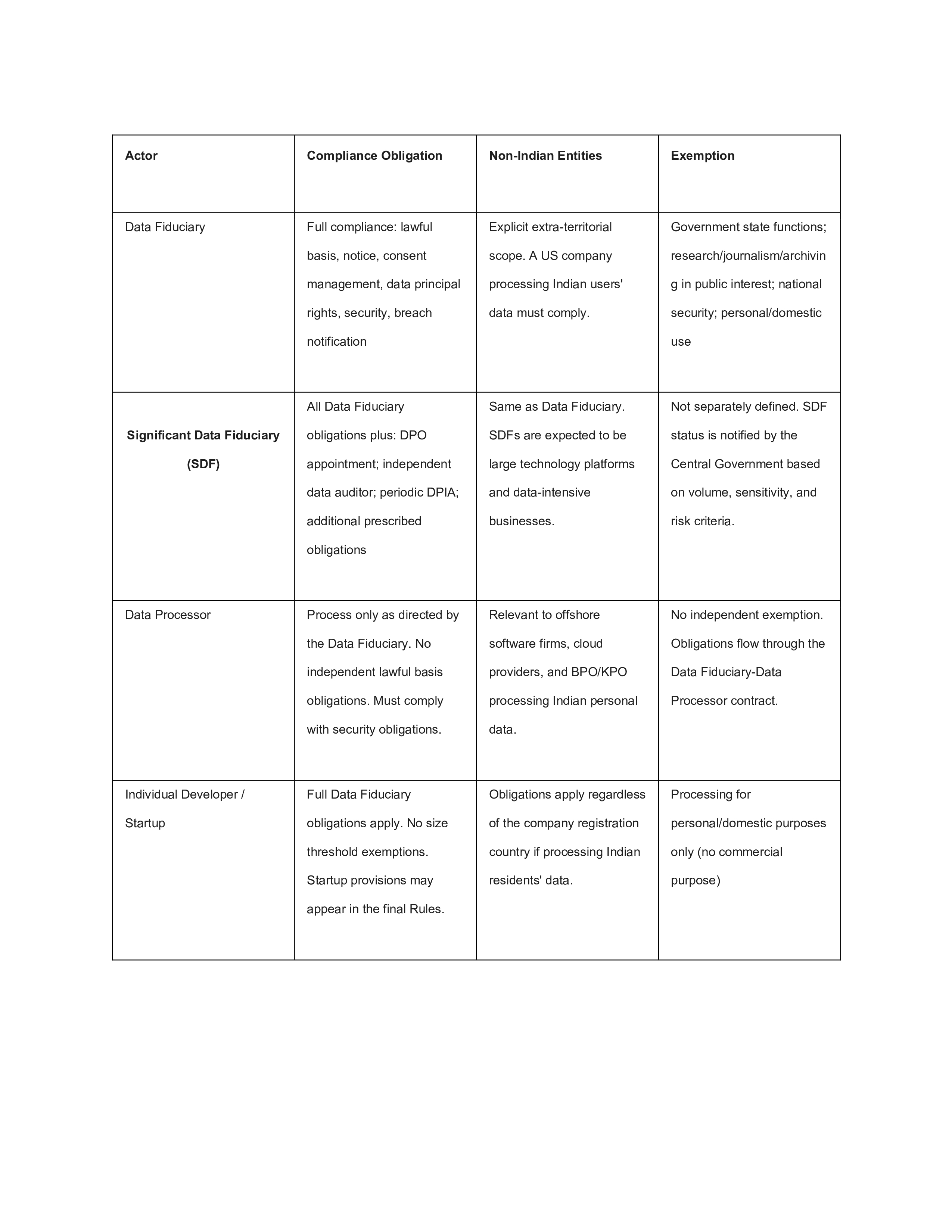
Definitions Every Engineering Team Must Understand
-
Personal Data: Any data about an individual who is identifiable by or in relation to such data. This covers name, email, phone number, Aadhaar number, PAN, biometric data, location data, health data, financial data, browsing history, device identifiers (IMEI, MAC address), and IP addresses where they can identify a person. All of these are personal data under India data protection law software development requirements.
-
Digital Personal Data: Personal data in digital form, or personal data collected in non-digital form but subsequently digitised. Any personal data stored in databases, logs, cookies, mobile app storage, or cloud services is digital personal data subject to the Act.
-
Processing: Wholly or partly automated operations on personal data, including collection, recording, organisation, structuring, storage, adaptation, retrieval, use, disclosure, erasure, and destruction. Any application that collects user data, stores it in a database, serves it to users, or deletes it is performing processing. There is no processing that falls outside the Act's scope.
-
Consent: Free, specific, informed, unconditional, and unambiguous indication of a Data Principal's wishes by a clear affirmative action. Pre-ticked checkboxes are not valid consent. Bundled consent for multiple unrelated purposes is not valid. Silence is not consent. Users must be able to withdraw consent as easily as they gave it.
-
Legitimate Uses: Processing without consent for specific purposes: state-provided benefits, medical emergency, breakdown of public order, compliance with laws, employment purposes, and sovereign functions. Legitimate uses are narrower than GDPR's legitimate interests. There is no general legitimate interest basis in the DPDP Act for commercial processing. Consent is the primary basis for commercial data processing.
-
Data Principal: The individual to whom personal data relates. In an application serving Indian users, every end-user is a Data Principal. Employees whose HR data is processed are Data Principals. Customers whose financial data is processed are Data Principals.
-
Data Fiduciary: An entity that, alone or in conjunction with others, determines the purpose and means of processing personal data. The organisation that decides what data to collect and why. Most software product companies are the Data Fiduciary for the personal data of their users.
Read more: How to Build DPDP-Compliant Applications in India
 Deutsch
 English
 Arabic
 French
 Spanish
 Portuguese
 Turkish
 Dutch
Dutch
 Italiano
 Russian
 Romaian
 Portuguese (Brazil)
 Greek
Greek
