


 Pro Benefits
 About
About
 Termini e Condizioni
 Privacy
 Child Safety & Protection
 Notifiche
 Ayrush Global It Services Pvt Ltd
Why Do Some TikTok Clone App Development Services Deliver Great Demos but Struggle When the App Actually Hits Real Users?
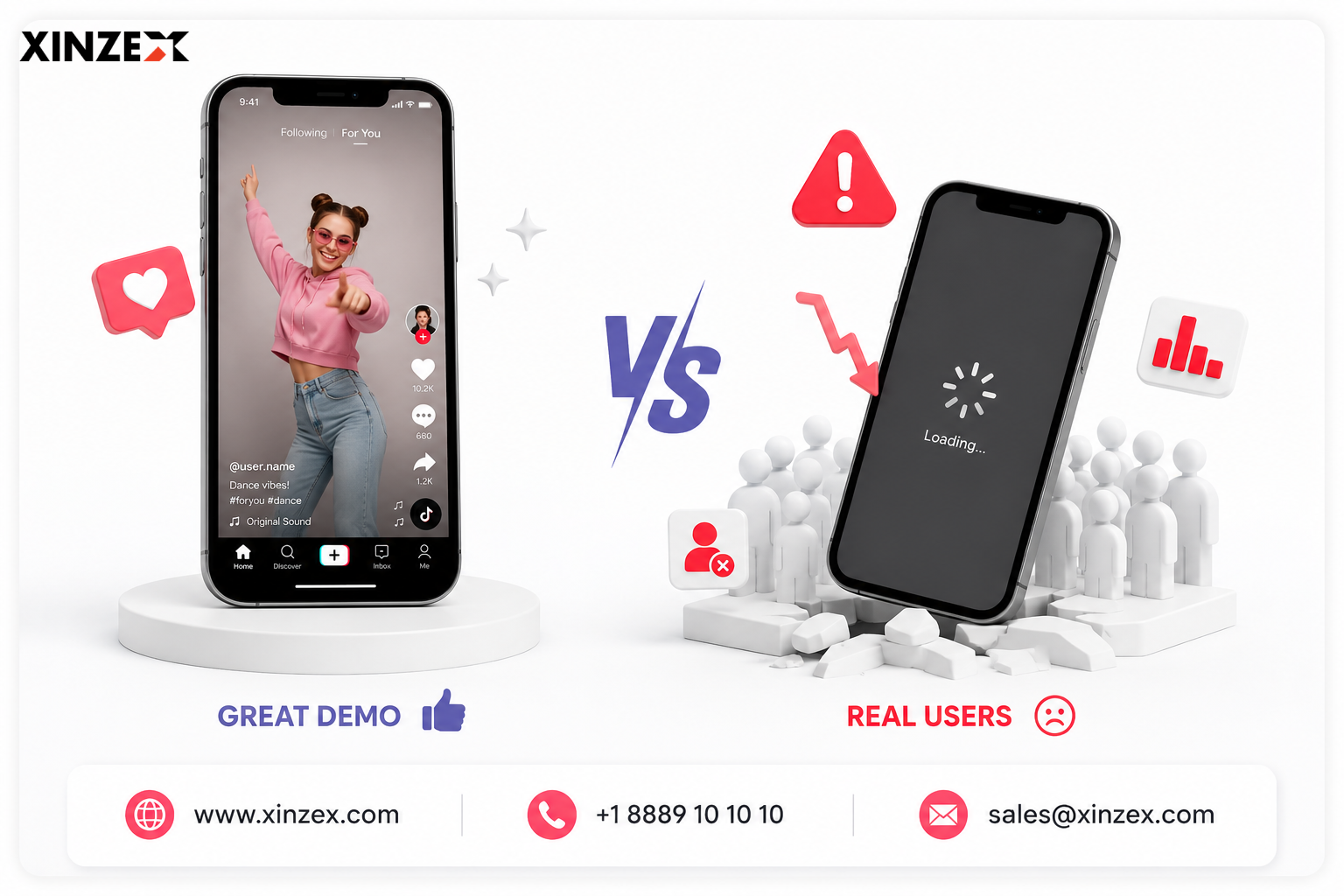
The demo is always impressive. That's not a coincidence; it's a controlled environment, running on a prepared dataset, accessed by two or three people in a Zoom call with stable internet. It is the best possible version of the product under the least possible stress. What it is not, in any meaningful way, is a preview of what happens when 15,000 real users open the app during the same hour and start doing unpredictable things.
This is the gap that swallows a lot of short-video platforms. Not the idea. Not the design. Not the feature set. The gap between "works in a demo" and "holds up in production", and the reason that gap exists, almost always traces back to how the TikTok clone app development service was run from the beginning.
The Real Reason TikTok Clone App Development Demos Succeed Where Products Fail
A demo is designed to succeed. Every decision in its construction, the dataset size, the network conditions, the number of simulated users, and the content volume is made to show the product at its best. That's not dishonest. It becomes a problem when the demo is also the only test the product ever goes through before it meets real users.
Real users do not behave like a demo. They upload unexpected content formats. They scroll faster than the feed ranking pipeline anticipated. They go live from locations with inconsistent connectivity. They open the app simultaneously during an event that nobody planned for. They interact with content in patterns that the recommendation engine was never trained on. And when the TikTok clone app development company behind the product built it to pass a demo rather than to survive these conditions, every one of those behaviors becomes a potential failure point.
The short-form video market is not small enough for this to be a low-stakes mistake. The global short-video platform market was valued at $116.43 billion in 2023 and is projected to reach $503.15 billion by 2032 at a CAGR of 17.8% (Precedence Research, 2023). TikTok crossed 1.7 billion monthly active users in 2024. YouTube Shorts surpassed 2 billion monthly logged-in users in 2023.
The competition is real, the user tolerance for broken experiences is low, and the window between a platform earning early traction and losing it to a smoother competitor is narrow. A TikTok clone app development service that optimises for demo quality and not production resilience is setting up a product for failure at the worst possible moment.
What TikTok Clone App Development Companies Get Wrong Between Demo and Production?
The failure modes are not random. They cluster around a few specific decisions that look fine in controlled conditions and fall apart under real load.
Template infrastructure is the most common culprit. A surprising number of TikTok clone app development vendors are operating white-label codebases dressed with a client's branding. These templates are built to demonstrate features, not to absorb production traffic. The database layer isn't tuned for the read-heavy workload that short-video feeds generate at scale. The video transcoding pipeline isn't built for the upload volume that comes with an active user base. The feed ranking logic is static — it doesn't update in response to real-time engagement signals the way a functional recommendation engine needs to. Everything works perfectly until real users arrive with their real behaviour, and then it doesn't.
The second failure pattern is demo-driven testing. A TikTok clone app development company that only tests what it can show in a presentation is a company that has never load-tested the application against realistic concurrent sessions. Conviva's 2023 State of Streaming report found a 39% spike in user abandonment when the stream startup delay exceeds two seconds. That number comes from real users on real networks — not from a Zoom call where everyone has a strong Wi-Fi connection. If the vendor hasn't tested against variable network conditions, concurrent upload spikes, and feed ranking under high engagement volume, they have no idea how the product behaves in production. Neither will you, until it matters.
Monolithic architecture is the third. When the feed ranking service, video transcoding, user interaction, and content delivery all live in the same application layer, a spike in any one of them affects all the others. Upload traffic slows the feed. Feed ranking delays block video load. Comment volume backs up the interaction layer. In a demo with three users, this is invisible. Under real concurrent load, it's the reason users describe the app as "laggy" even when individual features technically work. A TikTok clone app development service that separates these concerns into independently scalable services builds something that absorbs real-world spikes without the whole system feeling them.
What Separates a TikTok Clone App Development Service That Delivers in Production?
The platforms that hold up after launch, not just in demos, share a few structural properties that are easy to overlook until you're looking for them specifically.
The feed ranking engine operates on real-time signals. Views, replays, watch time, share velocity, and comment rate — these feed into the ranking pipeline continuously, not on a batch schedule that runs every few hours. Statista projects digital video viewers worldwide to be 3.78 billion by 2028, up from 3.37 billion in 2023. That audience expects a feed that feels personalised and responsive from the first session, not one that learns their behaviour over days of accumulated data. A static recommendation engine can fool three people in a demo. It cannot fool 15,000 users who have already used TikTok.
The video delivery pipeline handles adaptive bitrate encoding — adjusting stream quality dynamically based on the viewer's actual connection — so that a user on a congested 4G connection sees a degraded but watchable video rather than a loading screen. The content ingestion pipeline runs asynchronously, so a spike in uploads from a live event doesn't ripple backwards into the viewing experience. These are not advanced features. They are baseline requirements for a short-video platform operating in real conditions. The global live streaming market is growing at 18.3% annually toward $6.77 billion by 2032 (Allied Market Research). That growth assumes platforms can actually deliver live content under variable conditions — not just in controlled environments.
The infrastructure scales without manual intervention. Automated scaling policies tied to specific load metrics — CPU thresholds, request queue depth, latency percentiles — mean that when a creator goes viral at 11 pm, the system adds capacity before users feel the delay. Asking a TikTok clone app development company how their auto-scaling works is one of the fastest ways to tell whether they've operated a platform in production or just built one for a demo.
Why Xinzex Builds Differently Across Every TikTok Clone App Development Project?
Xinzex starts every TikTok clone app development engagement by asking a question most vendors skip: What does this platform look like when something goes right and traffic surges? That scenario — not the average case, not the launch case — determines the architecture. The infrastructure is sized for the spike because the spike is the moment that makes or breaks user retention.
The recommendation algorithm is custom-built for each project, not inherited from a template. It processes real-time engagement signals from the start, decoupled from the content delivery layer so ranking computation latency never touches the user-facing experience. The transcoding pipeline runs async. The service architecture separates feed ranking, content delivery, user interaction, and media storage so each can absorb its own load independently. Short-form video adoption is growing at 12.3% annually (Statista, 2024), and the platforms that convert early traction into lasting user bases are the ones that don't break when the growth hits.
Every TikTok clone app development service Xinzex delivers gets load-tested against realistic concurrent user projections before it ships — not against demo conditions, but against the numbers that reflect what the client actually expects to handle. The gap between demo and production is not a mystery. It's a choice about what you test for.
Conclusion
The distance between a great TikTok clone app development demo and a product that survives real users is almost always an infrastructure story, not a feature story. Template codebases, demo-only testing, monolithic architecture, static recommendation engines — these are decisions that look fine in a controlled environment and show their real costs under production load.
With the short-video market heading toward $503 billion by 2032 and user adoption accelerating across every demographic, a TikTok clone app development company that builds for demos is building for the wrong audience. The audience that matters shows up after launch, on unpredictable devices, in unpredictable locations, doing unpredictable things — and the infrastructure either holds or it doesn't.
Xinzex builds for that audience. If you want a TikTok clone app development service that tests for production before it ships, not after, that's the conversation worth having.
 Italiano
 English
 Arabic
 French
 Spanish
 Portuguese
 Deutsch
 Turkish
 Dutch
Dutch
 Russian
 Romaian
 Portuguese (Brazil)
 Greek
Greek
